Calala Island

Small Luxury Hotels of the World Member
Calala Island occupies a private island off Nicaragua's Caribbean coast, where thatch-roofed villas emerge from dense palm cover and an infinity pool meets the sea. The approach by boat sets the register immediately: this is a property built around isolation and visual drama, not amenity volume. For travellers prioritising seclusion over programming, it sits in a category of its own on this coast.

Pearl is the En Primeur Club membership app — saves, bookings, and concierge access live there. Same editors, same standards.
- Address
- Calala Island
- Phone
- (929) 269-1232
- Website
- calala-island.com
- Directions
- Get directions
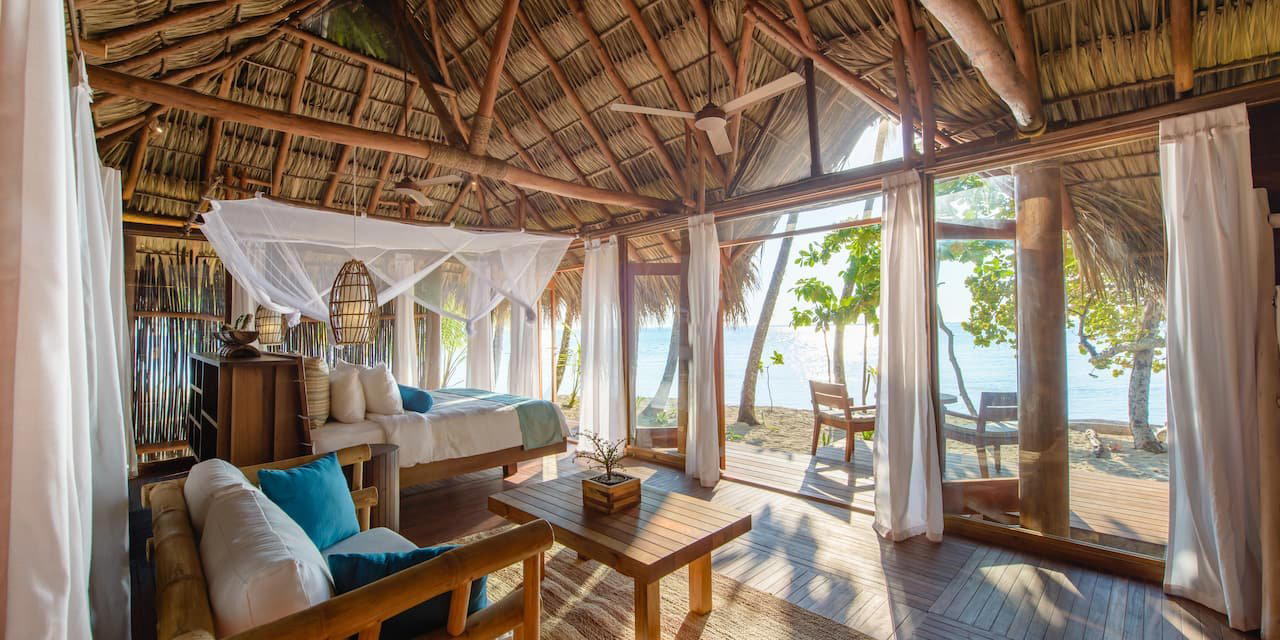
Arriving at the Edge of the Caribbean
The approach to Calala Island says more about its design philosophy than any floor plan could. Arriving by boat across open Caribbean water, the island reads first as undifferentiated jungle and sea — palms, horizon, the particular blue of shallow reef water. Only as the vessel draws closer do the structures reveal themselves: thatch-roofed villas folded into the tree line, an infinity pool that appears to dissolve into the ocean beyond. The jetty greeting that follows is unhurried, which is itself an architectural statement. Everything about the physical sequence of arrival is calibrated to establish one thing — that you have genuinely left the mainland behind.
This matters because the Caribbean coast of Nicaragua occupies a different register from the Pacific-facing properties that draw most international attention. Where the Pacific side has developed a recognisable hospitality infrastructure, properties like Morgans Rock Hotel San Juan del Sur and Rancho Santana in Rivas operate within a broader eco-luxury circuit, the Caribbean coast remains markedly less developed, which shapes both the expectation and the experience at a place like Calala Island. Remoteness here is not marketing copy. It is a geographic fact that structures everything else.
The Architecture of Deliberate Isolation
Private island properties worldwide face a consistent design question: how much should the built environment assert itself against the natural setting, and how much should it yield? The answer at Calala Island appears to favour yielding. Thatched roofing is not decorative pastiche in this context; it is a climate-responsive material choice that also reads as architectural continuity with the surrounding canopy. The villas do not announce themselves from a distance. They surface gradually, which is a form of restraint that distinguishes this approach from island resorts that front themselves with large glass facades or branded statements of arrival.
This places Calala Island in a specific tier of Caribbean island hospitality: properties where the design programme prioritises environmental integration over display. That tier includes, at different points on the globe and the price scale, places like Amangiri in Canyon Point and Hotel Esencia in Tulum, properties that use architecture to create a sense of discovered, rather than constructed, retreat. The thatch-and-palm vocabulary at Calala Island belongs to a tradition of tropical vernacular building that, when executed with discipline, produces spaces that feel generated by their location rather than imposed upon it.
The infinity pool is worth addressing specifically. On a private island, the pool is rarely just a pool; it functions as a compositional anchor, a visual device that frames the surrounding water. At Calala Island, the shimmer of the pool surface appearing through the palms before the villas are fully visible is a deliberate piece of sequencing, the resort reveals itself in stages, each stage calibrated to the experience of approach by sea.
Nicaragua's Caribbean Coast in Context
Understanding Calala Island requires some orientation within the broader Nicaraguan hospitality picture. The country's luxury property offer has developed unevenly. The Pacific coast, anchored by San Juan del Sur and the Rivas department, holds the majority of internationally recognised properties. Nekupe Sporting Resort and Retreat in Nandaime represents the inland eco-luxury direction, while Morgans Rock and Rancho Santana define the Pacific coastal tier. Consult our full NiCaribbean restaurants guide for broader regional context.
The Caribbean coast sits apart from all of this, linguistically, culturally, and logistically. The region carries a distinct Afro-Caribbean and indigenous Miskito identity that has almost nothing in common with the Spanish colonial heritage of the Pacific cities. Reaching Calala Island by sea positions the property within that separateness, rather than trying to bridge it. Travellers accustomed to high-amenity Caribbean island properties, the larger Aman footprint visible at Aman New York or Aman Venice, or the European grand hotel tradition present at Badrutt's Palace Hotel in St. Moritz and Hôtel de Paris Monte-Carlo, should calibrate expectations accordingly. Calala Island operates in a different register: smaller, more remote, and defined by what it withholds as much as by what it provides.
Planning the Visit
Access to Calala Island is by boat, and the logistics of that approach are worth thinking through before booking. Nicaragua's Caribbean coast is not served by the same transport infrastructure as the Pacific side, which means that reaching the island requires planning at a level above what most regional properties demand. The dry season along the Caribbean coast runs roughly from February through April and again from August through September, though the Caribbean side receives more rainfall year-round than the Pacific and travellers should verify current conditions before finalising dates. The remoteness that defines the experience also defines the planning requirement: this is not a property where spontaneous booking and arrival is the model. Those familiar with advance-planning disciplines around properties like Castello di Reschio in Lisciano Niccone or One&Only; Mandarina in Riviera Nayarit will recognise the pattern: the more deliberately positioned the property, the more the booking process itself becomes part of the experience.
Comparison Snapshot
Comparable venues nearby, for context on price, style, and recognition.
| Venue | Cuisine | Price | Awards | Notes |
|---|---|---|---|---|
| Calala IslandThis venue — the venue you are viewing | barefoot luxury private island resort | Not listed | Small Luxury Hotels of the World Member | Not listed |
| Morgans Rock Hotel San Juan del Sur | Rustic luxury eco-lodge designed to harmonize with tropical forest surroundings, featuring sustainable architecture with locally-sourced materials and indigenous artisan craftsmanship. | $300–500 | Not listed | San Juan del Sur |
| Jicaro Island Ecolodge | eco-chic treehouse-style casitas on stilts | $300–500 | Michelin Selected | Isletas De Granada |
| Nekupe Sporting Resort & Retreat | Sustainable luxury nature retreat with Nicaraguan cultural influences | Not listed | Virtuoso Luxury Hotel Partner | Nandaime |
| Morgan’s Rock Reserve & Ecolodge | rustic eco-hacienda blended into jungle hillside | Not listed | 1 Michelin Key · Mr & Mrs Smith Seal of Approval | Playa Ocotal |
| Rancho Santana | luxury beach resort with rustic charm and colonial touches | Not listed | Michelin Selected · La Liste Top Hotels | Tola |
Recognition history
Dated appearances from independent guides and award organizations, with the underlying list record or original source where available.
Small Luxury Hotels of the World Member
Small Luxury Hotels of the World
Details
- Romantic
- Intimate
- Scenic
- Honeymoon
- Romantic Getaway
- Anniversary
- Beachfront
- Infinity Pool
- Private Villa
- Pool
- Spa
- Beach Access
- Room Service
- Concierge
- Wi Fi
- Restaurant
- Bar
- Massage
- Waterfront
Relaxed barefoot luxury with serene beachfront settings, infinity pool views, and tranquil spa sanctuary amid lush palms and ocean breezes.