Amangiri






Ranked #98 on the World's 50 Best Hotels list (2025) and awarded Michelin 3 Keys (2024), Amangiri occupies 900 acres of protected canyon terrain in southern Utah. With 34 suites built from concrete dyed to match the surrounding sandstone, plus the separate Camp Sarika retreat, it positions the American Southwest's raw geology as the primary amenity. Rates from $5,050 per night.
 Discover on Pearl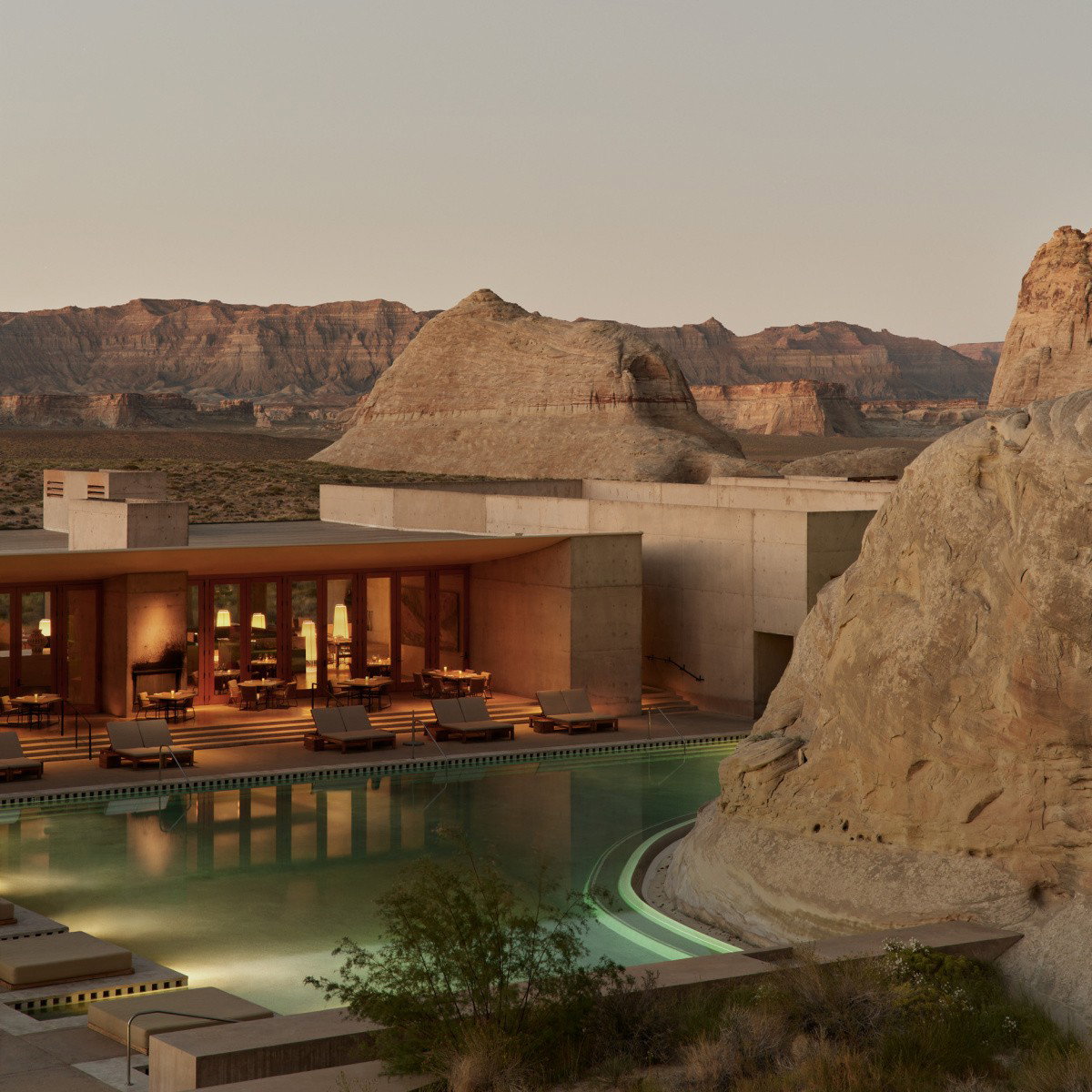
Where the Building Disappears Into the Cliff
The approach sets the tone before you reach the door. A single winding road descends into a protected valley in Canyon Point, Utah, and by the time the Central Pavilion comes into view, the architecture has already made its argument: concrete walls tinted to match the surrounding sandstone, low horizontal lines that read as a geological extension of the mesa rather than an intrusion on it. In an era when many remote luxury properties attempt to soften the environment they occupy, Amangiri goes the other way. The desert's hard edges are the point, not an obstacle to be managed.
This design discipline places Amangiri in a specific and relatively small category of destination resorts — properties where the physical structure and the landscape it inhabits are so deliberately integrated that separating the two becomes meaningless. Among American properties in this tier, peers include Post Ranch Inn in Big Sur and Ambiente, A Landscape Hotel in Sedona, both of which pursue a comparable logic of architecture as landscape response. Amangiri, however, operates at a different scale of ambition and recognition: it holds Michelin 3 Keys (2024), sits at #98 on the World's 50 Best Hotels list (2025), and earned 97.5 points on La Liste's Leading Hotels ranking for 2026. For the American Southwest, that award stack is without precedent among landscape-first properties.
The shortlist, unlocked.
Hard-to-book tables, cellar releases, and concierge-planned trips.
Get Exclusive Access →The Architectural Logic of Minimalism at Altitude
The design approach at Amangiri runs counter to what most premium hospitality defaults to. Where properties such as Hotel Bel-Air in Los Angeles or The Fifth Avenue Hotel in New York City use interior layering — rich textiles, layered finishes, historical reference , to create a sense of luxury, Amangiri works through subtraction. The 34 suites, spread across a Desert Wing and a Mesa Wing, use concrete walls and rough timber furnishings that strain against the usual conventions of resort hospitality. The tactile quality is deliberate: materials that read as hard, spare, and material-honest from across a room reveal themselves as precisely finished and carefully considered at close range.
The main swimming pool, which physically embraces a dramatic stone escarpment, functions as the property's organizing gesture. It is a design decision as much as an amenity: the pool makes the rock formation legible as architecture rather than backdrop. The Central Pavilion's Dining Room extends this relationship outward through floor-to-ceiling glass doors that open onto a terrace overlooking the pool and the desert beyond. An open kitchen anchored by a wood-fired oven provides the room's focal point, grounding the dining experience in a material directness that matches the wider aesthetic. The approach signals, coherently, that everything here is meant to be experienced rather than merely observed.
2,322 square-metre Aman Spa , one of the largest in the Aman portfolio , continues this discipline, with hydrotherapy and floatation pavilions, a watsu pool, yoga studio, and both indoor and outdoor treatment suites arranged to maximize engagement with the surrounding terrain. The spa's heated step pool in particular functions as an outdoor extension of the water program rather than a supplement to it.
Camp Sarika: The Same Logic, Taken Further
A ten-minute drive from the Central Pavilion (or a thirty-minute hike across open desert), Camp Sarika by Amangiri offers ten tented pavilions , five one-bedroom, five two-bedroom , that compress the resort's design principles into a more elemental format. Canvas-topped structures, expansive terraces with fire pits, and private heated plunge pools create a context where the boundary between interior and exterior becomes largely administrative. A shared pool, Jacuzzi, two spa suites, and a separate restaurant with an open rotisserie kitchen serve the camp's guests, who retain full access to the main resort's facilities.
The structural separation between Amangiri and Camp Sarika is significant. Many remote resorts that add a glamping or camp component treat it as a budget tier or a novelty. Here it functions as an alternative register: the same design conviction, differently configured, for guests who want to push further into the landscape rather than away from it.
The Grand Circle as Context, Not Backdrop
Amangiri's position in what is known as the Grand Circle , the Four Corners region where Utah, Colorado, New Mexico, and Arizona converge , is not incidental to the property's identity. Grand Canyon, Monument Valley, Bryce Canyon, and Zion National Park are all within reach, and the resort structures its activities around engagement with this wider geography. Private hiking trails across 900 acres operate alongside guided experiences led by resident archaeologists and palaeontologists. Horseback riding, canyoneering, Via Ferrata routes, hot-air ballooning, and helicopter flights extend the range further. The evening programming, including fireside storytelling and dedicated stargazing, is calibrated to the Navajo cultural history of the region, which has been continuously inhabited for centuries.
This positions Amangiri in a different way than destination properties that treat their surrounding landscape as a backdrop for resort activities. The experiential offer here is the landscape, structured and made accessible by the resort's infrastructure, rather than a set of amenities that happen to have scenic views. Among American properties that take a comparable approach, Sage Lodge in Pray and Alpine Falls Ranch in Superior operate in adjacent territory, though in the Northern Rockies rather than the canyon Southwest. Within the Aman network itself, Amangani in Jackson Hole is the closest structural parallel , a landscape-integrated property in the American West , though the terrain and the resulting design language differ substantially.
The Rooms and What They Offer
All 34 accommodations are suites, and the distinction between the Desert Wing and Mesa Wing is primarily one of view orientation: 18 suites in the Mesa Wing face toward the refined terrain and are considered the better position for sunset; 16 suites in the Desert Wing look out over the surrounding dunes and lower plateaus. Both wings share the same design register. Each suite includes a private terrace, twin rain showers, and soaking tubs positioned to frame the exterior. Pool suite variants in both wings add a private plunge pool. The Amangiri Suite, the property's sole top-category room, has an expansive private swimming pool and terrace lounge. Rates are published from $5,050 per night, placing Amangiri at the upper end of the American luxury resort tier , ahead of properties like Four Seasons at The Surf Club in Surfside and broadly in line with Aman New York and Aman Venice. Given the property's award profile and degree of remoteness, this rate structure is consistent with its peer set rather than anomalous to it.
Planning Your Stay
The nearest commercial airport is the regional facility in Page, Arizona, approximately 25 minutes by car. Amangiri provides complimentary transfers between the resort and Page Airport. For guests arriving from larger hubs, car transfers are available from Phoenix, Flagstaff, St George (Utah), and Las Vegas. Private air charter can be arranged to Page for those with schedule flexibility. Given the property's size , 34 suites plus Camp Sarika's ten pavilions , and its award-driven demand profile, early booking is advisable, particularly for spring and autumn when the canyon light is at its most photogenic and temperatures remain workable for outdoor activities. Summer stays require air-conditioned retreat; the winter months are cooler but the resort operates year-round, and the desert at lower temperatures has its own visual quality. For more on the surrounding area and what it offers beyond the resort itself, see our full Canyon Point restaurants guide.
Frequently Asked Questions
- What's the vibe at Amangiri?
- Amangiri sits in a protected valley in Canyon Point, Utah, and the atmosphere is defined almost entirely by the desert terrain surrounding it. The property is quiet by design: 34 suites spread across two wings, no large conference facilities, and programming oriented toward outdoor engagement rather than resort entertainment. Its 2025 World's 50 Best Hotels ranking (#98) and Michelin 3 Keys (2024) signal a level of service intensity that operates without visible formality. Rates begin at $5,050 per night.
- What's the leading room type at Amangiri?
- The Mesa Wing suites are generally considered the better position for sunset views across the refined terrain, with the Aman Spa located in the same wing. For those wanting greater privacy and direct outdoor connection, the pool suites add a private plunge pool to the standard terrace configuration. Camp Sarika's tented pavilions, a ten-minute drive away, each include fire pits and heated plunge pools for a more pared-back experience. Rates across all categories begin at $5,050 per night, with the Amangiri Suite at the leading of the range.
- What is Amangiri known for?
- Amangiri is known for its architecture: concrete structures tinted to match the surrounding sandstone cliffs, organized around a swimming pool built against a natural rock escarpment. Set on 900 acres in Canyon Point, Utah, with access to Grand Canyon, Zion, Bryce, and Monument Valley, it operates as a departure point for serious outdoor engagement as much as a resort destination. It holds Michelin 3 Keys (2024) and ranks #98 on the World's 50 Best Hotels (2025). Starting rates are $5,050 per night.
- How far ahead should I plan for Amangiri?
- With only 34 suites and ten Camp Sarika pavilions across the full property, and an award profile that draws consistent international demand, Amangiri books out well in advance during peak seasons (spring and autumn). For specific dates, particularly around holiday periods or shoulder-season weeks in April and October, planning several months ahead is practical. Transfers from Page Airport (25 minutes), Phoenix, Las Vegas, and Flagstaff can be arranged through the resort. Starting rates of $5,050 per night position this at the leading of the American luxury resort tier.
- What outdoor activities does Amangiri offer within the property itself?
- Beyond the access it provides to Grand Canyon, Zion, and the wider Grand Circle, Amangiri maintains private hiking trails and structured activity programming across its own 900 acres. Guided experiences led by resident archaeologists and palaeontologists, canyoneering routes, Via Ferrata climbing, horseback riding, hot-air ballooning, and helicopter flights are all available directly through the resort. Evening stargazing and fireside storytelling sessions draw on the region's Navajo cultural history. This activity depth, combined with the 2,322 square-metre Aman Spa, is a primary reason the property holds Michelin 3 Keys recognition (2024) and places #98 on the World's 50 Best Hotels (2025).
Peer Set Snapshot
These are the closest comparables we have in our database for quick context.
| Venue | Cuisine | Price | Awards | Notes |
|---|---|---|---|---|
| Amangiri | Michelin 3 Key | This venue | ||
| Aman New York | Michelin 3 Key | |||
| Hotel Bel-Air | Michelin 3 Key | |||
| The Beverly Hills Hotel | Michelin 3 Key | |||
| The Carlyle, A Rosewood Hotel | Michelin 2 Key | |||
| Raffles Boston | Michelin 2 Key |
Preferential Rates?
Our members enjoy concierge-led booking support and priority upgrades at the world's finest hotels.
Get Exclusive AccessThe shortlist, unlocked.
Hard-to-book tables, cellar releases, and concierge-planned trips.
Get Exclusive Access →