The format sits at the intersection of market hall and fine dining, making it one of the more architecturally ambitious food spaces in the Spanish capital. Visits work best as long, exploratory evenings rather than single-sitting dinners.

Pearl is the En Primeur Club membership app, where members save venues, book tables and use the concierge.
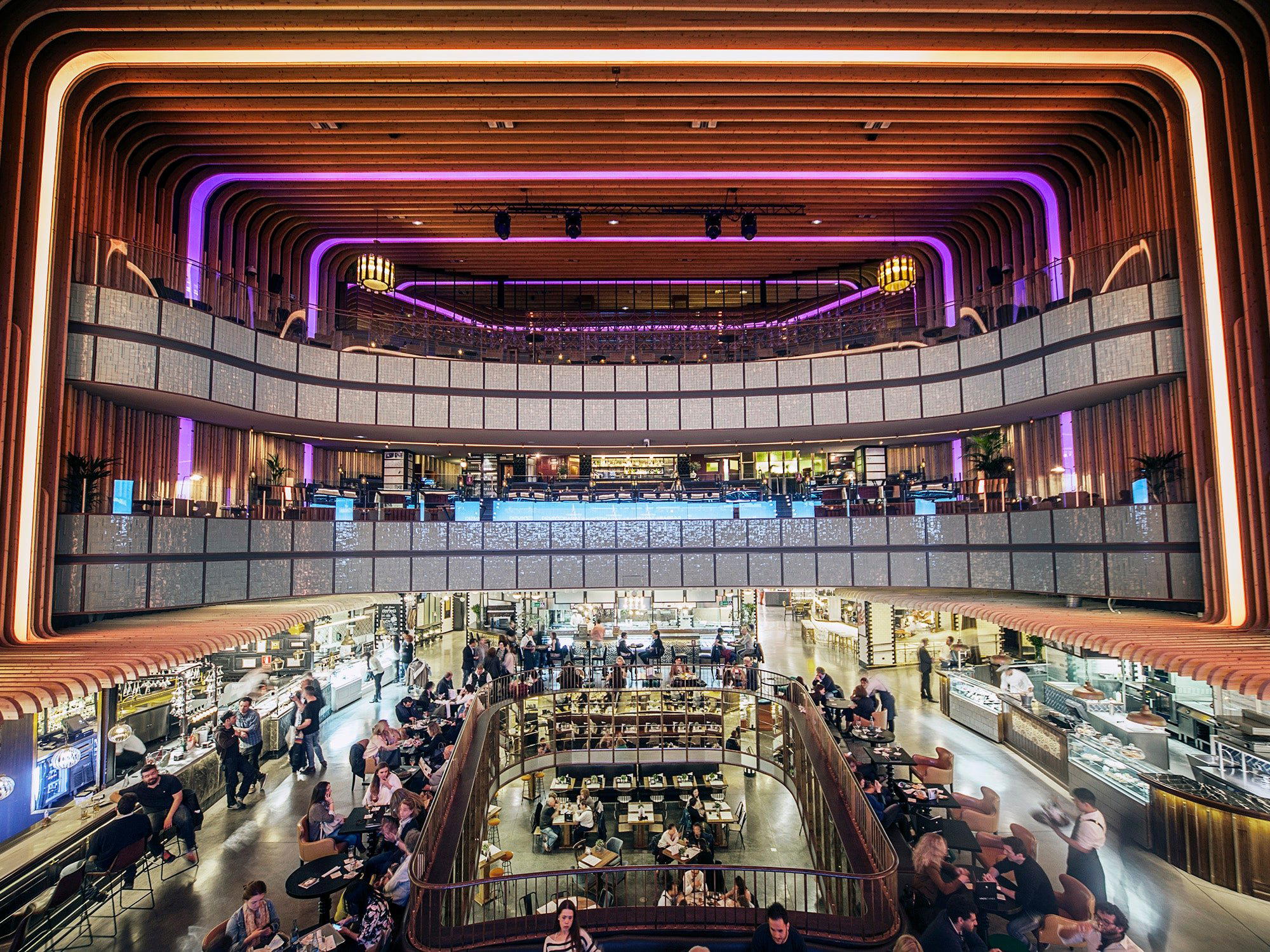
What the Space Actually Does to You
Auditorium conversions carry an inherent theatrical risk: the drama of the shell can outpace whatever fills it. At Platea, the calculation lands closer to balance than spectacle for its own sake. The horseshoe form means that wherever you're sitting or standing, you're always in partial view of other people eating, drinking, and moving between counters. There's a low hum that feels more like a theatre in interval than a market hall at capacity. The tiers create natural separations of pace: the lower stalls tend toward busier, faster circulation, while upper-level seating offers longer sightlines across the whole space.
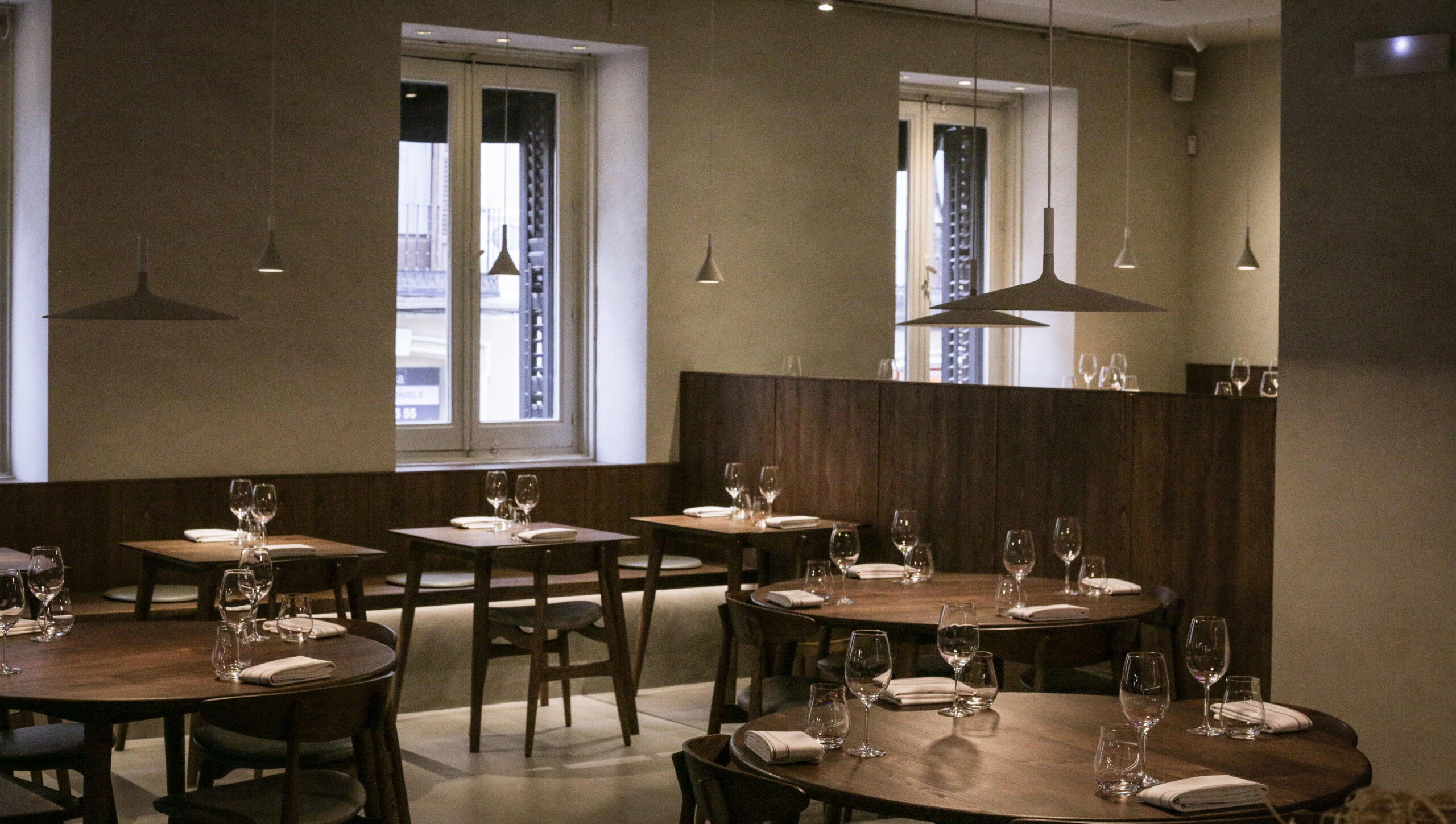
Lighting does significant work here. The interior retains enough of the original architectural volume that the overhead rig has room to define zones without hard partitions. Early evening, when daylight still filters through the upper sections, the space reads differently than it does after ten, when the balance shifts toward warmer, lower-key illumination and the bar programmes take over from the food counters. If you're timing a visit, that transition, roughly between nine and ten on a weekend evening, captures both registers.
The Format and What It Asks of You
Madrid's food market conversion model has a clear lineage. Mercado de San Miguel near the Palacio Real, and Mercado de San Antón a few blocks north of Platea in Chueca, both established templates for the premium market hall: street-level stalls, standing consumption, high turnover. Platea operates in the same broad category but departs from it structurally. The seated restaurant options within the space offer longer formats, and the presence of multiple distinct operators under one roof means the visit has more moving parts than a single-venue dinner. You need to decide whether you're grazing across stalls, committing to a sit-down restaurant, or letting the evening drift between both.
That flexibility is also the source of the venue's main logistical complexity. Unlike a single-concept restaurant where the booking, the format, and the expectation are unified, Platea requires more active navigation. For visitors who prefer a clear sequence, aperitif, table, dessert, bill, the format can feel diffuse. For those comfortable with looser, longer evenings where the next thing is chosen as you go, it rewards that approach considerably. Platea fits that register while also providing something the district's conventional restaurant row doesn't: a space where a Friday or Saturday evening can stretch across several hours without commitment to a single table or a fixed menu. For visitors staying in the area, this matters practically.
For bar-focused evenings in Madrid more broadly, the city's cocktail programme has developed considerably over the past decade. Angelita and Salmon Guru represent the more technical, internationally recognised end of that shift. 11 Nudos Madrid and 1862 Dry Bar sit within the same broader movement toward programme-led bar culture. Boadas in Barcelona represents an older, single-venue model that predates the multi-operator trend by decades. Venues like Bar Sal Gorda in Seville, Bar Gallardo in Granada, and Garito Cafe in Palma de Mallorca each reflect local versions of how Spanish cities balance tradition and contemporary format. Further afield, La Margarete in Ciutadella, Garden Bar in Calvia, and Bar Leather Apron in Honolulu show how the same instinct toward curated, multi-option hospitality spaces extends well beyond the Spanish context. Platea sits within that international trend while being shaped by specifically Madrileño references: the late eating culture, the importance of the paseo as evening structure, and the expectation that a good night out moves rather than stays fixed. The space runs into the late evening and is oriented toward extended, social visits rather than quick dinners. Weekend evenings draw a denser crowd; if you want the space at a more navigable pace, earlier weekday evenings offer the same architecture and operators with considerably less competition for seats. Given the multi-operator structure, there is no single booking path for the venue as a whole, though individual restaurants within it may take reservations. For further context on where Platea fits in Madrid's broader eating and drinking map, the full Madrid restaurants guide covers the city across neighbourhoods and formats.
A Pricing-First Comparison
| Venue | Cuisine | Price | Awards |
|---|---|---|---|
| Platea MadridThis venue (the venue you are viewing) | Not listed | $30–50 | Not listed |
| Salmon Guru | Cocktail Bar | $30–50 | World's 50 Best #46 · Falstaff Bar - 95 Falstaff Points |
| 1862 Dry Bar | Not listed | $20–30 | Falstaff Bar - 93 Falstaff Points · Top 500 Bars Best Bars #68 |
| Bad Company 1920 | Not listed | $10–20 | Falstaff Bar - 96 Falstaff Points · Top 500 Bars Best Bars #349 |
| Coalla | Not listed | Not listed | Star Wine List |
Continue exploring
More in Madrid
Bars in Madrid
All bars in Madrid →
Restaurants in Madrid
All restaurants in Madrid →


Details
- Lively
- Elegant
- Well Known
- Energetic
- Sophisticated
- Group Outing
- After Work
- Late Night
- Celebration
- Casual Hangout
- Live Music
- Historic Building
- Design Destination
- Panoramic View
- Seated Bar
- Lounge Seating
- Communal Tables
- Standing Room
- Classic Cocktails
- Craft Cocktails
- Conventional Wine
- Craft Beer
- Street Scene
Lively and dynamic with preserved original cinema architecture, theatrical lighting from the former venue, and a constantly evolving atmosphere featuring live music, DJ performances, and acrobatic shows.