Old Absinthe House
Few addresses on Bourbon Street carry the historical weight of the Old Absinthe House, a French Quarter institution that has been drawing drinkers since 1807. The bar's marble fountain, pressed-tin ceilings, and walls papering decades of business cards place it firmly in the tradition of New Orleans drinking culture — raucous, ritualistic, and unapologetically itself.

Pearl is the En Primeur Club membership app — saves, bookings, and concierge access live there. Same editors, same standards.
- Address
- 240 Bourbon St, New Orleans, LA 70112
- Phone
- (504) 524-0113
- Hours
- Mon–Wed 9 AM–2 AMThu 9 AM–3 AMFri–Sat 9 AM–4 AMSun 9 AM–3 AM
- Website
- ruebourbon.com
- Directions
- Get directions
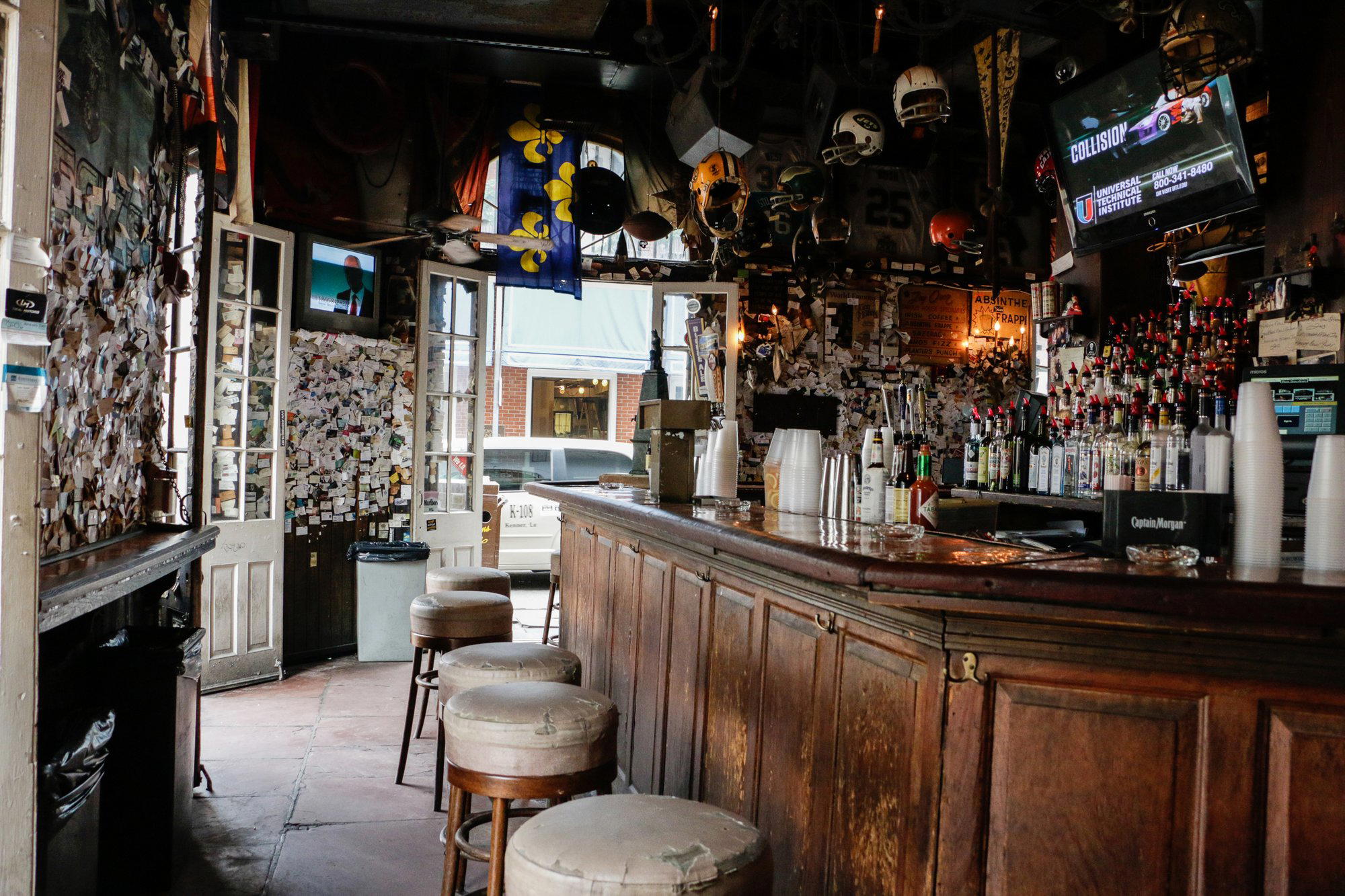
Bourbon Street at its worst is a corridor of frozen daiquiri machines and neon signage aimed squarely at people who will remember nothing in the morning. At 240 Bourbon, though, there is a building that predates Louisiana statehood. The Old Absinthe House has been operating in some form since 1807, which means it has outlasted yellow fever epidemics, Prohibition, hurricanes, and every subsequent wave of French Quarter commercialization. Walking in from the street, the shift is immediate: the ceiling is pressed tin, the bar is marble, and the walls are thick with business cards that visitors have pinned there across decades. It is not atmospheric in a designed sense. It is atmospheric because it has simply been here long enough that atmosphere accumulated on its own.
A French Quarter Drinking Tradition
New Orleans has a more layered drinking culture than almost any other American city, and the French Quarter sits at the center of that tradition. The city's bar history runs through absinthe and brandy punches in the nineteenth century, through Prohibition-era cocktail adaptations, through the mid-century fascination with the Sazerac and the Ramos Gin Fizz, and into the contemporary craft movement that produced serious programs at places like Jewel of the South and Cure. The Old Absinthe House sits at a different point on that spectrum. It is not a craft cocktail bar in the contemporary sense, and it does not position itself as one. What it offers is continuity: the sense that the room itself has been part of the city's drinking culture for so long that visiting it is less about the drink program and more about the place as a living document of New Orleans history.
The bar's name references absinthe, and that is not incidental. New Orleans was one of the great absinthe-drinking cities of nineteenth-century America, with the French Quarter serving as the primary distribution point for the spirit among Louisiana's Creole population. The absinthe drip — water trickling slowly over a sugar cube into a glass of the spirit — was a ritual practiced here long before absinthe became a fashionable category for contemporary bartenders. That heritage gives the Old Absinthe House a specific historical claim that most bars on the street cannot match.
The Room and What It Tells You
The physical environment here communicates more than any drinks menu could. The original marble absinthe fountain behind the bar is not decorative repro, it is the actual equipment used for the drip ritual in the building's earlier decades. The pressed-tin ceiling and the dark wood of the bar itself have the density of things that have not been renovated for effect. The business card tradition, in which visitors pin their cards to every available surface of the walls and ceiling, has been going long enough that the layers have layers. It gives the room a texture that no interior designer could replicate with a brief and a budget.
Service dynamic at a room like this is worth noting in its own right. In the more technically precise tier of New Orleans cocktail bars, Beachbum Berry's Latitude 29 with its tiki program depth, or Jewel of the South with its historically researched menu, the relationship between bartender, bar manager, and floor staff is organized around a specific drinks philosophy. At the Old Absinthe House, the team dynamic operates differently: the bar's identity is carried as much by institutional knowledge and the room's accumulated history as by a contemporary cocktail program. The staff here are guides to a place as much as they are drink-makers, and that distinction matters when you are deciding how to spend an evening in the Quarter.
Where It Sits in New Orleans Drinking Today
Contemporary New Orleans bar scene has sorted itself into recognizable tiers. At the technical end, you have programs like Cure, which helped establish the city as a serious cocktail destination in the 2010s, and Jewel of the South, which brought historically researched nineteenth-century American cocktails back into the conversation. 2 Phat Vegans represents a different kind of local institution, community-rooted, neighborhood-specific. The Old Absinthe House sits outside all of these categories. It is neither a craft program nor a neighborhood local. It is a heritage site that happens to still be serving drinks, and in a city as history-conscious as New Orleans, that is a legitimate category of its own.
For context on how heritage bars function in other American cities, it is worth noting that the model does not translate everywhere. The combination of a genuinely old physical structure, a specific spirit tied to local cultural history, and a neighborhood that has remained a drinking district for two centuries is not easily replicated. Bar Leather Apron in Honolulu, Julep in Houston, Kumiko in Chicago, Superbueno in New York City, ABV in San Francisco, Allegory in Washington, D.C., and The Parlour in Frankfurt on the Main each occupy their own distinct positions in their respective bar scenes, but none of them are operating out of a building that predates their country's statehood.
Planning Your Visit
The bar is located at 240 Bourbon Street, which puts it in the heart of the French Quarter and within walking distance of most Quarter hotels. Bourbon Street itself is loudest on Friday and Saturday nights, when the corridor fills from the river end, and the Old Absinthe House absorbs some of that foot traffic. Weeknight visits, particularly early evenings before the street hits full volume, allow the room to read more clearly on its own terms. The building is open most days, though hours can shift around major New Orleans events including Mardi Gras and Jazz Fest, when the entire Quarter operates on a different schedule. No reservation is required. Dress is casual by any standard; this is not a door-policy establishment. For broader context on where the Old Absinthe House fits within a full New Orleans itinerary, see our full New Orleans restaurants guide.
At-a-Glance Comparison
Comparable venues nearby, for context on price, style, and recognition.
| Venue | Cuisine | Price | Awards | Notes |
|---|---|---|---|---|
| Old Absinthe HouseThis venue — the venue you are viewing | cocktail_bar | $20–30 | Not listed | Not listed |
| 2 Phat Vegans | Bar | $10–20 | Not listed | French Quarter |
| Bacchanal Fine Wine & Spirits | wine_bar | Not listed | Not listed | Bywater |
| The Avenue Pub | pub | $20–30 | Not listed | Central City |
| Cane & Table | cocktail_bar | $30–50 | Top 500 Bars Best Bars #288 | French Quarter |
| Manolito | cocktail_bar | $20–30 | Not listed | French Quarter |
Continue exploring
More in New Orleans
Bars in New Orleans
Browse all →
Restaurants in New Orleans
Browse all →
Details
- Classic
- Well Known
- Historic
- Casual Hangout
- Late Night
- Historic Building
- Seated Bar
- Classic Cocktails
Current opening hours
- Monday
- 9 AM–2 AM
- Tuesday
- 9 AM–2 AM
- Wednesday
- 9 AM–2 AM
- Thursday
- 9 AM–3 AM
- Friday
- 9 AM–4 AM
- Saturday
- 9 AM–4 AM
- Sunday
- 9 AM–3 AM
Hours can change for holidays and private events. Last verified .
Old-school decor with dark, atmospheric lighting evoking 19th-century New Orleans, lively and inviting historic charm.