On Rue de Richelieu in the 1er arrondissement, Juveniles has held its position as one of Paris's most respected wine bars for decades, drawing a loyal crowd of Anglophones, natural wine converts, and locals in equal measure. Its Scots-founded identity and commitment to eclectic by-the-glass pours place it firmly in the tradition of the serious, unpretentious wine bar that Paris does better than almost anywhere else.
 Discover on Pearl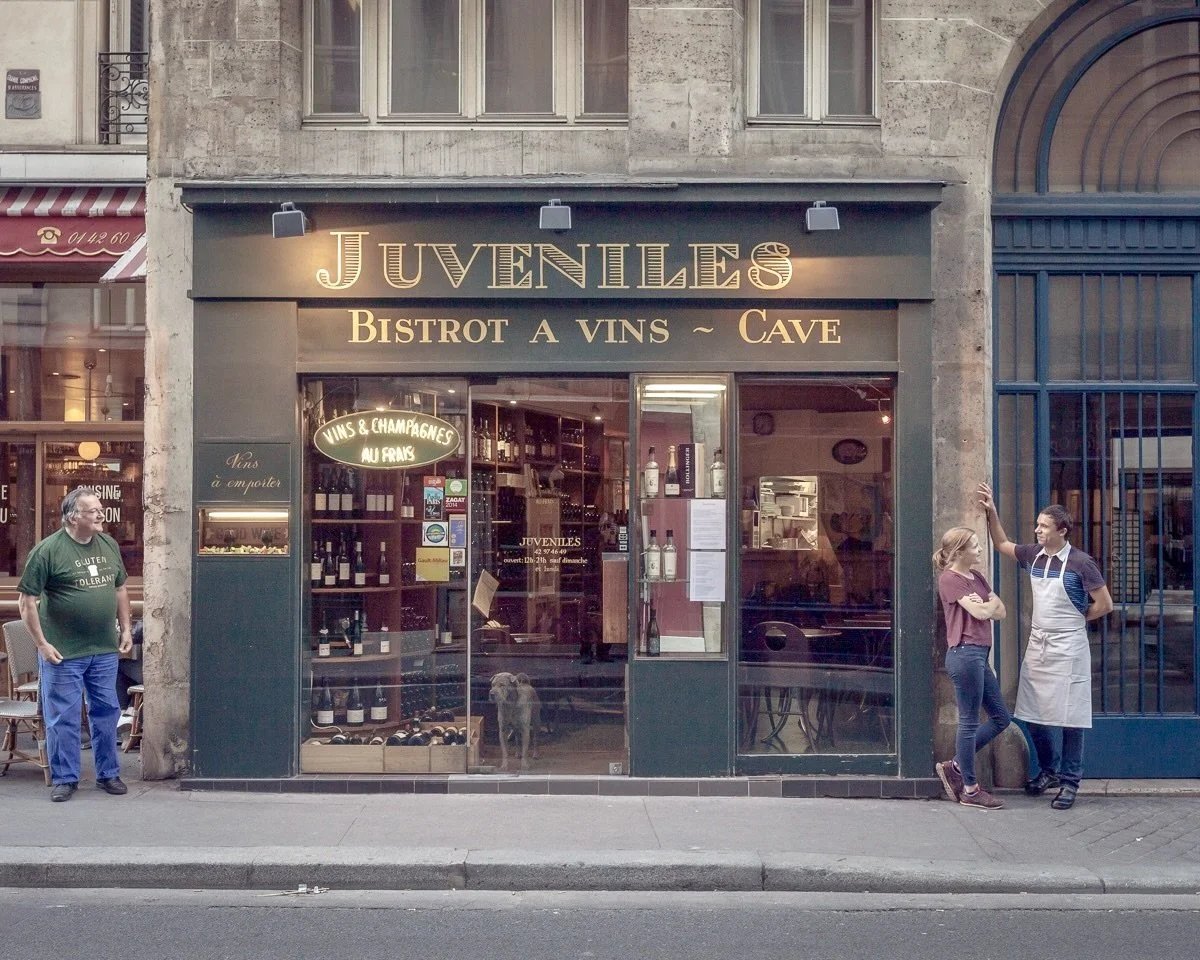
A Corner of Rue de Richelieu That Hasn't Needed to Reinvent Itself
Approach Juveniles from the Palais-Royal end of Rue de Richelieu and the neighbourhood itself sets the tone. You are in the administrative and cultural spine of central Paris, a few minutes' walk from the Bibliothèque nationale and the Comédie-Française, in a part of the 1er arrondissement that has always attracted a particular kind of regular: the person who has somewhere else to be but isn't quite ready to leave. The street is quieter than the tourist corridors nearby, and the bar fits that register. There is no sign demanding your attention, no queue management, no theatrics at the door.
Inside, Juveniles operates in the tradition of the Anglo-French wine bar that Paris developed as its own distinct format across the 1980s and 1990s: unpretentious room, serious list, food that knows its supporting role. The format never fully disappeared, but it has been harder to find in its original, undiluted form as the city's bar scene has fragmented into natural wine caves, cocktail-forward rooms, and destination dining annexes. Juveniles represents one of the cleaner surviving examples of what that format looks like when it has had decades to settle.
The Wine Bar Tradition and Where Juveniles Sits Within It
The Parisian wine bar sits at a specific intersection in French drinking culture: more serious than a café, less formal than a restaurant, and defined by the quality and variety of its by-the-glass offering rather than any single bottle. The leading versions of the format reward regulars who arrive mid-week, take a stool at the bar, and work through something unfamiliar with a plate of charcuterie or cheese alongside. Juveniles has operated in that register since its founding by Scottish expat Tim Johnston in the 1980s, and the Scots-British sensibility of the original enterprise gave it a slightly different pitch from the French-owned equivalents: more willing to range across regions, less reverential about appellation hierarchy.
That founding identity still marks the wine list's character. Where many Paris wine bars of a similar vintage have drifted toward exclusively natural or biodynamic selections to match current market expectations, Juveniles has historically maintained a wider range, treating producer quality and selection curiosity as the primary criteria. The result is a list that tends to include producers from outside the standard Parisian canon: Languedoc domaines, Spanish bottles, Georgian imports, alongside the Burgundy and Loire entries that anchor any serious French list. For a traveller arriving from outside France, this breadth provides useful orientation. For a Paris regular, it offers the kind of unpredictability that keeps a list interesting across multiple visits.
In the broader context of Paris drinking, Juveniles occupies a different tier from the high-design cocktail rooms. While venues like Danico or Candelaria have built their reputations around technical cocktail programs with strong creative direction, and Buddha Bar operates at the spectacle end of the market, Juveniles sits in the quieter tradition of the wine-led room where the glass in front of you, not the space around you, is the point. Bar Nouveau represents a more contemporary take on the format, while Juveniles holds its position as an older model that has aged without becoming a relic.
Food as Context, Not Ambition
The food at Juveniles has always worked in the service of the wine. The kitchen produces a short, daily-shifting menu that leans on charcuterie, cheese, and small plates designed to extend a session rather than anchor it. This is the correct approach for a wine bar of this type: the food earns its place by making you want to open another bottle, not by competing with the list for your attention. Visitors who arrive expecting a full dinner service may find the offer modest by restaurant standards; visitors who arrive understanding the format will find it entirely sufficient.
This model connects Juveniles to a broader tradition of rooms across France where the kitchen's function is precisely calibrated. You find the same logic at serious wine bars in Lyon's traboules district, in the better cave-à-manger operations that have multiplied across French provincial cities in recent years, and in places like Madame Pang in Bordeaux or Papa Doble in Montpellier, where drinks program and kitchen are in deliberate proportion. The format asks something of the diner: an acceptance that restraint in one area funds depth in another.
The Right Time to Go and How to Think About a Visit
Juveniles draws a particular kind of Paris crowd: the Anglo expat community that has maintained a connection to the bar across decades, the neighbourhood worker stopping in after the Bibliothèque nationale closes, the food-and-wine traveller who has read enough about the Paris bar scene to know where the older reference points sit. Midweek evenings tend to offer a more settled atmosphere; weekend lunchtimes attract a more transient tourist mix, which shifts the room's energy considerably.
Planning around season matters less here than at destination restaurants. The wine list rotates, the food changes daily, and the room itself doesn't perform differently at different times of year. The more useful planning consideration is simply showing up when the bar is less than half full, which generally means arriving before 7pm on a weekday. Walk-ins are the expected mode; there is no evidence of a formal reservations system for bar seating, and much of Juveniles' character comes precisely from the fact that it has always been a room you enter rather than one you book months in advance.
For context on how Juveniles fits into a broader Paris itinerary, our full Paris restaurants guide maps the city's drinking and dining options across price points and formats. And if your travels extend beyond the capital, similar serious-but-unpretentious drinking culture turns up at Crapule in Vannes, Josie par Rosette in Clichy, L'Esprit Libre in Horbourg-Wihr, Bar Fouquet's in Cannes, and further afield at Bar Leather Apron in Honolulu, each working a version of the same principle that a well-chosen glass in an uncontrived room is its own argument.
Frequently Asked Questions
- What drink is Juveniles famous for?
- Juveniles is a wine bar first and last. Its reputation rests on a by-the-glass selection that ranges more widely across regions and producers than many Paris equivalents, including bottles from the Languedoc, Spain, and Georgia alongside the standard French appellations. There is no signature cocktail; the point is the wine list's breadth and the staff's willingness to guide you through it.
- What's the defining thing about Juveniles?
- Its longevity and its consistency. In a city where bar formats cycle through trends quickly, Juveniles has maintained the Anglo-French wine bar model for decades without significant reinvention. That continuity is itself a form of editorial statement about what makes a room work: a serious list, food that supports rather than competes, and a room that doesn't ask you to perform enthusiasm.
- Can I walk in to Juveniles?
- Walk-ins are the standard mode of arrival. Juveniles has functioned as a drop-in wine bar since its founding, and there is no indication of a reservations-required policy for bar seating. Arriving early in the evening on a weekday gives you the leading chance of a seat without waiting; later on busy nights, the room fills quickly given its modest size.
- What kind of traveller is Juveniles a good fit for?
- The wine-curious traveller who wants to drink seriously without dressing up for the occasion. Juveniles suits someone who reads a list rather than defaulting to the house pour, who values a room's history as part of the experience, and who is comfortable with a food offer that supports rather than leads. It is less suited to someone looking for a full dinner or a visually theatrical space.
- Is a night at Juveniles worth it?
- For a visitor who treats Paris as a serious wine city rather than just a dining destination, yes. Juveniles provides access to a list with genuine range, in a room with genuine history, at prices that reflect the wine bar format rather than restaurant margins. The value case is direct: you are paying for the quality of what's in the glass, not for scenery or service theatrics.
- Does Juveniles have a connection to any particular wine region or producer style?
- The bar's founding Scots-British perspective gave it an unusually broad regional range from early on. Rather than anchoring to a single appellation or natural wine ideology, Juveniles has historically selected across France and beyond, including producers from Spain, the Languedoc, and occasionally Eastern Europe and the Caucasus. This makes it a useful reference point in the Paris scene precisely because it doesn't conform to the narrower curation of newer cave-à-manger formats.
City Peers
A fast peer set for context, pulled from similar venues in our database.
| Venue | Cuisine | Price | Notes |
|---|---|---|---|
| Juveniles | This venue | ||
| Bar Nouveau | |||
| Buddha Bar | |||
| Candelaria | |||
| Danico | |||
| Harry's Bar |
Need a Table?
Our members enjoy priority alerts and concierge-led booking support for the world's most difficult bars and lounges.
Get Exclusive Access