Canlis
Canlis has anchored Seattle's fine dining conversation for decades, occupying a hillside position above Lake Union that frames the room as much as any design decision. The bar program reflects the same long-view thinking as the dining room: considered, unhurried, and built around depth of selection rather than novelty.
 Discover on Pearl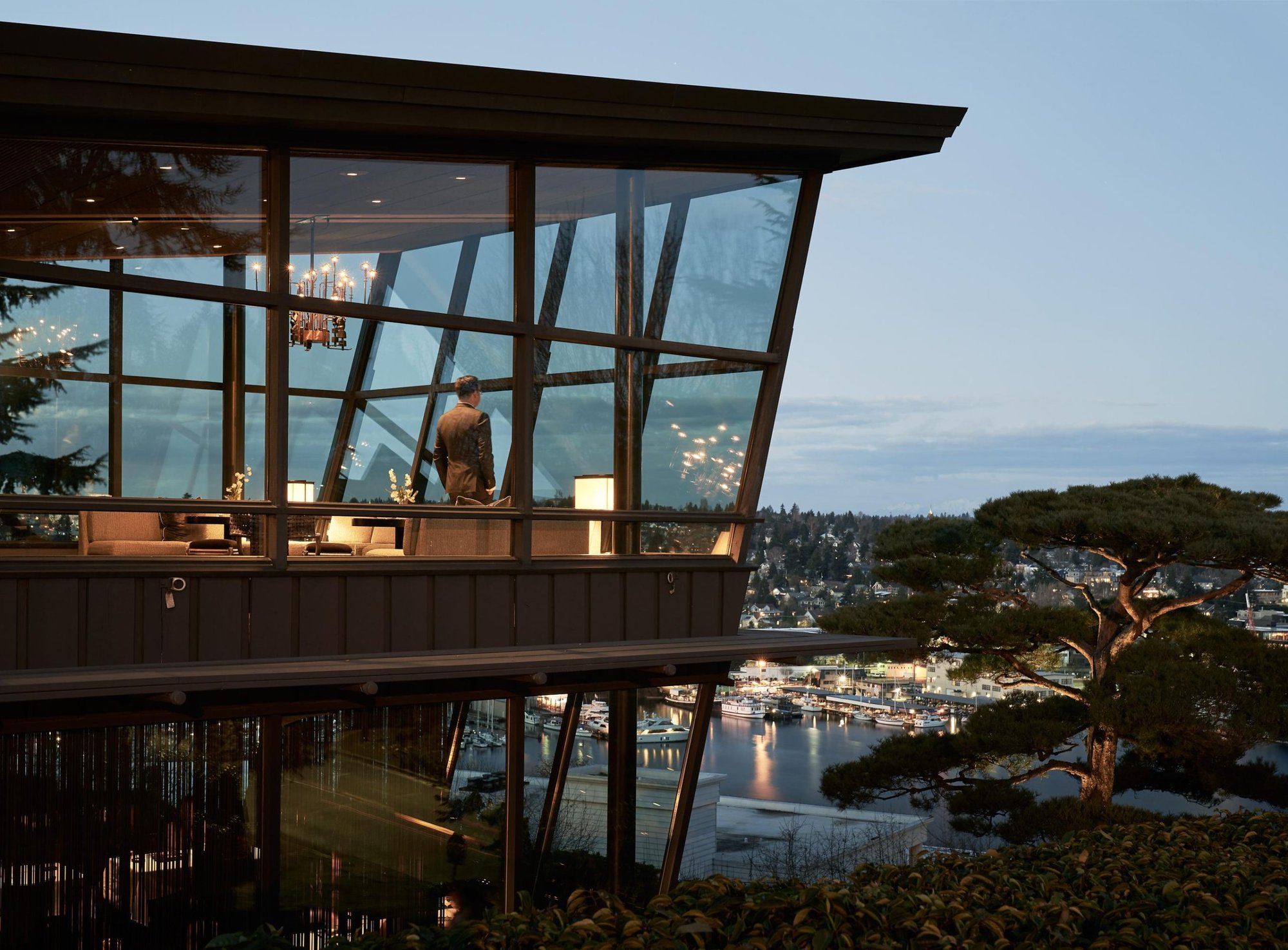
Above the Lake, Below the Radar of Easy Categorization
The approach to Canlis along Aurora Avenue North does something that few restaurant arrivals manage: it shifts your register before you've sat down. The road climbs slightly, the city noise drops, and the building's mid-century silhouette opens toward Lake Union in a way that reads less like a venue entrance and more like a deliberate pause. Seattle has no shortage of rooms with water views, but this one operates differently — the geometry of the space, angled toward the lake and the hills beyond, has been doing the same work since 1950. That continuity is not incidental. It is the argument Canlis makes about what fine dining in the Pacific Northwest can be when it refuses to reinvent itself on trend cycles.
Within Seattle's current dining scene, Canlis occupies a position that has fewer direct peers than it might appear. The city has developed strong mid-tier and neighborhood-driven restaurant culture — places like the bar programs at Roquette and The Doctor's Office that emphasize craft and accessibility , but the full-service, occasion-dining tier remains less populated than in comparable American cities. Canlis does not merely occupy that tier; it has largely defined it locally for multiple generations of diners. That longevity shapes how both regulars and first-timers approach a reservation: this is not a restaurant you audit for relevance, it is one you read for consistency.
The Back Bar as Archive
American fine dining bars have increasingly split into two models: the cocktail-forward programs that treat spirits as raw material, and the collection-oriented back bars that treat rare bottles as the point. Canlis belongs to the second tradition, and the distinction matters when you are deciding where to spend time before or after a meal.
The spirits selection at Canlis reflects decades of accumulation rather than a recent curation push. That temporal depth is legible in the whisky range, which skews toward aged American and Scotch expressions that would be difficult to assemble in a single purchasing effort. Bottles that passed through the market at lower prices before collectibility drove premiums upward now sit on the shelf as evidence of a long-running relationship with procurement. This is the same dynamic that distinguishes a serious back bar from a well-funded one: money can buy recent releases, but it cannot reconstruct the buying history that produced a bar with genuine archive depth.
In the broader American bar context, this kind of spirits-collection approach has parallels at places like Canon in Capitol Hill , Canon's format is explicitly collection-led, with a spirits library that runs to thousands of expressions , and at operators in other cities who have made the rare-bottle back bar their editorial identity: Bar Leather Apron in Honolulu, Kumiko in Chicago, and ABV in San Francisco each operate with selection depth as the organizing principle. Canlis approaches the same logic from within a full-service fine dining context, which changes how the bar functions: it serves both the room and the diner who arrives early to spend time at the counter before moving to the table.
Wine and the Long View
The wine program at Canlis carries the same institutional weight as the spirits selection. Pacific Northwest fine dining has developed a credible regional wine identity over the past three decades, built on Washington State Cabernet, Syrah, and Riesling alongside Oregon Pinot Noir. A serious list in this market needs to reflect that regional depth while maintaining the French and Italian backbone that American fine dining rooms have historically required. Canlis has been navigating that balance for long enough that the cellar reflects multiple eras of acquisition, not just current purchasing priorities.
For diners whose primary interest is in the wine program rather than the spirits back bar, the length and age range of the list is the relevant signal. Lists that read as historically assembled, with verticals and older vintages alongside current releases, indicate a level of institutional commitment that younger or less-capitalized operations cannot replicate. That commitment also implies a sommelier team with depth of knowledge rather than a single specialist covering all bases.
The Occasion Calculus
Seattle's dining culture has expanded considerably in the past decade, with neighborhoods like Capitol Hill, Ballard, and South Lake Union developing distinct characters and strong individual operators. This expansion has given diners more options at more price points, which has sharpened the question of when a room like Canlis is the right choice. The answer has become more specific: Canlis makes most sense when the occasion itself is the point, when the evening needs structure and duration rather than informality and discovery.
That is a different use case from, say, 2963 4th Ave S or the tighter, more experimental formats that Seattle's bar scene has been developing. It is also a different register from the craft-cocktail rooms that have defined the city's bar identity in recent years. Canlis is not competing in those categories. It is occupying a separate space: the long dinner, the considered wine selection, the room that asks something of its guests in return for what it provides.
For those building a broader picture of where Canlis sits within American occasion dining, useful comparison points exist in other cities. Jewel of the South in New Orleans, Julep in Houston, and Superbueno in New York City each represent different takes on the serious, considered drinking experience. Internationally, The Parlour in Frankfurt on the Main operates in a similar register of deliberate, unhurried service. None of these are direct peers of Canlis, but they share the underlying premise that the experience of service and selection is inseparable from the drinks themselves.
Planning a Visit
Canlis is located at 2576 Aurora Ave N, Seattle, WA 98109, on the western edge of the Queen Anne neighborhood, with the building positioned above the western shore of Lake Union. Reservations are standard practice for this category of restaurant, and lead times at this tier in Seattle typically run several weeks for prime evening slots, longer for weekend dates. The room's mid-century architecture has been preserved rather than updated for contemporary minimalism, which means the physical environment reads as a coherent design statement rather than a renovation project. Visitors who want to explore Seattle's broader dining and drinking scene alongside a Canlis reservation will find useful context in our full Seattle restaurants guide.
Frequently Asked Questions
- What should I drink at Canlis?
- The back bar is where Canlis's collection depth becomes apparent. Aged American whiskeys and Scotch expressions accumulated over decades sit alongside the cocktail program, and the wine list carries the same institutional weight , with Washington State and Oregon selections reflecting the restaurant's long engagement with Pacific Northwest producers. If you are focused on spirits, arrive early and spend time at the bar before moving to the table.
- What is Canlis leading at?
- Canlis holds a position in Seattle fine dining that no other single room has occupied with comparable continuity. The combination of a historically assembled wine cellar, a spirits back bar with genuine archive depth, and a room that has maintained its mid-century character since 1950 places it in a different category from the city's newer occasion-dining options. At the price point this tier commands in Seattle, that track record is the primary credential.
- Should I book Canlis in advance?
- Yes. Canlis is Seattle's most established fine dining room, and demand at this tier of the city's restaurant market consistently outpaces availability for desirable slots. Weekend evenings and holidays book furthest in advance. For a first visit, a weeknight reservation is often easier to secure and no less representative of what the room offers.
- What is the leading use case for Canlis?
- Canlis performs leading as an occasion restaurant: a long dinner where the evening's structure is the point rather than a secondary consideration. The room, the wine program, and the spirits selection are all calibrated for duration and deliberateness. It is less suited to quick pre-theater dining or casual drop-in visits, and more suited to celebrations, client meals, or evenings where the act of sitting down to a serious dinner is itself the destination.
- Is Canlis worth visiting?
- For diners who have already covered Seattle's neighborhood restaurants and bar programs and want to understand the city's full dining range, Canlis is the necessary final reference point. The room has been operating since 1950 and has maintained relevance through multiple cycles of change in American fine dining , that alone is a data point worth engaging with directly.
- How does Canlis compare to Seattle's cocktail bar scene?
- Canlis and Seattle's specialist cocktail bars are solving different problems. Rooms like Canon in Capitol Hill have built their identity around spirits-collection volume , thousands of expressions across every category. Canlis carries collection depth within a full-service fine dining format, which means the bar functions as a prelude to the table rather than as the primary event. Diners who want the cocktail program as the focus will find that Canon's explicit library format serves that purpose more completely; diners who want serious spirits selection as part of a longer evening will find Canlis the more coherent choice.
Comparison Snapshot
These are the closest comparables we have in our database for quick context.
| Venue | Cuisine | Price | Awards | Notes |
|---|---|---|---|---|
| Canlis | This venue | |||
| Canon | World's 50 Best | |||
| Bar Miriam | ||||
| Rob Roy | ||||
| Roquette | World's 50 Best | |||
| The Doctor's Office | World's 50 Best |
Need a Table?
Our members enjoy priority alerts and concierge-led booking support for the world's most difficult bars and lounges.
Get Exclusive Access