Google: 4.5 · 2,532 reviews
Cabbage Key Inn and Restaurant
Reachable only by boat across Pine Island Sound, Cabbage Key Inn and Restaurant occupies a shell midden island in Lee County that has defined off-grid Florida for decades. The rambling 1930s house, its walls thick with dollar bills left by passing boaters, delivers a dining experience rooted in place rather than polish. It is the kind of stop that rewards the detour.
 Discover on Pearl
Pearl is the En Primeur Club membership app — saves, bookings, and concierge access live there. Same editors, same standards.
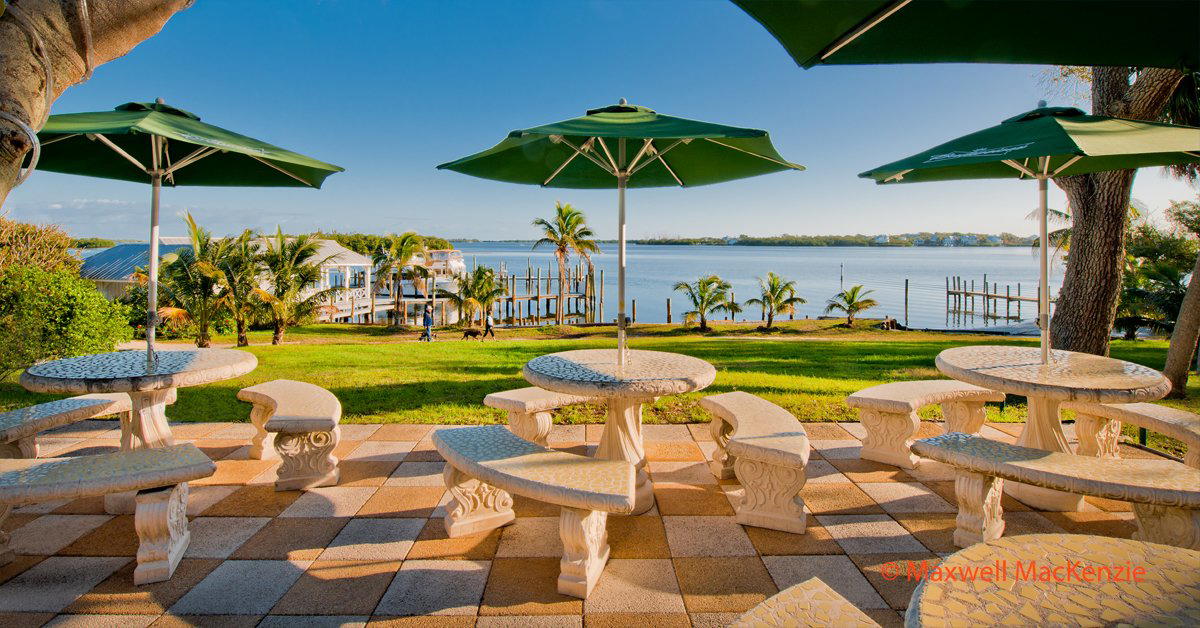
An Island Arrived at by Water
There is a category of American dining destination that earns its reputation not through tasting menus or press coverage but through physical inaccessibility. Cabbage Key Inn and Restaurant belongs firmly in that category. Sitting on a small island in Pine Island Sound off Lee County's Gulf Coast, it is reachable only by private boat or scheduled water taxi, a logistical barrier that has, paradoxically, preserved both its character and its following across generations. The approach matters here: open water gives way to a dense canopy of trees, and the structure that emerges at the dock is a two-story Craftsman house built in 1938, refined on a shell midden ridge that was already ancient when the building went up.
That shell midden — a mound composed of centuries of accumulated shellfish remains left by the Calusa people — functions as the island's natural foundation and gives the property its slight elevation above the surrounding mangrove flats. It is an architectural circumstance that no designer could replicate or commission. The building sits where it sits because the land required it, and that relationship between structure and terrain defines the aesthetic identity of the place more than any deliberate design choice.
The Building as Artifact
Florida's vernacular architecture from the pre-air-conditioning era has a specific logic: wide porches to catch the Gulf breeze, screened openings to manage insects, deep overhangs to block the midday sun. The Cabbage Key house preserves that logic in functional form. The wood-frame construction, the layered porches, the relationship between interior and exterior , these are not stylistic choices preserved for atmosphere but the original engineering responses to the climate. Properties built to those standards and still operating in their original form represent a thinning category along the Florida Gulf Coast, where development pressure and storm cycles have erased most of the comparable stock.
Inside, the walls of the dining room carry one of the more discussed visual features in Florida casual dining: an accumulation of signed dollar bills that visitors have been pinning to the surfaces for decades. The practice predates social media by a considerable margin, and the density of coverage across walls and ceiling has reached the point where the bills function as insulation as much as decoration. It is the kind of feature that photographs poorly but reads immediately in person, a textural record of the volume of people who have made the water crossing specifically to eat here. For context on how American properties at the other end of the design spectrum handle accumulated history, compare the approach at Chicago Athletic Association in Chicago or The Fifth Avenue Hotel in New York City, where heritage is curated and controlled. At Cabbage Key, it accumulates organically.
Where It Sits in the Lee County Scene
Lee County's dining scene divides broadly between the resort-oriented restaurants of Fort Myers Beach and Sanibel and a smaller tier of destination spots that require more deliberate effort to reach. Cabbage Key sits in the latter group, alongside a handful of marina-adjacent and island-accessible properties that draw from a regional boating community as much as from leisure tourism. For our full assessment of where this fits within the county's wider food and travel picture, see our full Lee County restaurants guide.
The comparison set for Cabbage Key is not the resort dining rooms of Naples or the newer coastal concepts opening in Cape Coral. It is better understood alongside island-access properties elsewhere in Florida that combine lodging, food, and a physical remove from the mainland as the core proposition. Little Palm Island Resort and Spa in Little Torch Key operates at a substantially higher price point and polish level, but the underlying logic , island access as a defining feature, not a complication , is shared. Further afield, the same principle of terrain-as-architecture appears at Amangiri in Canyon Point and Post Ranch Inn in Big Sur, though those properties have been shaped by significant design investment. Cabbage Key's version of the same impulse arrived without the intervention.
For travelers moving between Florida's Gulf Coast and properties further up the eastern seaboard, the contrast with urban design-led hotels is instructive. Raffles Boston, Aman New York, and Four Seasons at The Surf Club in Surfside represent a mode of hospitality built on controlled refinement. Cabbage Key operates from the opposite premise: the setting does the work, and the building gets out of the way.
Getting There and Planning the Visit
The water taxi from Pineland Marina is the standard approach for visitors without a private vessel, and scheduling around tides and departure times is the primary logistical consideration. The island also offers overnight accommodation in the inn's original rooms and in a small number of cottages, which transforms the visit from a lunch excursion into a stay that captures the property's evening and early morning character, when the day-tripper boats have returned to the mainland. Travelers comparing island lodge formats elsewhere in the United States should note that comparable properties at Kona Village, A Rosewood Resort in Kailua Kona or Blackberry Farm in Walland require similar advance planning, though at different price levels and with different amenity expectations.
Because the island has no road access and no bridge, the rhythm of a visit is necessarily slower than the mainland. That deliberate pace is, for many visitors, the point. Properties that architect a similar sense of remove through different means include Troutbeck in Amenia and Sage Lodge in Pray, both of which use landscape rather than water to create separation from urban rhythms.
Comparison Snapshot
These are the closest comparables we have in our database for quick context.
| Venue | Awards |
|---|---|
| Cabbage Key Inn and RestaurantThis venue — the venue you are viewing | |
| Aman New York | Michelin 3 Key |
| Amangiri | Michelin 3 Key |
| Hotel Bel-Air | Michelin 3 Key |
| The Beverly Hills Hotel | Michelin 3 Key |
| The Carlyle, A Rosewood Hotel | Michelin 2 Key |
At a Glance
- Rustic
- Scenic
- Cozy
- Quiet
- Hidden Gem
- Romantic Getaway
- Family Vacation
- Weekend Escape
- Waterfront
- Historic Building
- Outdoor Dining
- Waterfront Dining
- Waterfront
Laid-back Old Florida charm with festive lounge decor, panoramic waterfront views, and tranquil nature trails.