Annabel's
Annabel's at 46 Berkeley Square has defined a certain mode of London private-members-club life since the 1960s — a place where the line between supper club, cocktail destination, and late-night social institution has always been deliberately blurred. The setting across multiple floors of a Georgian townhouse places it firmly in Mayfair's upper tier, where the room itself carries as much weight as anything on the menu.
 Discover on Pearl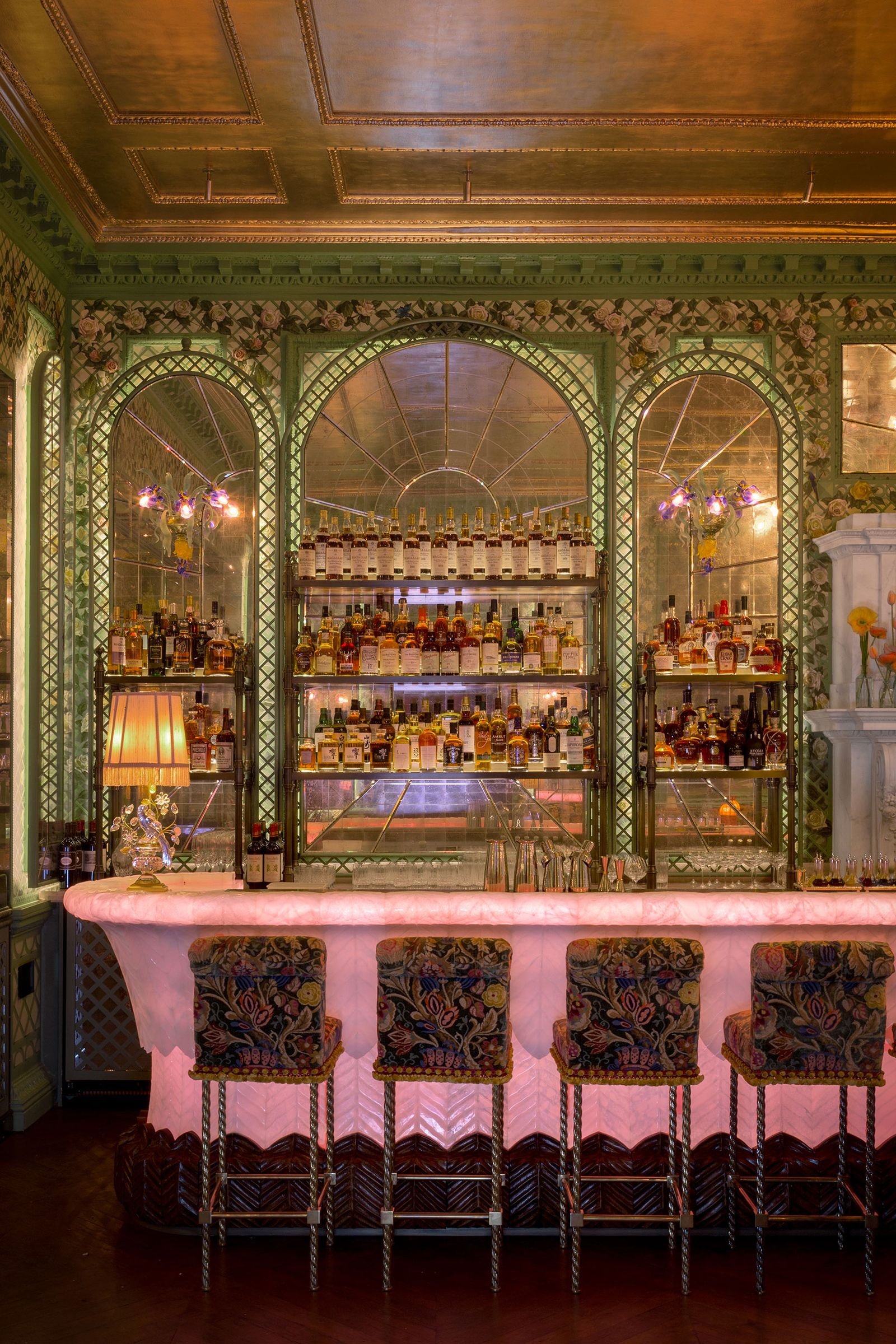
Berkeley Square After Dark: The Architecture of a British Institution
There are venues that occupy a building, and then there are venues that become inseparable from one. Annabel's at 46 Berkeley Square belongs to the second category. The Georgian townhouse on one of Mayfair's most composed garden squares has housed the club since the 1960s, and the address carries its own shorthand in London social life — a reference point that requires no further explanation in certain circles. Approaching from the square itself, past the plane trees and the measured formality of the surrounding architecture, the entrance registers as deliberately understated. The drama is saved for the interior.
That interior, refurbished significantly in 2018, now runs across multiple floors and operates in a visual register somewhere between a Victorian conservatory and a surrealist fever dream — walls covered in tropical flora, taxidermy positioned with intent, lighting that flatters while creating a sense of controlled theatre. London's private members club circuit has long divided between the Soho-media model and the Mayfair-establishment model. Annabel's sits firmly in the latter tradition, though the 2018 renovation signalled a deliberate pivot toward a younger, more aesthetically literate membership demographic without abandoning the core proposition of exclusivity.
The shortlist, unlocked.
Hard-to-book tables, cellar releases, and concierge-planned trips.
Get Exclusive Access →What Mayfair Expects: Context and Competitive Position
Mayfair's food and drink offering has compressed into a smaller, more expensive band over the past decade. The neighbourhood's dining rooms and bars increasingly compete on atmosphere and membership value rather than pure culinary distinction , a pattern visible across the private club tier from Mark's Club to George. Annabel's operates within that peer set, but with a floor area and multi-room format that gives it programming flexibility most single-room competitors lack. The club spans a garden bar, a main restaurant, and dedicated event and dancing spaces, which positions it as a full-evening venue rather than a dinner-with-drinks destination. That distinction matters when assessing what you're actually paying for: the price of entry here includes the room, the room's history, and everything that flows from both.
Comparison venues across London's cocktail and bar scene , from the technical precision programs at 69 Colebrooke Row to the format discipline of A Bar with Shapes For a Name , represent a different axis of the London drinks world entirely. Those venues compete on recipe innovation and ingredient sourcing; Annabel's cocktail offering competes on setting and occasion-framing. Both are legitimate positions in a city large enough to sustain multiple drinking philosophies simultaneously. The Academy and Amaro occupy intermediate ground, with programs that blend technical credibility and social atmosphere. Annabel's makes no pretence of being a craft bar; it is a club that serves cocktails, and the distinction is worth holding onto when forming expectations.
Cultural Roots: The British Supper Club Tradition
The private members club with a restaurant at its core is a specifically British institution, and Mayfair is where that institution has always concentrated most densely. The model traces back at least to the 18th century, when gentlemen's clubs around St James's formalised the connection between food, drink, and curated social access. Annabel's adapted that format for the post-war era, introducing dancing and a more mixed-gender membership structure that distinguished it from the older St James's model. The 1960s founding placed it in a decade when London's social architecture was being redrawn , the club absorbed that energy and has spent six decades calibrating its response to successive generational shifts in what the city's wealthy and well-connected want from a night out.
The supper club format , dinner that transitions organically into drinking and dancing without requiring guests to change venues , never entirely went out of fashion in London, but it became less common as standalone restaurants and dedicated nightlife spaces specialised further. Annabel's has always resisted that specialisation, and the multi-floor 2018 refit doubled down on the all-evening proposition. In that sense, it occupies a cultural position that is genuinely distinct from the technical bar programs emerging from Islington or Bermondsey: this is an evening architecture, not a drinks program.
The Room Itself as the Point
2018 renovation by interior designer Martin Brudnizki transformed what was a conventionally handsome club interior into something considerably more theatrical. Each room across the building operates under a different visual concept , the Jungle Bar, with its dense tropical illustration covering every surface, has become the most photographed space and the most referenced in press coverage. That level of interior investment signals something about how the club understands its value proposition: in a city where food and drink quality alone no longer justifies a premium address, the experience of being inside the building becomes the differentiator. The approach is visible across Mayfair's newer hospitality generation, but Annabel's executes it with a historic address that newer entrants cannot replicate.
For readers assessing where Annabel's sits relative to the broader UK bar and club circuit, the frame of reference matters. Venues like Bramble in Edinburgh, Merchant Hotel in Belfast, Schofield's in Manchester, Mojo Leeds, and Horseshoe Bar Glasgow represent a different register of British drinking culture , each rooted in their city's specific social fabric, with pricing and format calibrated accordingly. Annabel's is a London Mayfair institution calibrated for a global visitor class that treats the address as part of the value, alongside members for whom the club functions as a recurring social infrastructure rather than an occasional splurge. Those are meaningfully different audiences making meaningfully different decisions, and the venue serves both.
For a fuller picture of where Annabel's fits within London's broader food and drink scene, the full London restaurants and bars guide maps the city's current offerings across price tiers, neighbourhoods, and formats. For visitors who want to compare the Mayfair private-members proposition against technically-led cocktail bars in other cities, L'Atelier Du Vin in Brighton and Hove and Bar Leather Apron in Honolulu offer useful contrast points in how very different venues construct premium drinking occasions.
Planning Your Visit
Annabel's operates on a members-and-guests model, which means access for non-members depends on a member escort or attendance at specific public-facing events and dinners that the club occasionally opens to a wider audience. Mayfair's private club tier generally does not publish detailed operational hours or pricing publicly, and Annabel's follows that convention , checking the club's official channels directly is the reliable route for current event programming and any guest access arrangements. The Berkeley Square address is a short walk from Green Park and Bond Street Underground stations, placing it within easy reach of the broader Mayfair and St James's area. Dress code expectations at this tier of Mayfair club run toward smart-formal; arriving in anything casual is a reliable route to an awkward conversation at the door.
Frequently Asked Questions
- What is the defining thing about Annabel's?
- The address and the format together. Annabel's at 46 Berkeley Square has been part of Mayfair's social architecture since the 1960s, and the 2018 renovation by Martin Brudnizki added an interior theatricality , most visibly the Jungle Bar , that placed it back at the centre of London's premium social media and press conversation. It is a full-evening club with restaurant, bars, and dancing, which gives it a format depth most single-room competitors in the neighbourhood lack. The price point reflects both the real estate and the room's history.
- What is the must-try cocktail at Annabel's?
- The cocktail list at Annabel's is framed by the setting as much as by recipe. In a club of this type, the drinks program tends to foreground presentation and occasion rather than technical innovation, so the most reliable approach is to order something that works with the room , a classic long drink or champagne cocktail rather than anything demanding clinical concentration. The Jungle Bar specifically calls for something with colour and visual presence. Specific current menu items are leading confirmed directly with the club, as offerings vary with events and season.
- Can I walk in to Annabel's?
- In general, no. Annabel's operates as a private members club, which means unannounced entry for non-members is not the standard arrangement. Guest access typically requires a sponsoring member. The club does, however, programme events and dinners that can include non-members under specific booking arrangements , the official website is the correct place to check current access options, as these vary through the year.
- When does Annabel's make the most sense to choose?
- If you have member access or an invitation, Annabel's works leading as a full-evening commitment rather than a single-course stop. The multi-room format and the transition from dinner to dancing make the most sense when you are treating the venue as the event rather than the backdrop to a separate occasion. Celebrations, significant social gatherings, and evenings where the room itself is meant to carry meaning are the conditions under which the price and access effort return the most value.
- How does Annabel's membership history shape what it is today?
- Annabel's founding in the 1960s represented a departure from the older all-male St James's club model , its mixed membership and dancing format made it a reference point for a generation of London social life. That founding identity has shaped the club's subsequent renovations and marketing, including the 2018 refit, which leaned into theatrical design to maintain relevance across successive membership cohorts. The result is a venue whose history is part of what members and guests are paying for, in the same way a long-established restaurant's provenance functions as a trust signal before a plate arrives.
Comparable Spots, Quickly
A quick peer snapshot; use it as orientation, not a full ranking.
| Venue | Cuisine | Price | Awards | Notes |
|---|---|---|---|---|
| Annabel's | This venue | |||
| Bar Termini | World's 50 Best | |||
| Callooh Callay | World's 50 Best | |||
| Happiness Forgets | World's 50 Best | |||
| Nightjar | World's 50 Best | |||
| Quo Vadis | World's 50 Best |
Need a Table?
Our members enjoy priority alerts and concierge-led booking support for the world's most difficult bars and lounges.
Get Exclusive AccessThe shortlist, unlocked.
Hard-to-book tables, cellar releases, and concierge-planned trips.
Get Exclusive Access →