
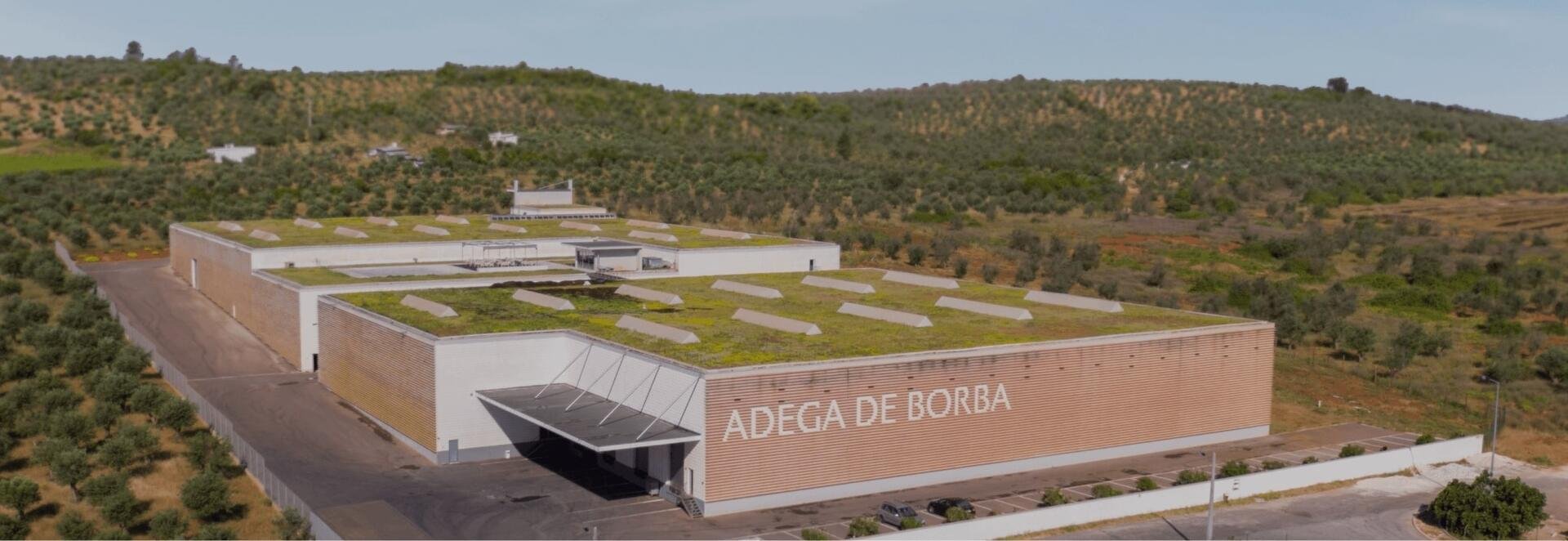
Adega Cooperativa de Borba sits at the centre of one of the Alentejo's most concentrated wine-producing towns, earning a Pearl 2 Star Prestige rating in 2025. The cooperative format channels fruit from across the Borba appellation into wines that read as a collective portrait of the region's granite and marble-flecked soils. For visitors tracing the Alentejo's winemaking character, it is a natural anchor point.
Borba's Marble Country and What It Means for the Glass
The town of Borba sits in a part of the Alentejo where marble is quarried from the ground and white limestone dust settles on vine leaves during dry summers. This is not incidental scenery. The same geological formations that have made Borba a centre of stone extraction for centuries also shape the mineral signature of its wines: soils dense with calcium carbonate, well-drained and heat-retentive, pushing vines to root deep and produce fruit with a structural firmness that distinguishes the Borba sub-appellation from its Alentejo neighbours. Approaching Largo Gago Coutinho e Sacadura Cabral, where the cooperative sits on a corner of one of the town's quieter squares, that geological context arrives before any wine is poured.
The Adega Cooperativa de Borba operates within a Portuguese winemaking tradition that is less fashionable to discuss than single-estate production but arguably more representative of how a region actually tastes. Cooperative wineries aggregate fruit from dozens of small growers, producing wines that reflect not one producer's micro-terroir but the appellation as a whole. In the Alentejo, where landholdings are fragmented and small-scale viticulture still forms the backbone of the agricultural economy, the cooperative model has historically been the mechanism through which a region's identity gets bottled. Our full Borba wineries guide maps how that tradition plays out across the town's producers.
The 2025 Pearl 2 Star Prestige Rating and What It Signals
In 2025, Adega Cooperativa de Borba received a Pearl 2 Star Prestige recognition, which places it among a tier of Portuguese producers acknowledged for consistent quality at scale. For a cooperative, this kind of credential carries a different weight than it would for a boutique estate: it reflects sustained performance across a range of styles and vintages, with fruit sourced from multiple growers rather than a single controlled vineyard block. The rating anchors the adega's position within Borba's competitive set, alongside estate producers who focus on single-variety or single-plot expressions. Where those producers offer depth in a narrow window, the cooperative offers breadth, a snapshot of the appellation's character drawn from many corners of the same landscape.
That breadth is worth taking seriously in the context of Alentejo winemaking. The region's native varieties, Aragonez, Trincadeira, Alicante Bouschet, and Antão Vaz among them, each respond differently to Borba's specific conditions. Aragonez, known elsewhere as Tempranillo, tends to produce wines here with more grip and less of the jammy softness it can show in warmer sub-zones. Trincadeira, when managed carefully in the intense Alentejo heat, delivers dark fruit with a spice character that owes something to the diurnal temperature swings the region experiences in autumn. A cooperative drawing on multiple growers gives it access to old vine material, varying expositions, and plot-level differences that a single estate cannot replicate by definition. For producers elsewhere in Portugal doing comparable work at scale, Bacalhôa Vinhos in Azeitão and Herdade do Esporão in Reguengos de Monsaraz offer instructive comparisons in how Alentejo-adjacent production addresses the tension between volume and terroir expression.
The Alentejo Cooperative in a Broader Portuguese Context
Portugal's cooperative winemaking sector has undergone a long, uneven rehabilitation over the past two decades. For much of the late twentieth century, cooperative production was synonymous with high yields, oxidised whites, and reds that traded freshness for bulk. The shift came gradually, driven partly by EU agricultural funding that modernised cellar equipment, and partly by a generational change in winemaking approaches across the country. In the Dão, the Vinho Verde region, and the Alentejo, cooperatives that invested in temperature-controlled fermentation and stricter sorting protocols began producing wines that held their own against estate labels at the same price point.
Borba's cooperative sits inside that revised narrative. Its position within the DOC Borba appellation, one of the eight demarcated sub-zones within the broader Alentejo DOC, means it works with grapes grown under a defined set of regulations governing varieties, yields, and ageing requirements. The sub-appellation structure matters here: Borba's designation is separate from neighbouring Redondo or Reguengos, and the differences in soil composition and altitude, however modest, are enough to produce wines with a distinct profile. This specificity of origin is what separates DOC Borba production from generic Alentejo regional wine, and it is why the cooperative model, when executed well, becomes a genuine expression of place rather than a generic product.
For visitors with a broader interest in Portuguese wine cooperatives and their evolution, the contrast with fortified wine traditions further north is instructive. The cooperative format in the Douro, where port production has always involved aggregation of fruit from across the valley, produced a different kind of institutional quality: Quinta do Bomfim in Pinhão and Quinta do Seixo in Tabuaço both demonstrate how individual quintas within that larger system developed distinct identities. In the Alentejo, the analogy holds: Borba's cooperative produces wines anchored to a specific appellation while drawing on the diversity of growers within it.
Visiting Borba and Planning Around the Adega
Borba is a small town, and its winemaking geography is compact enough to be covered on foot or by a short drive between sites. The cooperative's address on Largo Gago Coutinho e Sacadura Cabral places it within the town centre, accessible from the main through-road that connects Borba to Estremoz to the north and Vila Viçosa to the south. The Alentejo wine route links these towns, and a day that moves between them covers a meaningful cross-section of how the sub-appellation's character varies over a relatively small geographic area. Practical planning for the broader town, including accommodation and dining that sits alongside the winemaking visits, is covered in our full Borba restaurants guide, our full Borba hotels guide, and our full Borba bars guide.
Timing a visit to the Alentejo is worth considering carefully. The harvest window, typically late August through October depending on the variety and vintage conditions, represents the most active period in the cellar but also the most demanding for the teams running it. Spring visits, before the summer heat sets in fully, offer a more measured pace and the chance to assess wines from the previous vintage across multiple producers. The cooperative format means there is generally more wine available to taste across the range than would be the case at a single-estate producer with limited production, which makes the adega a practical anchor for a tasting itinerary. Our full Borba experiences guide covers additional context for building a visit around the region's winemaking calendar.
For comparison with Alentejo-adjacent producers whose output addresses similar questions of scale and appellation identity, Adega Cartuxa in Évora offers a useful reference point in how institutional winemaking in the region balances heritage with technical precision. Further afield, Abadía Retuerta in Sardón de Duero and Blandy's Wine Lodge in Funchal each represent how appellation-level production, whether in Iberian table wine or Madeira, builds institutional credibility over time through consistent territorial expression rather than individual auteur statements. The cooperative in Borba belongs to the same conversation, with its 2025 Pearl 2 Star Prestige recognition as the current external marker of where it sits within that tradition.
Frequently Asked Questions
- What's the vibe at Adega Cooperativa de Borba?
- The adega operates as a working cooperative in a small Alentejo market town, which means the atmosphere is functional and rooted in local winemaking culture rather than tourist-oriented hospitality. Borba is a compact town where marble quarrying and vine-growing have historically run in parallel, and the cooperative sits within that working-town context. Its 2025 Pearl 2 Star Prestige recognition confirms it is taken seriously within Portuguese wine circles, though pricing and format details are not publicly listed.
- What's the must-try wine at Adega Cooperativa de Borba?
- Specific current releases are not confirmed in available data, so naming a single wine would be speculative. What is documented is that the cooperative draws on the DOC Borba sub-appellation, where Aragonez and Trincadeira are the dominant red varieties and the marble-dense soils produce wines with structural firmness and mineral character. The 2025 Pearl 2 Star Prestige rating covers the adega's overall output, suggesting the range rather than a single bottle is the relevant unit of quality. Visiting and tasting across the portfolio is the more reliable approach than relying on a single recommended label.
- What's the standout thing about Adega Cooperativa de Borba?
- The standout element is the combination of appellation specificity and cooperative scale. A Pearl 2 Star Prestige rating in 2025 for a cooperative producer is a meaningful credential: it reflects consistent quality across a range assembled from multiple growers within the Borba sub-appellation, rather than a single estate's controlled output. Borba's marble and limestone soils give the wines a measurable terroir signature, and the cooperative model means that signature is drawn from a wider cross-section of the appellation than any single producer can access.
- Can I walk in to Adega Cooperativa de Borba?
- The cooperative is located at Largo Gago Coutinho e Sacadura Cabral 25 in the centre of Borba, making it physically accessible without advance transport planning. Phone and website details are not currently listed in available data, so confirming opening hours or tasting availability before arriving is advisable through local tourism channels or on-site inquiry. The Pearl 2 Star Prestige recognition in 2025 confirms it is an active, quality-acknowledged producer, but visit logistics are leading verified directly given the absence of published contact information.
- How does Adega Cooperativa de Borba fit into the DOC Borba appellation relative to single-estate producers in the same sub-zone?
- As a cooperative, the adega aggregates fruit from multiple growers across the Borba sub-appellation rather than producing from a single controlled estate, which means its wines represent a broader cross-section of the appellation's soils and expositions than most individual producers can offer. The DOC Borba designation requires adherence to defined variety, yield, and ageing standards, so both cooperative and estate wines operate within the same regulatory framework. The cooperative's 2025 Pearl 2 Star Prestige recognition places it within the quality tier of the sub-appellation's acknowledged producers. For a more complete picture of the Borba winemaking scene, our full Borba wineries guide maps the range of estate and cooperative production across the town.
At-a-Glance Comparison
These are the closest comparables we have in our database for quick context.
| Venue | Classification | Awards | First Vintage | Notes |
|---|---|---|---|---|
| Adega Cooperativa de Borba | 1 awards | This venue | ||
| Quinta do Bomfim | World's 50 Best | |||
| Quinta do Seixo (Sandeman), Douro Valley | World's 50 Best | |||
| Quinta do Vallado | World's 50 Best | |||
| Graham's Port | World's 50 Best | |||
| Herdade do Esporão | World's 50 Best |
Access the Cellar?
Our members enjoy exclusive access to private tastings and priority allocations from the world's most sought-after producers.
Access the Concierge