

Among the Douro Valley's Port producers, Quinta do Noval holds some of the oldest terraced vineyards along the river's steep slopes above Pinhão. Awarded Pearl 4 Star Prestige in 2025, it sits in a category defined by heritage vine stock and serious critical standing. Travellers who visit for the landscape alone rarely leave without a deeper understanding of what age and altitude do to a vine.
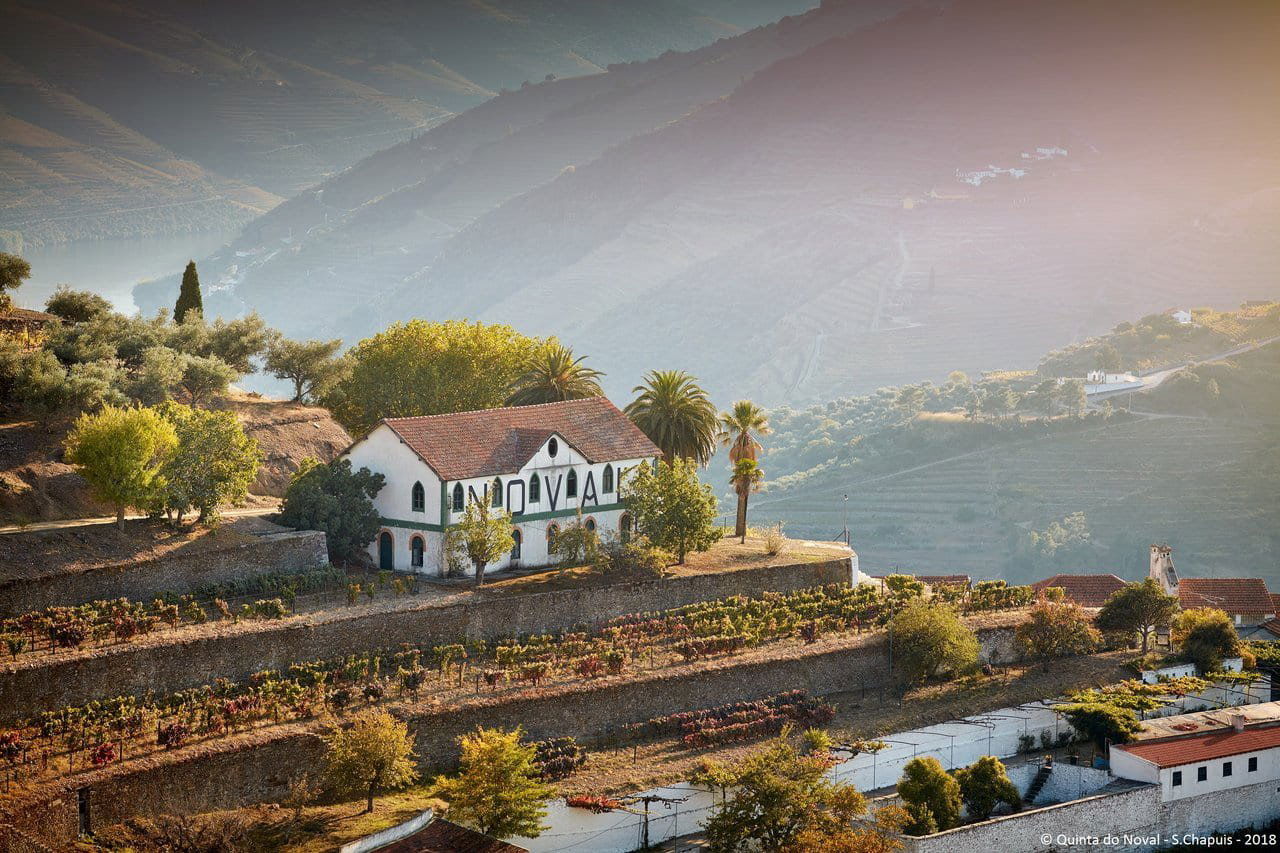
Where the Terraces Begin to Tell a Story
Approaching Pinhão from the Douro line, the river bends and the valley opens. The schist walls holding the terraced vineyards in place are not a backdrop — they are the architecture. Quinta do Noval's plots sit among the oldest on these slopes, and that age is visible: gnarly, low-trained vines with root systems that have had decades, in some cases well over a century, to force themselves through fractured rock in search of water. The physical landscape here is not incidental to the wine. It is the wine's primary argument.
The Douro's upper reaches, particularly the Cima Corgo subregion around Pinhão, have long been understood as the valley's most concentrated source of Port material. The altitude variation is steep, the diurnal temperature swings are significant, and the schist soils drain aggressively, forcing vines to produce small, intensely flavoured berries. Quinta do Noval's terraces sit within that broader logic, and the EP Club Pearl 4 Star Prestige rating awarded in 2025 reflects a standing consistent with the upper tier of Douro heritage producers.
The Terroir Argument in This Part of the Valley
Port production in the Douro is formally regulated through the Benefício system, which assigns a letter grade to each plot based on altitude, vine age, gradient, and other factors. Old vines carry particular weight in this calculus: they tend toward lower yields and more concentrated must, which translates directly into permitted Port production quotas. Quinta do Noval's vine age is not a marketing detail — it functions as a structural advantage inside a regulatory framework that rewards exactly that kind of stock.
The Douro's major quintas broadly divide into two models: those integrated into large shippers with significant annual volume targets, and those operating at smaller scale with more selective release patterns. Noval occupies a position closer to the latter cohort, where individual vineyard blocks, specific vine populations, and longer ageing cycles become the primary differentiators. Across the river and along the same stretch of valley, estates like Quinta do Bomfim and Quinta da Roêda (Croft) operate within major shipper structures; the competitive conversation around Noval tends to sit at a different register.
Reading the Landscape: What the Terraces Signal
The terraced form of viticulture in the Douro is not an aesthetic choice , it is the only way to farm these slopes without catastrophic erosion. The engineering of schist walls dates back centuries, and many of the original terrace structures remain in use. More recent interventions in parts of the Douro have introduced patamares, wider mechanised terraces that allow tractor access but reduce vine density and alter drainage patterns. The presence of older, narrow socalcos (the original hand-built terraces) at a quinta is generally an indicator of older vine material and a commitment to hand-harvesting, which carries cost implications and, most proponents argue, quality implications.
Quinta do Noval's terraces along the schist slopes above the Douro represent that older tradition. The view from within or above those terraces , looking across to the far bank, where vineyards on different aspects catch light differently through the day , is the kind of scene that has made the Douro a UNESCO World Heritage landscape. Quinta das Carvalhas, perched high on the opposite bank, offers a contrasting perspective from altitude. The valley reads differently depending on where you stand within it.
Pinhão as a Base and What the Region Offers
Pinhão itself is a small riverside town with a train station whose azulejo tile panels , hand-painted scenes of the harvest , function as an accidental museum of early 20th-century Douro life. The town sits at the confluence of the Pinhão river and the Douro, and the density of named quintas within walking or short driving distance is concentrated enough to structure several days of visits around this single base. Quinta do Noval's address on Rua da Praia puts it directly in the town's riverside zone.
For travellers planning time in the area, our full Pinhão wineries guide covers the broader field of producers accessible from the town. Pinhão's restaurant and bar infrastructure is limited relative to Porto or the Douro's more developed tourist infrastructure, but the quality of table wine served locally , often from producers with no significant export presence , is one of the region's overlooked pleasures. Our full Pinhão restaurants guide maps what's available, alongside our full Pinhão bars guide and our full Pinhão hotels guide for accommodation in the immediate area. For non-wine activities, our full Pinhão experiences guide covers boat trips, hiking routes, and vineyard access points across the Cima Corgo.
Where Quinta do Noval Sits in the Wider Portuguese Wine Conversation
Portugal's wine geography rewards producers who operate across multiple appellations and traditions. The Douro Valley's Port heritage is the country's most internationally recognised, but it sits alongside producers in very different registers: Bacalhôa Vinhos in Azeitão works the Setúbal Peninsula's distinct conditions, while Herdade do Esporão in Reguengos de Monsaraz represents the Alentejo's quite different approach to scale and table wine production. The Douro's fortified tradition, which Noval represents at the heritage end, has no real equivalent elsewhere in Portugal.
Beyond Portugal, the comparison points for serious Port producers are limited: Madeira's oxidative tradition (see Blandy's Wine Lodge in Funchal for that register) and a handful of fortified traditions in Spain and beyond. For visitors coming from Porto and planning to extend their understanding of the Douro further east, Quinta do Seixo (Sandeman) in Tabuaço and Churchill's in Vila Nova de Gaia offer different entry points into the same tradition. For a completely different kind of estate winery experience, Abadía Retuerta in Sardón de Duero across the Spanish border operates in a format that has more in common with grand hotel estates than with Port quintas. And for those whose interest in aged, complex spirits extends beyond wine, Aberlour in Aberlour represents a parallel tradition of maturation and heritage in Speyside.
Planning a Visit
Quinta do Noval's address at R. da Praia 15, 5085-042 Pinhão, places it within the town itself, accessible by the scenic Douro railway line from Porto (approximately two hours, with a change at Régua for some services) or by car along the N222, which runs the southern bank of the river. Booking arrangements and visit formats should be confirmed directly with the quinta, as tasting room access and tour availability at Douro estates varies by season and is often subject to advance arrangement. The harvest period from late September into October is the most active time on the estate and across the valley, but it is also when access for casual visitors is most constrained. Spring visits, when the vine growth is at its most vivid and temperatures are manageable, offer a different read on the landscape.
Frequently Asked Questions
What is the signature bottle at Quinta do Noval?
Quinta do Noval is known within the Port trade for a specific vineyard parcel planted with ungrafted pre-phylloxera vines, which produces a wine released under the Nacional label in declared vintages. This is among the rarest allocations in Port production globally, with quantities in most declarations running to only a few hundred cases. The quinta also produces Vintage Port across its main vineyard in declared years, alongside aged tawny and colheita styles that reflect the Douro's extended cask-ageing tradition.
What is the main draw of Quinta do Noval?
The combination of vine age, terrace heritage, and the EP Club Pearl 4 Star Prestige recognition (2025) places Quinta do Noval in the upper bracket of Douro heritage producers accessible from Pinhão. For visitors to the valley, the estate represents an opportunity to engage with Port production at the point where history and current critical standing converge, in a landscape that itself carries UNESCO World Heritage status.
Is Quinta do Noval reservation-only?
Like most serious Douro quintas, Quinta do Noval operates visits through prior arrangement rather than walk-in access. Contact details and current visit formats are leading confirmed through the quinta's official channels, as schedules vary by season and year. Planning ahead is advisable, particularly during the harvest period and peak summer months when availability across all Douro estates tightens.
What kind of traveller is Quinta do Noval a good fit for?
If your interest is in vine-age provenance, the mechanics of Port classification, and the physical character of one of Europe's most geologically distinct wine landscapes, Quinta do Noval addresses that interest at a serious level. The Pearl 4 Star Prestige rating from EP Club (2025) signals a property that rewards visitors who arrive with some knowledge of the category rather than those seeking a broad, introductory tasting format. It fits within a Pinhão-based itinerary that might also include estates like Quinta do Bomfim and Quinta das Carvalhas for comparative reference across the valley.
How old are the vines at Quinta do Noval, and why does vine age matter for Port?
Quinta do Noval holds some of the Douro Valley's oldest terraced vine stock, including a plot of ungrafted pre-phylloxera vines that survived the late 19th-century phylloxera epidemic that destroyed most of Europe's vineyards. In Port production, old vines are valued for their naturally lower yields and the concentration they bring to the must, and the Douro's Benefício regulatory system formally rewards vine age through higher classification scores. This makes vine age at a quinta like Noval both a quality argument and a regulatory asset, rather than simply a heritage narrative.
A Tight Comparison
Comparable options at a glance, pulled from our tracked venues.
| Venue | Classification | Awards | First Vintage | Notes |
|---|---|---|---|---|
| Quinta do Noval | World's 50 Best | This venue | ||
| Quinta do Bomfim | World's 50 Best | |||
| Quinta da Roêda (Croft) | 1 awards | |||
| Quinta das Carvalhas | 1 awards |
Access the Cellar?
Our members enjoy exclusive access to private tastings and priority allocations from the world's most sought-after producers.
Access the Concierge