
Quinta da Roêda sits on one of the Douro Valley's most studied schist slopes above Pinhão, where Croft has farmed Port grapes for generations. Awarded Pearl 2 Star Prestige in 2025, the estate offers a direct encounter with the terroir that defines single-quinta Port at its most geologically expressive. For wine travellers tracing the valley's upper reaches, it belongs on the itinerary.
Schist, Slope, and the Douro's Upper Grammar
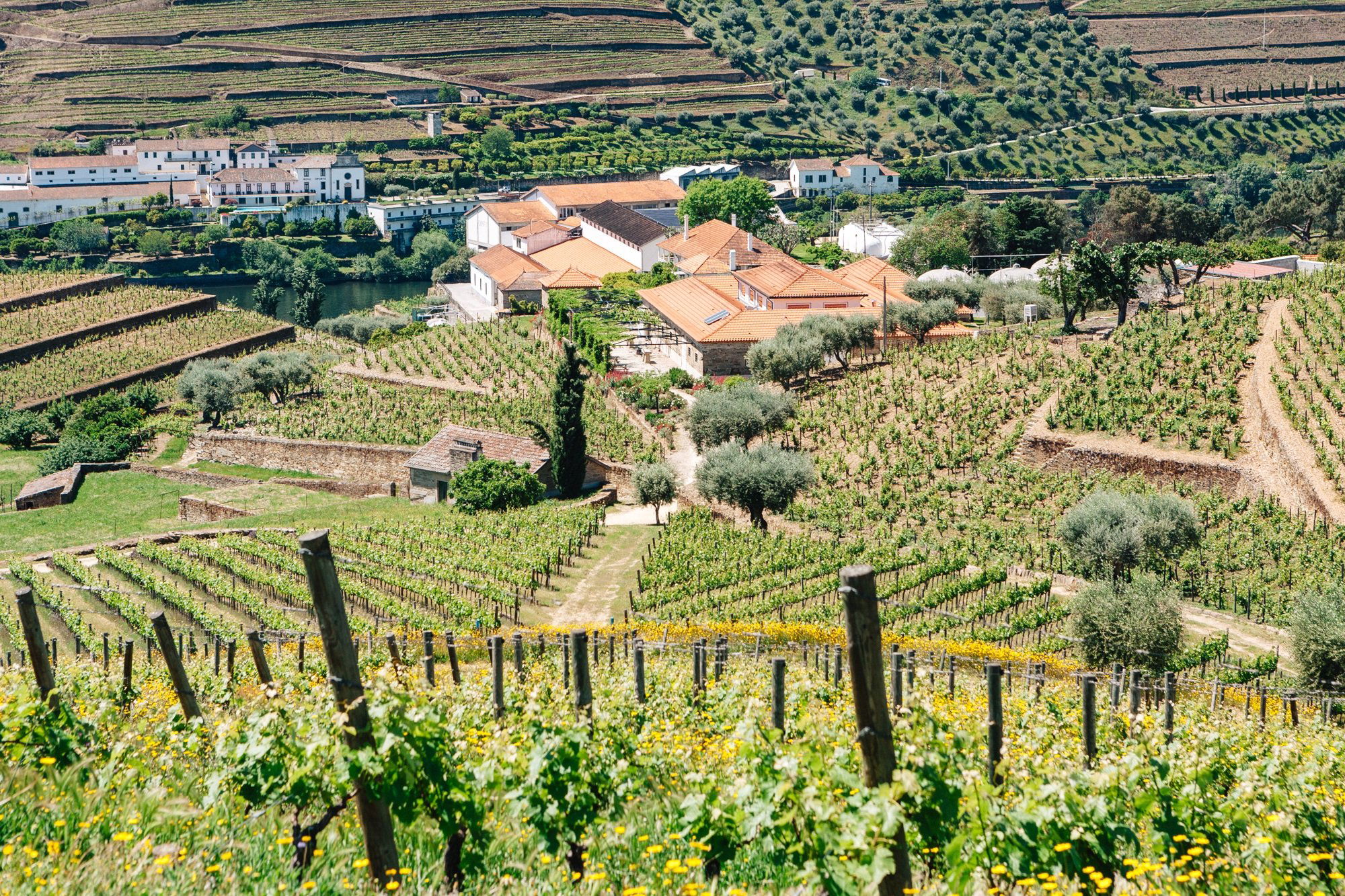
Approach Quinta da Roêda from the N323 and the valley does the work of orientation before you arrive. The road follows the Douro's northern bank past terraced vineyards stacked in precise horizontal lines against near-vertical hillsides, and the schist that defines this geology — thin, flaking, heat-retaining, brutally poor in organic matter — is visible in every exposed cut of soil. This is what Port grapes grow in, and what makes Pinhão and its immediate surrounds the reference point for understanding why Douro wine tastes the way it does. Quinta da Roêda, managed by Croft and addressed on the N323 just outside Pinhão, sits within that context as one of the valley's named single-quinta estates: a property where the growing conditions are specific, documented, and traceable through the wine in the glass.
The estate earned a Pearl 2 Star Prestige award in 2025, a signal that places it in a tier of Douro wineries where the combination of site quality, production standard, and visitor experience clears a threshold most properties in the region do not reach. That recognition is worth noting not as a marketing credential but as a comparative calibration: Roêda sits in the same prestige peer set as other recognised single-quinta estates along the valley, and it competes on the terms that matter to serious wine travellers , vineyard pedigree, house lineage, and the specificity of what a named site produces.
What Schist Does to a Wine
The Douro's terroir argument runs on geology more than climate, though both are extreme. Schist forces vine roots deep in search of water and mineral nutrition, restricting yields and concentrating flavour in ways that more fertile soils cannot replicate. The result, across the valley's leading sites, is Port and Douro wine with a particular density and structural grip that owes as much to the rock beneath the topsoil as to the grape varieties grown above it. Touriga Nacional, Touriga Franca, and Tinta Roriz , the core Douro varieties , behave differently on schist than on granite or clay, producing wines with more aromatic precision and less softness in the mid-palate.
Roêda's position on the northern bank of the Douro, in the sub-region centred on Pinhão, places it where these conditions are at their most concentrated. The Douro Superior and Baixo Corgo flank this central Cima Corgo zone, but it is the Cima Corgo that wine houses have historically prioritised for their finest quintas, and the geographical clustering of named estates around Pinhão reflects that accumulated judgment. When Croft works with Roêda's fruit to produce single-quinta vintage Port, the schist origin is the argument being made , the claim that a specific place, managed consistently over time, produces something that blending across multiple sites cannot.
Roêda in the Single-Quinta Conversation
The Douro's single-quinta category has grown considerably since the 1980s, when a handful of houses began releasing vintage declarations from named properties in years that did not meet the threshold for universal declaration. What started as a second-tier product , a way to bottle good wine from strong vintages without the commercial weight of a full declaration , has evolved into a distinct category with its own following. Collectors who track single-quinta releases are often more interested in place-specific expression than in the prestige of a universally declared vintage, and estates like Roêda serve that interest directly.
Among Pinhão-area quintas, the comparisons are instructive. Quinta do Noval, with its Nacional plot of ungrafted vines, occupies a category largely its own. Quinta do Bomfim and Quinta das Carvalhas offer their own expressions of valley terroir and visitor programmes that draw wine travellers into a direct comparison of site character. Roêda's particular value in this peer group is the Croft lineage , a house with centuries of Port production history , attached to a named estate that can be walked, tasted, and assessed against that house tradition.
Further afield, the Douro's wider circle of recognised estates includes Quinta do Seixo (Sandeman) in Tabuaço, which sits on the valley's southern bank and offers a useful counterpoint in terms of aspect and microclimate. For wine travellers who want a broader Portuguese comparison outside the Douro entirely, Bacalhôa Vinhos in Azeitão and Herdade do Esporão in Reguengos de Monsaraz provide Setúbal and Alentejo reference points against which the Douro's schist-driven character reads most clearly.
Planning a Visit to Pinhão
The practical logic of visiting Quinta da Roêda runs through Pinhão, the small riverside town that serves as the organisational centre for upper Douro wine tourism. The town itself is a short drive from the estate along the N323, and the majority of serious wine travellers use Pinhão as a base for multi-day exploration of the valley's northern bank quintas. Accommodation options in the area range from converted estate guesthouses to smaller riverside hotels; the full Pinhão hotels guide maps the current options by location and style.
The optimal visiting window for the Douro runs from late spring through early autumn. The harvest period in late September and early October brings the most visible activity across the valley's quintas , treading tanks, filled lodges, the concentrated smell of fermenting must , but summer visits carry the advantage of full vine canopy and the Douro's characteristic heat, which makes the schist's thermal properties legible in the landscape itself. Winter visits are quieter and cooler, with stripped vines and a different visual argument for the valley's severity.
Visitors exploring beyond Roêda will find the Pinhão area supports a full programme. The Pinhão wineries guide covers the valley's current estate lineup in detail. For meals and bars anchored to the town itself, the Pinhão restaurants guide and Pinhão bars guide provide current recommendations. The Pinhão experiences guide covers boat trips, walking itineraries, and other formats for engaging with the valley's landscape more directly than a cellar visit allows.
For travellers building a broader Portuguese wine itinerary, Roêda's prestige positioning makes it a natural anchor for a Douro segment that also takes in Churchill's in Vila Nova de Gaia or Blandy's Wine Lodge in Funchal for the contrast between valley production and coastal or island ageing. Those who want to extend the itinerary into Iberia more broadly might compare the Douro's schist character against the limestone and clay of Abadía Retuerta in Sardón de Duero; or, for a complete change of register, against the peat and copper of Aberlour in Aberlour, where terroir expression operates through an entirely different set of variables.
The Estate as Argument
What a visit to Quinta da Roêda ultimately offers is a direct encounter with the proposition that place matters in Port production. The schist, the slope aspect, the altitude, the specific sub-regional position within the Cima Corgo , these are not decorative context. They are the technical explanation for why the wine tastes the way it does, and the estate makes that argument legible in a way that a bottle alone cannot. The 2025 Pearl 2 Star Prestige recognition confirms that Roêda operates at a level where the quality case holds under scrutiny from evaluators who work across the full spectrum of Portuguese wine properties. For visitors who want to understand single-quinta Port as a category rather than simply consume it, this is one of the Douro's clearer classrooms.
Frequently Asked Questions
- What do visitors recommend trying at Quinta da Roêda (Croft)?
- The estate's core interest lies in its single-quinta Port production, where Croft's house approach to the Douro's native varieties , Touriga Nacional, Touriga Franca, and Tinta Roriz among them , is expressed through the specific character of Roêda's schist terroir in the Cima Corgo sub-region. In years of single-quinta declaration, those wines represent the most direct argument for what the site produces. The estate earned Pearl 2 Star Prestige in 2025, which positions it among the Douro's recognised prestige properties.
- What's the standout thing about Quinta da Roêda (Croft)?
- The combination of Croft's historic Port house lineage and a named single-quinta estate with a specific, traceable terroir argument sets Roêda apart from generic Douro wine tourism. Its 2025 Pearl 2 Star Prestige award places it in a defined prestige tier. Located on the N323 near Pinhão, the estate is positioned in the Douro's most concentrated zone for named quinta estates.
- Should I book Quinta da Roêda (Croft) in advance?
- Given that the estate carries Pearl 2 Star Prestige recognition for 2025 and sits in one of the Douro's highest-traffic wine tourism zones around Pinhão, advance contact is advisable, particularly during the September-October harvest period when demand across all valley quintas is at its peak. Booking details are leading confirmed directly through Croft's main channels, as specific contact information for the quinta is not publicly listed here.
- What's the leading use case for Quinta da Roêda (Croft)?
- If you are a wine traveller specifically interested in schist-driven single-quinta Port and want to understand how a named Douro estate expresses its terroir through a major house's production, Roêda is well-suited. The 2025 Pearl 2 Star Prestige award confirms its standing as a serious estate visit rather than a casual tourism stop. It is less suited to visitors seeking a full hospitality or gastronomy experience, as the estate's primary offer is viticultural and oenological rather than lifestyle-oriented.
- How does Quinta da Roêda compare to other Croft Port expressions?
- Roêda functions as Croft's single-quinta statement: a site-specific declaration that differs from the house's blended vintage Ports by anchoring every bottle to one property's geology and microclimate. The estate's Cima Corgo position near Pinhão places it in the Douro's most historically prestigious sub-region for Port production, and its 2025 Pearl 2 Star Prestige recognition confirms that the quality argument holds at a level that evaluators measure against the full peer set of Portuguese wine estates. For drinkers who want to trace the difference between house-style blending and single-site expression within a single Port producer, Roêda provides the clearest point of comparison within the Croft range.
Accolades, Compared
These are the closest comparables we have in our database for quick context.
| Venue | Classification | Awards | First Vintage | Notes |
|---|---|---|---|---|
| Quinta da Roêda (Croft) | 1 awards | This venue | ||
| Quinta do Bomfim | World's 50 Best | |||
| Quinta das Carvalhas | 1 awards | |||
| Quinta do Noval | World's 50 Best |
Access the Cellar?
Our members enjoy exclusive access to private tastings and priority allocations from the world's most sought-after producers.
Access the Concierge