Erste Markgräfler Winzergenossenschaft Schliengen-Müllheim

Falstaff Winery - Listed
A large, historic Baden cooperative in Schliengen, Erste Markgräfler Winzergenossenschaft Schliengen-Müllheim is strongest as a lens on Markgräflerland wine culture rather than as a boutique estate visit. Its scale, 1908 founding, roughly 200 member-growers, and focus on Spätburgunder, Gutedel, Müller-Thurgau and Grauburgunder make it a useful stop for understanding how southern Baden turns warm climate and varied vineyard holdings into accessible regional wine.

The approach is not the theatre of a small family domaine. This is cooperative wine country in practical form: cellar infrastructure, a wine-market rhythm, and the quiet efficiency of a place built to receive fruit from many hands rather than perform intimacy for visitors. In Markgräflerland, that matters. Southern Baden’s wine identity has long depended on village-scale growers, warm conditions, and varieties that speak more clearly through regional habits than through a single auteur narrative.
Erste Markgräfler Winzergenossenschaft Schliengen-Müllheim belongs to that tradition. Founded in 1908, it gathers around 200 members and works from roughly 250 hectares of vineyards, with annual production of about two million litres. Those figures put the experience in a different category from a small cellar-door tasting: the interest is in how a cooperative translates many parcels and many growers into a consistent Baden idiom.
Markgräflerland seen through cooperative scale
Baden is Germany’s warm-climate counterpoint, and Markgräflerland sits at the southern end of that story. The region is closely associated with Gutedel, the local name for Chasselas, alongside Spätburgunder, Müller-Thurgau and the Burgundian white varieties that have become central to Baden’s modern offer. Volcanic-influenced soils and a sunny growing season give the wines their regional frame: ripeness without needing to chase weight, and acidity that keeps the whites direct rather than broad.
The cooperative model changes the way terroir is expressed. A single estate often asks the drinker to read one family’s parcels and cellar decisions. A large cooperative asks a different question: can a region’s growers, spread across many holdings, create a reliable shared accent? Here, the answer sits in breadth. Still red, still white, rosé and sparkling wines all appear in the range, which makes the portfolio less a narrow statement than a working map of local drinking culture.
The production language is conventional and functional rather than experimental. That is not a criticism. In a region where Gutedel can be at its strongest as a table wine and Spätburgunder benefits from clarity, controlled cellar work often serves the place better than cellar theatrics. Stainless-steel fermentation and lees handling are part of the documented approach for the Baden Spätburgunder, pointing toward fruit definition, texture and a clean regional profile rather than a heavy oak signature.
What the glass is trying to explain
Useful way to read this portfolio is by variety first, then by scale. Gutedel is the cultural anchor: a southern Baden staple that rarely behaves like a trophy grape but tells a great deal about local appetite, food habits and climate. Spätburgunder provides the red-wine argument, especially in Baden, where Pinot Noir has moved beyond light local red into a serious regional category. Müller-Thurgau and Grauburgunder fill out the everyday side of the range, where freshness, price discipline and recognisable varietal character matter.
Named “Für mich 100% Baden Spätburgunder” is the clearest documented example of the cooperative’s red-wine style. It is a single-varietal Baden Pinot Noir made with stainless-steel fermentation and maturation on fine lees for several months. That technical choice is revealing: it places the wine closer to a fruit-led, texture-conscious Baden expression than to a barrel-dominated red. In practical terms, this is the kind of wine that explains why Baden Pinot has gained traction with drinkers who want ripeness and grip without the heaviness that can flatten the variety.
“Das ist 100% Baden” line, marked by a peacock emblem, gives the range a higher-tier regional signal. In cooperative terms, that sort of line matters because it separates everyday production from more selective bottlings without abandoning the collective identity. The point is not scarcity theatre; it is a way for a broad producer to show that Baden’s cooperative sector can work above simple volume wine.
Recognition here is more regional and trade-facing than award-led. A Falstaff listing for a 2014 Muskateller Trocken gives the winery an external critical reference, while regional press attention has focused on its premium line and its role in the Baden wine scene. The stronger trust signal, though, is structural: a cooperative founded in 1908, operating at significant vineyard scale, in a subregion with a deeply rooted wine economy.
A practical stop for understanding Schliengen wine
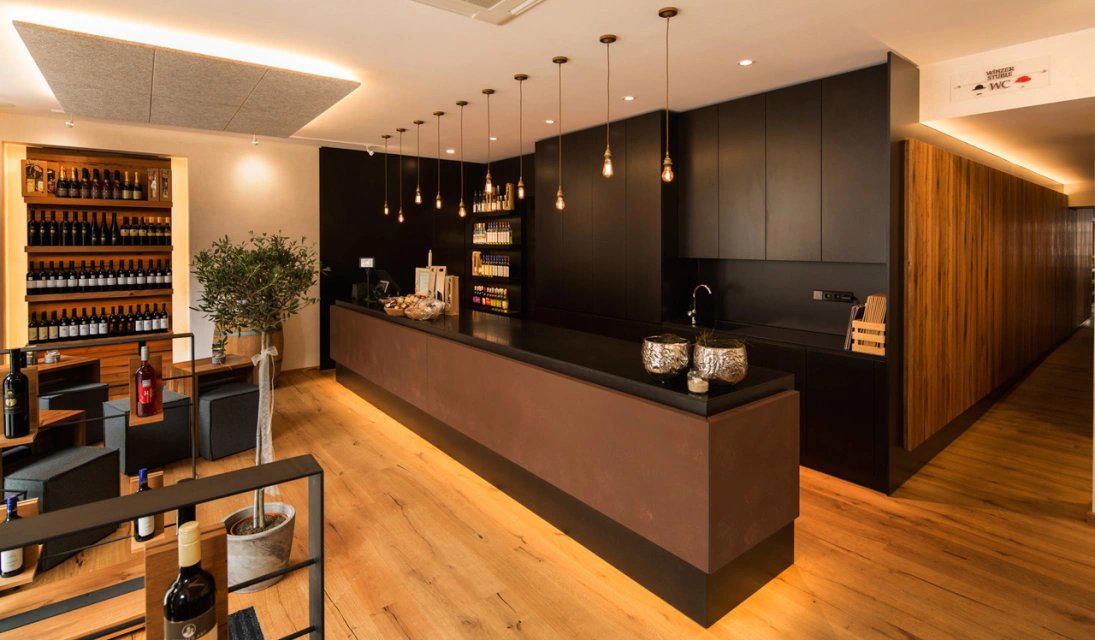
The setting is classic and industrial, with a quiet, functional character rather than a resort-style tasting-room mood. That makes it better suited to drinkers who want orientation in local varieties, groups looking for wine education, or travellers using Schliengen as a base for Baden wine rather than those seeking a highly choreographed hospitality experience. On-site parking and a stand-up bar format reinforce the idea of a working wine market: efficient, direct, and more useful than ornamental.
The 2023 fire that destroyed stored bottled wine valued at up to €2 million is part of the recent operational context, not a romantic footnote. For a cooperative of this size, storage and distribution are not backstage details; they are central to how growers get wine into market. The subsequent relationship with Markgräfler Winzer eG for sales and distribution fits a broader pattern in European cooperative wine: shared infrastructure can be as important as vineyard holdings.
Travellers building a Schliengen wine itinerary should treat this stop as the large-format cooperative reference point, then widen the frame through smaller local producers and regional guides. Useful nearby reading includes Weingut Blankenhorn, Weingut Büchin, Weingut Greiner, Weingut Harteneck and Weingut Zimmermann. For broader planning, see our full Schliengen wineries guide, along with our full Schliengen restaurants guide, our full Schliengen hotels guide, our full Schliengen bars guide and our full Schliengen experiences guide. Further afield, the wider German-speaking wine map includes & Handwein in Mannheim, 2 Naturkinder in Kitzingen, 3 Winner in Bechtheim, »der Steiner« Hans Steiner in Podersdorf am See and ®walzer in Gneixendorf Bei Krems.
Frequently asked questions
What's the vibe at Erste Markgräfler Winzergenossenschaft Schliengen-Müllheim?
The mood is quiet, classic, and industrial, with a functional cellar and production facility in Schliengen, Baden. It feels built for wine rather than theatre, which suits a cooperative founded in 1908.
How pricey is Erste Markgräfler Winzergenossenschaft Schliengen-Müllheim?
Pricing at Erste Markgräfler Winzergenossenschaft Schliengen-Müllheim is listed as $$.
Where can I find Erste Markgräfler Winzergenossenschaft Schliengen-Müllheim?
Erste Markgräfler Winzergenossenschaft Schliengen-Müllheim is located at Schliengen, Baden, Baden-Wuerttemberg, Deutschland, Schliengen.
What's Erste Markgräfler Winzergenossenschaft Schliengen-Müllheim best at?
It is strongest as a working introduction to Markgräflerland wine, especially Gutedel alongside Spätburgunder, Müller-Thurgau, and Grauburgunder. The scale matters too: around 200 members and roughly 250 hectares give the range real regional weight.
Can I walk in to Erste Markgräfler Winzergenossenschaft Schliengen-Müllheim?
Yes, the venue is walk-in friendly and uses a stand-up bar format. That makes it easy to drop in at Schliengen, with on-site parking available for practical access.
What's the best use case for Erste Markgräfler Winzergenossenschaft Schliengen-Müllheim?
It works well for wine education, group outings, and corporate visits, especially if the aim is to understand Baden through a cooperative lens. The large-capacity setup and vineyard setting around Schliengen-Müllheim support that kind of visit.
What's a smart way to approach Erste Markgräfler Winzergenossenschaft Schliengen-Müllheim?
Start with the region's core grapes, especially Gutedel, then move to the red and white still wines for comparison. Keep the visit practical rather than leisurely: this is a production-focused cooperative in Schliengen, not a boutique estate.
Recognition history
Dated appearances from independent guides and award organizations, with the underlying list record or original source where available.
Falstaff Winery - Listed
Falstaff
Request a visit to Erste Markgräfler Winzergenossenschaft Schliengen-Müllheim
Tell us when you would like to go and how many people, and we put the request to the estate and reply to you by email.
Continue exploring
More in Schliengen
Wineries in Schliengen
All wineries in Schliengen →
Bars in Schliengen
Browse all →

Details
- Classic
- Industrial
- Group Outing
- Wine Education
- Corporate Event
- Estate Grounds
- Historic Building
- Vineyard
- Spätburgunder
- Gutedel
- Müller Thurgau
- Grauburgunder
- Still Red
- Still White
- Still Rosé
- Sparkling
- Stand Up Bar