
Falstaff Winery - 1 Stars
Ego Bodegas belongs to Jumilla’s newer Monastrell story: dry heat, calcareous soils and a producer founded in 2011 with a focused red-wine identity. The appeal is not grand hospitality theatre but the way Murcia’s arid wine country translates into structured, full-bodied still reds, including vegan-certified bottlings such as Goru Verde.

Pearl is the En Primeur Club membership app — saves, bookings, and concierge access live there. Same editors, same standards.
- Address
- Valle Hoya de Torres s/n, 30520 Jumilla, Murcia, Spain
- Phone
- +34 868 68 09 39
- Hours
- Mon–Fri 7 am–3 pmSat–Sun Closed
- Website
- egobodegas.com
- Directions
- Get directions

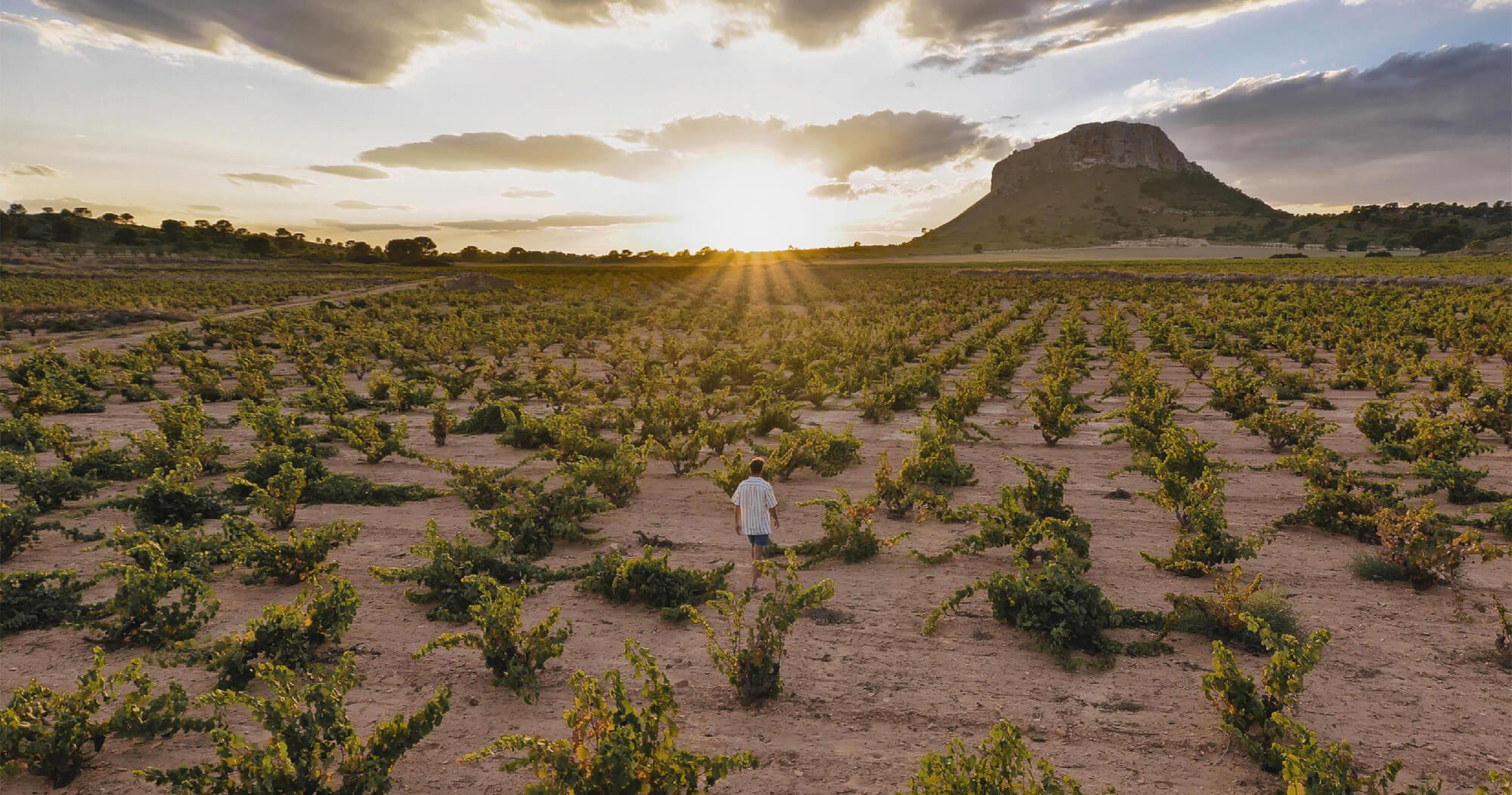
The approach to Jumilla wine country is not a soft pastoral prelude. Murcia’s inland vineyards sit under hard light, dry air, pale soils and a climate that makes vines work for every berry. That severity is the point. In southeastern Spain, Monastrell is the regional argument: thick-skinned, heat-adapted and able to carry alcohol, colour and tannin without a cosmetic international blend.
Ego Bodegas fits that contemporary Jumilla reading. Founded in 2011, it belongs to the appellation’s newer producer class rather than its old-estate lineage, with a clear focus: Monastrell-based still red wine from a region where the grape dominates plantings. Murcia’s wine conversation is often overshadowed by Spain’s louder regions, but Jumilla has a defined identity: its Denominación de Origen dates to 1966, and its continental-Mediterranean climate, low rainfall and long sunshine hours give the wines a different register from cooler Atlantic or high-altitude northern Spain.
For a Murcia wine itinerary, distinguish hospitality-led estates from producers centred on the bottle. Ego Bodegas sits closer to the latter: vineyard country near Jumilla, appointment only, and an editorial case built on terroir translation rather than restaurant-style service. For a wider regional frame, keep Our full Murcia wineries guide nearby, then cross-check the city’s travel texture through Our full Murcia restaurants guide, Our full Murcia hotels guide, Our full Murcia bars guide and Our full Murcia experiences guide.
Jumilla's heat writes the structure of the wine
Jumilla’s defining facts are agricultural before aesthetic. The region straddles Murcia and Albacete, with arid conditions, more than 3,000 hours of sunshine in a typical year and rainfall around 300 L/m². Vines face hot summers, cold winters, drought pressure and occasional violent rain. Monastrell handles that stress better than many varieties, producing small, concentrated bunches with thick skins and enough acidity to keep full-bodied reds from feeling shapeless.
Soils explain why the wines can be forceful without being merely heavy. Jumilla’s dark calcareous soils, often poor in organic matter and marked by caliche, retain moisture while encouraging deep roots. Sandy composition and high pH contribute to the region’s viticultural resilience, including natural resistance to phylloxera in some sites. Ego Bodegas works inside that grammar: sun, drought, limestone, Monastrell. The category is not delicate red wine. It is dry, structured, colour-saturated Murcia red, for drinkers who understand ripeness as regional condition, not winemaking accident.
Goru Verde 2021 is a useful reference point: a 100% Monastrell still red with 14% alcohol, full body and cork closure. Those facts say more than tasting adjectives: varietal purity, Mediterranean ripeness and a conventional red-wine format expressing Jumilla’s core grape without disguise. Decanter has listed Goru Verde 2021 as a premium tasting, while Wine Casual described an earlier Goru Verde 2013 as “full-throttle Monastrell,” placing it neatly in the region’s power-led tradition.
A modern Monastrell portfolio, with vegan certification as a real marker
Spain’s wine regions often split between inherited prestige and producers using clearer labels, digital reach and export-facing portfolios to reach drinkers who do not buy by appellation memory alone. Ego Bodegas belongs to the newer group. Its name is a direct brand statement, and its range is organised around Monastrell expressions rather than a wide varietal spread. Goru Verde, Goru, El Goru Gold and Goru 38 Barrels form a ladder from accessible regional red to more ambitious bottlings while keeping the varietal message consistent.
The vegan certification matters because it is not a vague lifestyle claim. The European Vegetarian Union certifies the producer’s wines as vegan, meaning no animal-derived ingredients are used in fermentation, filtration or fining. Practically, that matters for drinkers avoiding traditional fining agents such as egg white, casein or isinglass, and places the winery in a broader shift where Spanish producers communicate process as clearly as origin.
Goru 38 Barrels is the portfolio’s clearest small-batch signal by name and positioning, pointing to a barrel-led selection rather than a simple entry-level red and contrasting with Goru Verde’s direct varietal reading. El Goru Gold adds another premium tier, including a 2020 vintage within the line. This does not turn Jumilla into luxury theatre; it makes the region easier to read. The grape remains central, while the producer offers ways to measure concentration, oak influence and release hierarchy.
Within Spain, that approach sits beside a wider movement of regional producers sharpening identities outside headline appellations. Compare Spanish winery formats through 3 Ases Bodegas y Viñedos in Quintanilla De Arriba, 4Kilos Vinícola in Felanitx, Aalto Bodegas y Vinedos in Quintanilla De Onesimo Valladolid, Abadia de Aribayos in Moraleja Del Vino, Abadía Retuerta in Sardón de Duero and Abel Mendoza Monge in San Vicente de la Sonsierra. This is not stylistic equivalence; it shows modern European wine travel becoming more regional, producer-specific and less dependent on a few famous names.
How to read Ego Bodegas within a Murcia itinerary
The right lens for Ego Bodegas is not a drop-in tasting room with elaborate add-ons. It is an appointment-only winery in Jumilla whose value lies in understanding what Murcia’s dry interior does to Monastrell. It suits travellers building a focused wine day better than those expecting casual all-day access or a food-pairing programme. Groups, children, dogs and outdoor seating are not the organising idea; red wine from a hot, high-altitude growing area is.
The absence of a listed wine club or shipping programme also shapes expectations. This is a producer to consider in situ, as part of a Murcia wine route, rather than a membership-driven luxury release machine. Nearby regional references such as Hacienda Montecorto and Intuicíon can help structure a broader Murcia-focused cellar conversation, while European outliers such as »der Steiner« Hans Steiner in Podersdorf am See and & Handwein in Mannheim show how producer identity shifts with climate, grape and market context.
Editorial verdict: read Ego Bodegas through soil and climate first. Jumilla’s heat, calcareous ground and Monastrell dominance frame the wines; the producer’s 2011 start, vegan certification and focused red-wine portfolio give that frame contemporary shape. In Murcia, where wine travel rewards specificity, that is enough reason to pay attention.
Recognition history
Dated appearances from independent guides and award organizations, with the underlying list record or original source where available.
Falstaff Winery - 1 Stars
Falstaff
Continue exploring
More in Murcia
Wineries in Murcia
Browse all →

Restaurants in Murcia
Browse all →
Hotels in Murcia
Browse all →
Details
- Vineyard
- Monastrell
- Still Red
Current opening hours
- Monday
- 7 am–3 pm
- Tuesday
- 7 am–3 pm
- Wednesday
- 7 am–3 pm
- Thursday
- 7 am–3 pm
- Friday
- 7 am–3 pm
- Saturday
- Closed
- Sunday
- Closed
Hours can change for holidays and private events. Last verified .