Babylonstoren

Babylonstoren is a working Cape Dutch farm estate on the Klapmuts-Simondium Road outside Franschhoek, where winemaking sits alongside an eight-hectare garden, accommodation, and multiple dining spaces. Its wine program earned ten awards at the 2025 Decanter rollup, including a Gold medal, alongside a Pearl 3 Star Prestige rating in 2025, positioning it firmly among the Franschhoek valley's most decorated producers.
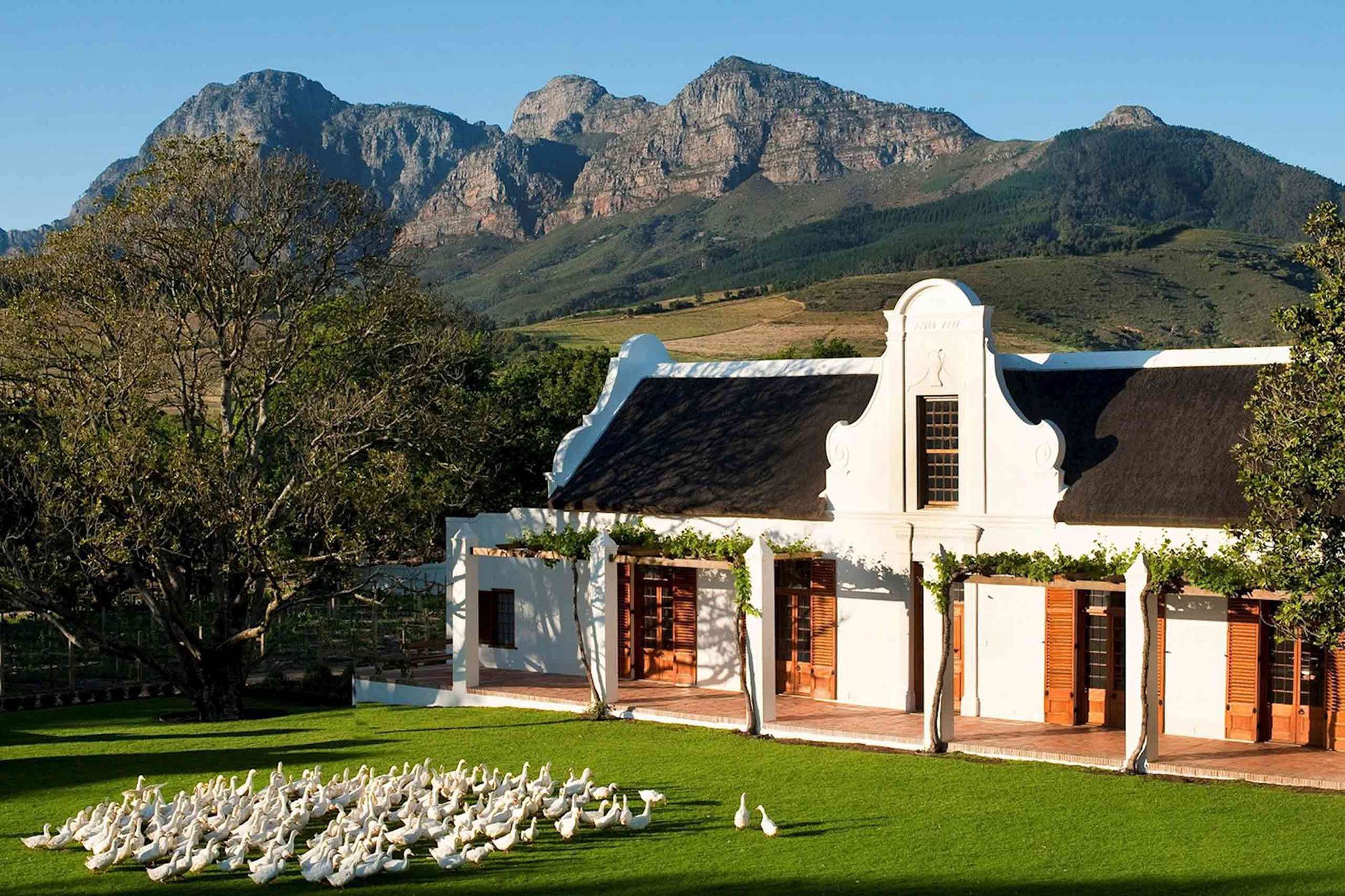
Farm, Garden, and Glass: The Logic of Babylonstoren
The approach along the Klapmuts-Simondium Road gives you the estate before you arrive at it. Rows of vines press against the Simonsberg foothills, and the whitewashed gables of the Cape Dutch homestead appear well before any signage does. This is working farmland that has been operating on this plot since the late seventeenth century, and the architecture says as much: thick walls, small windows, a courtyard geometry designed for shelter and utility rather than display. What has changed is the integration of hospitality into that agricultural frame. The gardens, the cellar, the kitchen, and the guest accommodation now operate as interlocking parts of a single property, a model that several Cape Winelands estates have attempted but few have sustained with the same degree of coherence.
Wine at Babylonstoren: Decanter's Verdict and What It Signals
The wine program's credentials are now independently documented. At the 2025 Decanter World Wine Awards rollup, Babylonstoren collected ten medals across its range: one Gold, six Silver, and three Bronze. The Gold-level result places at least one wine in the tier that Decanter reserves for bottles scoring 95 points or above, a bracket that, in South African terms, represents serious competition with the Cape's most decorated cellars. The accompanying Pearl 3 Star Prestige rating in 2025 reinforces the picture: this is a wine operation that is being assessed against an international peer set, not just a local one.
Breadth of the medal tally across ten wines is also informative. A single trophy from a boutique release is a different signal than consistent recognition across a portfolio. Ten decorated wines suggests a cellar operating with range, which in the Franschhoek and Simondium context typically means varieties that track both the cooler valley floors and the warmer hillside exposures. The Cape's Mediterranean climate rewards producers who understand aspect and altitude, and medal spreads of this kind usually reflect exactly that knowledge applied across a multi-varietal program.
For comparison within the valley, Boekenhoutskloof operates as Franschhoek's most internationally traded name, with its Syrah-led range and The Chocolate Block as its commercial flagship. Anthonij Rupert Wyne (L'Ormarins) brings a different scale of investment and a prestige Bordeaux-blend focus. La Motte Wine Estate has long positioned around Shiraz and classical structure. Babylonstoren's position in this peer set is defined less by a signature single variety and more by the farm-integrated identity of the program: the wines are sold in context, as products of a specific piece of land that visitors can walk through, eat on, and stay at.
The Farm Philosophy and Why It Shapes the Wine
The editorial angle here is not the winemaker's biography but the logic of the estate model itself. Cape winemaking has a long tradition of farm-to-glass production, but the contemporary version of that idea separates into two distinct types. The first is the cellar-led estate, where hospitality is an add-on to a wine business. The second is the fully integrated property, where farming, food, accommodation, and wine reinforce each other commercially and philosophically. Babylonstoren belongs to the second type more completely than almost any comparable property in the Western Cape.
The eight-hectare garden that sits at the centre of the property is not ornamental. It supplies produce to the kitchen, structures the visitor experience, and communicates a set of values about land use that extends directly to the vineyard. When a cellar can point visitors to the soil its vines grow in, the compost its garden generates, and the table its produce reaches, the wine becomes legible in a way that purely cellar-focused estates cannot replicate. That coherence is what earns Babylonstoren its position in conversations about South Africa's most complete estate experiences, separate from and in addition to its medal tally.
Across the broader Western Cape, a handful of properties attempt this model. Delaire Graff Estate in Stellenbosch does it with a luxury hotel and art collection overlay. Creation Wines in Hermanus does it through food-and-wine pairing experiences tied to the Hemel-en-Aarde terroir. Constantia Glen in Cape Town takes a more cellar-concentrated approach. Babylonstoren's version is distinguished by the scale and age of its agricultural infrastructure, which gives the proposition a depth that newer properties are still building toward.
Simondium, Not Franschhoek: The Address Matters
The estate's postal address is Simondium rather than the Franschhoek village, a distinction worth noting for planning purposes. The property sits on the Klapmuts-Simondium Road, which places it at the northern edge of the broader Franschhoek valley wine corridor, accessible from both the Franschhoek side and the Paarl direction. Visitors driving from Cape Town typically approach via the R44 or N1/R301, with journey times from the city centre in the range of 45 to 55 minutes depending on the route. This is a significant detail for anyone building a day itinerary: Babylonstoren pairs logistically with Paarl-side properties as readily as with the Franschhoek village cluster.
Within the valley, Boschendal is the nearest comparable estate in terms of scale and integrated hospitality, located a short drive toward the pass. Haute Cabrière, with its dramatic cellar built into the mountainside, sits further up the valley toward the Franschhoek Pass. For visitors building a multi-stop day, the spatial logic tends to run from Babylonstoren at the Simondium end through Boschendal and then up to the village, finishing with the higher-altitude producers near the pass.
Planning a Visit
Babylonstoren operates as an estate with multiple entry points: the cellar and tasting room, the garden tour, the restaurants, and accommodation for overnight guests. Because the property attracts visitors across all these categories simultaneously, advance booking for dining and accommodation is the practical approach, particularly for weekends and the Cape summer season running from November through March. The Decanter and Pearl recognition in 2025 has increased the estate's international profile, which in turn affects table and tour availability during peak periods. For the wines specifically, the ten-medal Decanter portfolio is distributed through the estate's own channels, so visiting the property directly remains the most complete way to access the full range. For context on other Franschhoek producers worth pairing with a visit, the full Franschhoek wineries guide covers the valley comprehensively.
For those planning a longer stay in the area, the Franschhoek hotels guide covers accommodation options across price tiers, while the Franschhoek restaurants guide maps the village's dining scene separately from estate experiences. The bars guide and experiences guide round out the full picture for multi-day itineraries.
Beyond South Africa, the farm-integrated estate model Babylonstoren represents has direct parallels in other wine regions. Abadía Retuerta in Sardón de Duero operates a comparable hotel-and-cellar combination in Castilla y León, while Aberlour in Aberlour represents a different category of destination production entirely, for visitors tracking premium drinks experiences globally.
Frequently Asked Questions
- What's the vibe at Babylonstoren?
- The estate reads as a working Cape Dutch farm first and a hospitality destination second. The whitewashed homestead, extensive gardens, and vineyard surroundings create an environment defined by agricultural scale rather than resort polish. Its 2025 Pearl 3 Star Prestige rating and ten Decanter medals confirm that the wine quality underpins the wider experience. Pricing for accommodation and dining sits toward the premium end of the Franschhoek valley, consistent with a property operating at this level of recognition and infrastructure.
- What wines should I try at Babylonstoren?
- The 2025 Decanter rollup awarded medals to ten wines across the range, with one Gold-level result at 95 points or above. Without confirmed varietal data in the current record, the most reliable approach is to ask the tasting room staff to guide you through the Gold and Silver medal wines directly: those are the independently verified high points of the current portfolio. The breadth of the tally across ten wines suggests the range spans multiple varieties, so a structured tasting is worth the time rather than a single-bottle selection.
- What makes Babylonstoren worth visiting?
- The combination of a seventeenth-century working farm, a medal-decorated wine program (ten awards at 2025 Decanter, Pearl 3 Star Prestige 2025), an eight-hectare productive garden, and multiple dining formats makes this one of the Western Cape's most coherent estate propositions. Comparable properties in Franschhoek like Boschendal offer a similar integrated model, but Babylonstoren's specific combination of agricultural depth and wine credentials occupies a distinct position in the valley's offer.
- Should I book Babylonstoren in advance?
- Yes, for dining and accommodation, advance booking is advisable. The estate's 2025 Decanter and Pearl recognition has reinforced its international profile, and summer weekends (November through March) fill quickly. If your primary interest is the tasting room, walk-in access may be possible on quieter weekday mornings, but checking directly with the estate before arrival is the sensible precaution, particularly if you are building the visit into a fixed itinerary.
Where It Fits
A quick snapshot of similar venues for side-by-side context.
| Venue | Classification | Awards | First Vintage | Notes |
|---|---|---|---|---|
| Babylonstoren | 1 awards | This venue | ||
| La Motte Wine Estate | World's 50 Best | |||
| Boschendal | 1 awards | |||
| Haute Cabrière | 1 awards | |||
| Anthonij Rupert Wyne (L’Ormarins) | 1 awards | |||
| Boekenhoutskloof | 1 awards |
Access the Cellar?
Our members enjoy exclusive access to private tastings and priority allocations from the world's most sought-after producers.
Access the Concierge