
Yakitori BLACK puts Fujiidera, south of central Osaka, into the city’s serious yakitori conversation. Its Tabelog 100 Yakitori WEST selections in 2024 and 2025, counter-led format, and focused drinks program place it in a specialist tier rather than the casual skewer-and-beer lane.
Pearl is the En Primeur Club membership app — saves, bookings, and concierge access live there. Same editors, same standards.
- Address
- 1 Chome-15-28 Oka, Fujiidera, Osaka 583-0027, Japan
- Phone
- +81 72-931-1881
- Website
- instagram.com
 Saves & bookings on Pearl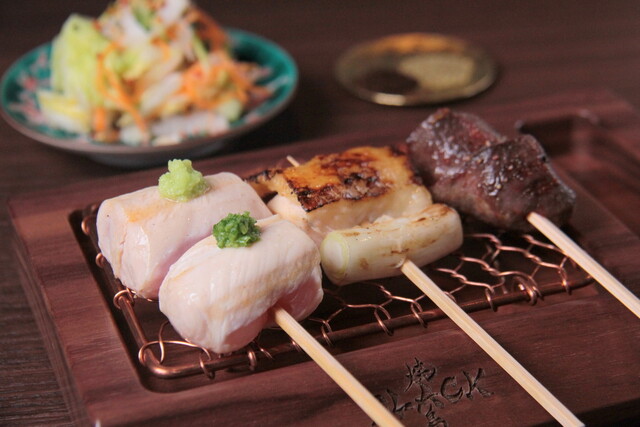
Fujiidera changes the tempo before dinner begins. The station area is smaller and less performative than Namba or Umeda, which matters for yakitori: the meal is built on timing, smoke control, and the quiet tension of a counter, not on theatrical arrival. In that setting, Yakitori BLACK reads as part of Osaka’s increasingly serious suburban dining map, where destination restaurants no longer need a central postcode to draw committed diners.
Osaka’s yakitori culture has always had range. At one end sit quick, inexpensive skewer shops built for after-work drinking; at the other, tightly managed counters where poultry sourcing, charcoal work, pacing, and drink pairing shift the category into tasting-menu territory. The presence of Tabelog 100 Yakitori WEST recognition in both 2024 and 2025 places this address in the latter conversation. That award signal is useful because yakitori can be deceptively hard to read from the outside: the difference between competent grilling and serious craft often appears in temperature control, sequencing, and restraint rather than spectacle.
Fujiidera gives the counter a different kind of gravity
Central Osaka dining tends to reward immediacy: station density, late-night drift, and a constant flow between bars, ramen counters, and izakaya. Fujiidera asks for a more deliberate decision. That distance from the core changes the psychology of the meal. Diners are not dropping in between errands; they are choosing a specific yakitori experience in a residential-commercial pocket south of the city center.
That context helps explain why the room’s small-scale format matters. A counter-led yakitori restaurant depends on proximity to the grill and on a narrow rhythm between cook, charcoal, and guest. The semi-private option for a small group gives the restaurant some flexibility, but the category’s real intelligence usually sits at the counter, where pacing and heat are visible rather than abstract. This is not the same proposition as a broad izakaya menu, where skewers are one section among many; the point is concentration.
Compared with Osaka peers in a lower spending band, such as TORILABO at JPY 6,000 to JPY 7,999, the Fujiidera address occupies a more expensive yakitori bracket. Other comparison points in the city, including Inui, Takara Ya, Jikoryu Ramen Watamen, and Kei Chan, speak to Osaka’s depth at casual price levels, but they do not describe the same dining decision. The relevant distinction is not simply cost. It is whether dinner is being treated as a quick local stop or as a focused grill-counter session with award recognition attached.
Yakitori as a precision format, not a side order
The defining idea here is yakitori as a discipline of sequence. In Japan, the form can look simple to newcomers: chicken, skewers, charcoal, salt or tare. Serious counters operate differently. Cuts are portioned to preserve texture, fat is managed rather than hidden, and the order of service can move from leaner, cleaner expressions toward richer pieces. Without inventing dish names, the category itself tells the reader what to watch for: heat, timing, and whether each skewer arrives as a separate decision rather than a repetitive plate.
The drinks language also signals ambition. Sake, shochu, and wine are all part of the offer, with particular attention paid to sake and wine. That matters in contemporary yakitori because the category has moved beyond the old beer-only stereotype. Wine can work with smoke and fat when acidity and structure are handled well; sake can amplify sweetness, saline notes, and grilled aromatics without crowding the food. A restaurant that treats both seriously is positioning yakitori within a broader dining conversation, not just a drinking snack tradition.
Tabelog score of 3.75 gives another useful reading, especially in Japan, where high user scores in specialist categories tend to accumulate slowly and cautiously. The score should not be treated like a Western star rating, but paired with repeat Tabelog 100 Yakitori WEST selection, it suggests sustained attention from diners who compare within the genre rather than across generic restaurant lists.
How it fits into an Osaka food itinerary
Yakitori BLACK is useful for travelers who already understand Osaka beyond the Dotonbori shorthand. The city’s dining strength is not only takoyaki, okonomiyaki, and market grazing; it is also the way specialist formats thrive in tight rooms across the prefecture. A Fujiidera dinner pairs better with a day built around southern Osaka or Kintetsu-line movement than with an overpacked central crawl. The reward is a version of the city where the meal feels selected, not stumbled upon.
For broader planning, Our full Osaka restaurants guide gives the wider dining frame, while Our full Osaka hotels guide, Our full Osaka bars guide, Our full Osaka wineries guide, and Our full Osaka experiences guide help separate a dedicated food trip from a single dinner booking. Osaka’s range also runs from casual staples like 551 Horai (551蓬莱) to bakery and cafe stops such as 52CHO-ME BAKERY and.cafe, plus Italian-leaning addresses including a canto (Italian) and 99 Pizza Napoletana Gourmet.
Readers building a Japan-wide dining route can set this against other regional formats: beef sukiyaki at -Grilled beef Sukiyaki- KAMAKURA TANUKIAN 鎌倉 たぬき庵 in Kamakura, charcoal tuna cooking at. 鮪と炭火焼き うお炭 秋葉原店 in Tokyo, contemporary dining at.know in Kumamoto, Vietnamese cooking at (Shoku) Vietnam in Kawasaki, curry specialization at [Curry Senmon Ten] Maruyama Kyoju. in Sapporo, Kyoto minimalism at [ki:] in Kyoto, and Japanese drinking culture abroad at Jōdo Saké Bar in Los Angeles or Onigiri Time in Pasadena. Against that spread, the Fujiidera counter’s appeal is clear: it narrows the evening to poultry, charcoal, and the discipline required to make both feel consequential.
Comparable Spots
Comparable venues at a glance for context.
| Venue | Cuisine | Price | Notes |
|---|---|---|---|
| Yakitori BLACK | Yakitori Omakase | $$$ | Osaka |
| Kiyo Suke | Traditional Sukiyaki & Shabu-shabu | $$$ | Chūō |
| Yakitori Saihi | Yakitori | $$$ | Chūō |
| Sushi Akazu | Traditional Edomae Omakase Sushi with Red Vinegar Rice | $$$ | Kita |
| Yama Hashiru | Yakitori Omakase | $$$ | Kita |
| Kakigori Laboratory | Modern Kakigori (Shaved Ice) | $$$ | Nishi-ku |
Recognition history
Dated appearances from independent guides and award organizations, with the underlying list record or original source where available.
Tabelog 100 #63 · No. 63
Tabelog · Tabelog 100 - Yakitori - WEST - 2025
Continue exploring
More in Osaka
Restaurants in Osaka
Browse all →




Bars in Osaka
Browse all →


Hotels in Osaka
Browse all →



Wineries in Osaka
Browse all →
At a Glance
- Date Night
- Group Dining
- Special Occasion
- After Work
- Late Night
- Chefs Counter
- Standalone
- Sake Program
Current opening hours
- Monday
- 6–11 PM
- Tuesday
- 6–11 PM
- Wednesday
- 6–11 PM
- Thursday
- 6–11 PM
- Friday
- 6–11 PM
- Saturday
- 6–11 PM
- Sunday
- Closed
Hours can change for holidays and private events. Last verified .