
Akihabara’s tonkatsu culture is not only about speed and convenience; it also has a disciplined, specialist tier where pork cutlet is treated with the seriousness usually reserved for sushi counters. Tonkatsu Marugo belongs in that tier, with repeated Tabelog Tonkatsu 100 selections and a compact room that makes planning part of the meal.
Pearl is the En Primeur Club membership app — saves, bookings, and concierge access live there. Same editors, same standards.
- Address
- 東京都千代田区外神田1-8-14
- Phone
- +81332556595
- Website
- tabelog.com
 Saves & bookings on Pearl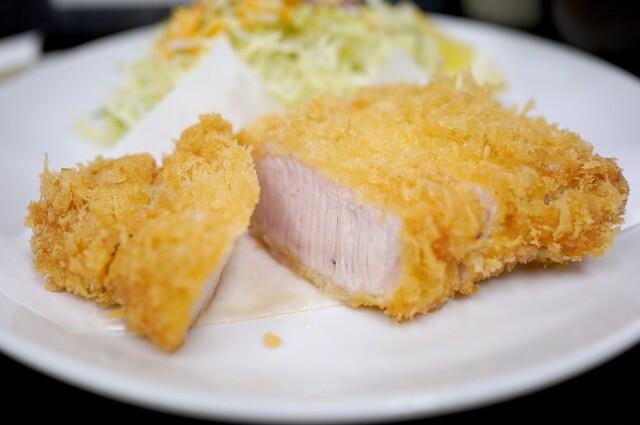
Akihabara usually announces itself in circuitry: station exits, parts shops, game signage, and crowds moving between platforms and side streets. The tonkatsu counter cuts against that tempo. In Tokyo, the serious pork-cutlet house is compressed: a narrow room, a fryer at the centre, rice and cabbage moving in rhythm, and a queue culture rewarding diners who plan lunch rather than improvise it.
That matters because tonkatsu holds a particular place in the city’s dining hierarchy. It is everyday food by category, but better specialists behave more like single-dish restaurants than casual set-meal shops. The question is execution, not novelty: cut, coating, oil management, resting, and the balance between richness and pace. Tonkatsu Marugo sits in this bracket, selected for Tabelog Tonkatsu 100 in 2026, with prior selections across 2024, 2022, 2021, 2019, 2018, and 2017. For a genre judged by repeat local use more than ceremony, that continuity is meaningful.
Akihabara's serious pork-cutlet room, not a station-meal compromise
Akihabara can flatten dining expectations. Around a major interchange, visitors often assume speed, convenience, and a disposable meal between shopping stops. Stronger local addresses complicate that view. Old Tokyo forms still sit near the electronics district: soba, sweets, curry, grilled fish, and tonkatsu, each serving a different neighbourhood rhythm. Tonkatsu Marugo is not competing with multi-course Ginza dining; it competes with the city’s specialist comfort-food houses, where value lies in repetition and focus.
The nearby comparison set is useful. Myojinshita Kandagawa Honten occupies a higher-spend traditional-dining lane, Kanda Yabu Soba speaks to older Kanda soba culture, while Takemura and CHOPIN represent low-cost local stops of another kind. AROMAS of INDIA adds the station-area reality of Tokyo dining: compact neighbourhoods hold multiple cuisines at sharply different price levels. Against that spread, tonkatsu’s appeal is directness. The dish has enough structure to reward obsession, yet remains readable to a first-time visitor within seconds of sitting down.
The format also suits the city’s solo-dining intelligence. Counter seating is part of the room’s grammar, and modest capacity means turnover and timing shape the experience. Tokyo’s better single-specialty restaurants often ask diners to accept this bargain: fewer choices, less lingering, more attention on the core dish. That is fair here. The Tabelog score of 3.74 and repeated category recognition place the restaurant above a casual convenience pick, while the format keeps it grounded in the district’s lunch-and-dinner habits.
What the recognition says about tonkatsu in 2026
Tabelog’s Hyakumeiten lists reward category depth rather than broad luxury signalling. A tonkatsu selection is not a Michelin tasting-menu claim; it points to consistency within a narrow Japanese genre. In 2026, that distinction matters. Tokyo visitors often map sushi, ramen, and tempura in advance, treating tonkatsu as a backup. The city does not. Specialist pork-cutlet rooms keep loyal followings because small technical differences are obvious: batter weight, oil freshness, cut thickness, juiciness, and how the set meal lands as a complete plate.
There is a price-tier lesson too. Tokyo remains unusually good at preserving seriousness below luxury pricing. A restaurant can be category-recognised, compact, and still priced for a non-occasion meal. That makes tonkatsu useful for travellers seeking the city’s dining culture beyond trophy reservations. The form is democratic, not careless. The meal can be quick; the craft is not rushed.
For readers building a fuller Tokyo dining map, category contrast helps. The same trip might include yakitori at 124. KAGURAZAKA (Yakitori), curry at 3 Chome no Curry Ya San, or an Akihabara seafood stop such as . 鮪と炭火焼き うお炭 秋葉原店. The point is not to rank unlike formats. It is to see how Tokyo rewards specialization across price bands, from cutlet houses and curry counters to sushi, yakitori, and izakaya cooking.
The planning logic: treat casual dining with serious timing
The booking experience is defined by the absence of a formal reservation cushion. That changes the approach. In Tokyo, no-reservation specialist restaurants are not necessarily casual in demand; they shift planning from calendar management to arrival discipline. The room’s scale, counter component, and Akihabara location make timing more important than mood. Diners who build the meal around the district, rather than squeeze it between fixed appointments, will have a cleaner experience.
The practical context is clear for travellers. The restaurant is close to Akihabara Station, and the surrounding area gives enough alternatives for a wait or reset if timing slips. Payment and seating conventions are more traditional than international hotel dining, so approach it as a local specialist room, not a concierge-managed destination restaurant. Families can consider it, though compactness matters; the listed family guidance notes children are welcome, with a posted stroller restriction.
Across Japan, the lesson transfers: better everyday restaurants often require the same planning seriousness as expensive ones, just differently. That applies in Tokyo and beyond, from 12/10 Shinjuku ten and 2D Cafe to regional addresses such as -Grilled beef Sukiyaki- KAMAKURA TANUKIAN 鎌倉 たぬき庵 in Kamakura.cafe in Osaka.know in Kumamoto, (Shoku) Vietnam in Kawasaki, [Curry Senmon Ten] Maruyama Kyoju. in Sapporo, and [ki:] in Kyoto. For a broader city read, use Our full Tokyo restaurants guide, then cross-check through Our full Tokyo hotels guide, Our full Tokyo bars guide, Our full Tokyo wineries guide, and Our full Tokyo experiences guide. For Japanese drinking culture outside Japan, Jōdo Saké Bar in Los Angeles and Onigiri Time in Pasadena show how specific formats travel and change.
The editorial verdict is simple: Tonkatsu Marugo is for travellers who take Tokyo’s everyday specialisms seriously. It is not the city’s grand-dining face, and that is the point. The value is seeing how one dish, handled with category discipline, can carry a neighbourhood meal.
Cuisine and Credentials
Comparable venues to calibrate price, style, and recognition.
| Venue | Cuisine | Price | Notes |
|---|---|---|---|
| Tonkatsu Marugo | Tonkatsu (Japanese Pork Cutlet) | $ | Chiyoda |
| Kanda Yabu Soba | Edo-Style Soba | $ | Chiyoda |
| Takeya | Udon & Izakaya | $ | Bunkyō |
| 玄冶店 濱田家 | Japanese Izakaya | $ | Chūō |
| 御料理 心馬 | Japanese Asian Restaurant | $ | Chūō |
| DOMINICA Ginza ten | Soup curry specialty (Sapporo-style Japanese curry) | $ | Chūō |
Recognition history
Dated appearances from independent guides and award organizations, with the underlying list record or original source where available.
Tabelog 100 #55 · No. 55
Tabelog · Tabelog 100 - Tonkatsu - 2026
At a Glance
- Classic
- Cozy
- Well Known
- Solo
- Family
- Casual Hangout
- Standalone
- Historic Building
- Sake Program
- Beer Program
A nostalgic, Showa-era style tonkatsu house with a cozy, no-frills feel and an active, queue-heavy atmosphere.