


1 Michelin Star · Gault & Millau Remarkable Restaurant
Our verdict
One Michelin-starred Sushi B occupies a eight-seat counter on Rue Rameau in Paris's 2nd arrondissement, placing it among the city's most concentrated omakase experiences. Ranked #454 among Europe's top restaurants by Opinionated About Dining in 2024, chef Masayoshi Hanada builds each service around ingredient precision, balanced dashi, unmasked sashimi, and technique that lets the raw material speak first.

Pearl is the En Primeur Club membership app, where members save venues, book tables and use the concierge.
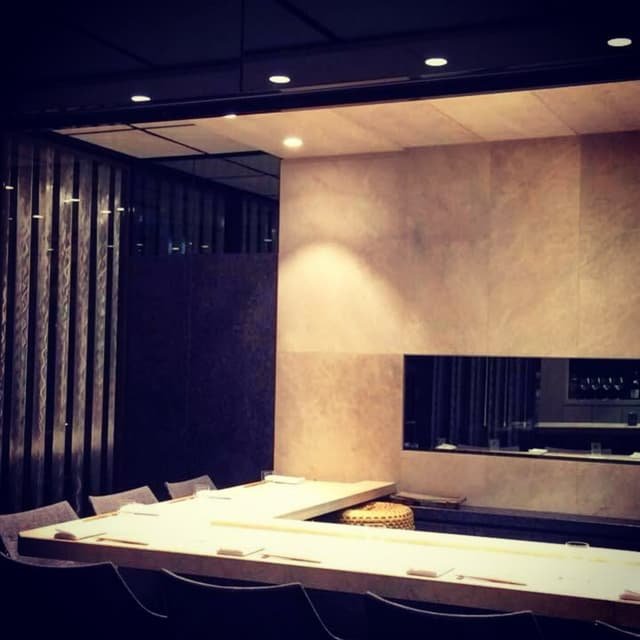
Paris's Japanese Counter Tradition and Where Sushi B Sits Within It
Paris has sustained a serious Japanese dining culture for decades, but the city's omakase tier has tightened considerably since the mid-2010s. Where once a handful of counters held the field, the arrondissements now contain a layered spectrum: izakayas and ramen bars at one end, multi-course omakase counters at the other. The upper tier, small-format, chef-driven, ingredient-obsessed, has grown in density and in price, pulling closer to the Tokyo model where eight or ten seats and a single nightly seating define the format entirely.
The address on Rue Rameau is significant context. The street flanks the Louvois Square garden, a calm pocket in a district that otherwise runs toward finance and commerce. That quietness is part of the value proposition for counters operating at this price level: the setting does not compete with the food. Compare that placement to peers like Kei, which brings Japanese technique into a French-inflected dining room near the Palais-Royal, or L'Ambroisie on Place des Vosges, different cuisines, but both examples of how address and atmosphere function as part of the proposition in Paris's top-tier dining.
Ingredient-First: The Logic Behind the Counter
The dominant question in serious Japanese dining outside Japan is always the supply chain. Tokyo's Tsukiji and Toyosu markets set the global benchmark for fish quality, and any counter operating in Europe or North America works against that structural disadvantage from day one. The counters that earn sustained recognition, at this level and in peer markets like New York's Masa or Toronto's Sushi Masaki Saito, tend to solve that problem not by mimicking Tokyo's volume, but by working with a narrower selection of ingredients sourced at the highest available level and treated with the kind of precision that makes provenance visible on the plate.
At Sushi B, the approach is ingredient-forward in the most literal sense: the role of soy sauce and wasabi is deliberately subordinate. Opinionated About Dining's recognition specifically notes that the sushis and makis are never overpowered by condiments, a detail that matters more than it might seem. The temptation to mask inconsistency in sourcing with aggressive seasoning is real at this format. A counter confident enough to let the fish lead, with soy and wasabi as accent rather than anchor, is making a claim about its supply chain. The dishes cited in OAD's review reinforce that framing: a fillet of grilled seabass with spinach and lemon-flavoured dashi; fried seabream with grated white radish in an Agedashi style; sashimi of amberjack with sesame-flavoured soy sauce, shiso flower, and wasabi. Each construction layers supporting elements, dashi broth, pickled or fresh vegetable, aromatic garnish, without obscuring the protein at the centre.
Dashi is the structural component worth focusing on here. In Japanese cuisine, dashi functions as the foundational liquid from which almost all flavour logic extends. The difference between a dashi made from first-grade kombu and katsuobushi and a convenience stock is not subtle; it registers across every preparation that uses it. A lemon-flavoured dashi alongside seabass is a specific compositional choice that only works if the dashi itself has enough depth to carry the citrus without flattening. That kind of attention to base components, invisible to diners who are not looking for it, legible to those who are, is a consistent marker at the top end of this format.
The Format: Eight Seats, Split Seatings, No Margin for Error
The counter seats eight. That number is not a constraint imposed by the room so much as a deliberate operating decision: at eight seats, the chef controls the pace of every piece, the temperature of every preparation, and the attention given to each guest. Split seatings, two evening slots on Wednesday through Sunday, with additional lunch service Thursday through Sunday, mean multiple services per day, each running as a closed, self-contained session. The 7 PM to 9 PM and 9:30 PM to 11:30 PM evening windows are tight, which reinforces the expectation that pacing is managed from behind the counter rather than from the kitchen.
Monday and Tuesday closures are standard at this format level, allowing sourcing, prep, and recovery time that larger operations absorb across larger teams. The rhythm at Sushi B mirrors what serious omakase counters in Paris and elsewhere have adopted as the operational baseline for this category: fewer covers, more sessions, complete chef presence throughout.
The comparison is not with Paris's neighbourhood Japanese bistros or broader Asian dining options, but with the small cluster of European counters, and their counterparts in New York and Toronto, operating at the intersection of Japanese precision and European ingredient access.
Paris's Broader Dining Context and the €€€€ Tier
Sushi B operates at the €€€€ price level, which in Paris is a bracket shared by the city's most decorated French kitchens. Alléno Paris au Pavillon Ledoyen, Le Cinq at the Four Seasons Hôtel George V, and Arpège all sit at the same price ceiling, each anchored by multi-star Michelin recognition and decades of operation. That Sushi B holds a single Michelin star places it below that threshold in terms of formal recognition, but the OAD dual-market ranking and the counter's operational format position it differently. The comparison set for the dining decision is not solely about award tally but about format preference: a twelve-course French progression at a table of four, or eight seats at a counter where the service and preparation are continuous and visible.
France's dining culture also rewards the kind of product-led approach that Sushi B represents. The country's great ingredient-driven restaurants, from Bras in Laguiole with its focus on Aubrac plateau plants and terrain, to Flocons de Sel in Megève with its Alpine sourcing discipline, have established a framework where the quality of the raw material is the primary critical criterion. That framework is not alien to what Sushi B does; it operates on compatible principles with different national culinary grammar. The seabass, the amberjack, the white radish: all are treated as subjects rather than supports.
For those building a multi-day Paris itinerary around serious dining, the EP Club guides to restaurants, hotels, bars, and experiences provide the broader map. France's regional restaurant circuit, Mirazur in Menton, Troisgros in Ouches, Auberge de l'Ill in Illhaeusern, Paul Bocuse in Collonges-au-Mont-d'Or, and the Paris wineries guide round out the wider picture for anyone approaching France as a sustained dining destination.
Know Before You Go
Address: 5 Rue Rameau, 75002 Paris, France
Price level: €€€€
Seats: 8 (counter format)
Opening hours: Wednesday evenings only (7–9 PM, 9:30–11:30 PM); Thursday–Sunday lunch (12:30–1:45 PM) and two evening seatings; Monday–Tuesday closed
Awards: Michelin 1 Star (2024); Opinionated About Dining Leading Restaurants in Europe #454 (2024); OAD Leading Restaurants North America #520 (2025); OAD Leading New Restaurants in Europe Recommended (2023)
Booking: Advance booking required; the split-seating format and eight-seat capacity mean availability is limited across all sessions
Chef: Masayoshi Hanada
What Do People Recommend at Sushi B?
Reviews consistently highlight the balance between technique and restraint: the sushi and maki are built to let the fish register first, with soy sauce and wasabi used sparingly rather than as the dominant seasoning. Dishes that appear in critical recognition include sashimi of amberjack with sesame-flavoured soy sauce, shiso flower, and wasabi; grilled seabass with spinach and lemon-flavoured dashi; and fried seabream with grated white radish in an Agedashi preparation. The counter format, eight seats, chef in direct view, is itself a consistent recommendation signal: it is the structural reason the preparation quality is visible and consistent across every cover. Chef Masayoshi Hanada's Michelin star and back-to-back OAD recognition across both the European and North American rankings provide the credential context for that consistency.
A Tight Comparison
A short peer table to compare basics side-by-side.
| Venue | Cuisine | Price | Awards | Notes |
|---|---|---|---|---|
| Sushi BThis venue (the venue you are viewing) | Michelin-Starred Omakase Sushi | $200–300 | 1 Michelin Star · Gault & Millau Remarkable Restaurant | Not listed |
| Alléno Paris au Pavillon Ledoyen | Modern French Fine Dining | $150–200 | 3 Michelin Stars · World's 50 Best #79 | Creative |
| Kei | Modern French with Japanese Influences | $300–500 | 3 Michelin Stars · World's 50 Best #93 | Contemporary French, Modern Cuisine |
| L'Ambroisie | Classic French Haute Cuisine | $300–500 | 2 Michelin Stars · World's 50 Best #23 | French, Classic Cuisine |
| Le Cinq - Four Seasons Hôtel George V | Modern French Fine Dining | $300–500 | 3 Michelin Stars · World's 50 Best #24 | French, Modern Cuisine |
| Plénitude | Modern French Sauce-Led Fine Dining | $300–500 | 3 Michelin Stars · World's 50 Best #14 | Contemporary French |
Recognition history
Dated appearances from independent guides and award organizations, with the underlying list record or original source where available.
Michelin 1 Star
Michelin
Opinionated About Dining Top Restaurants in Europe Recommended
Opinionated About Dining
Gault & Millau Remarkable Restaurant
Gault & Millau
Full recognition history (8 entries)
Michelin 1 Star
Michelin
Opinionated About Dining Top Restaurants in North America Ranked #520
Opinionated About Dining
Michelin 1 Star
Michelin
Opinionated About Dining Top Restaurants in Europe Ranked #454
Opinionated About Dining
Opinionated About Dining Top New Restaurants in Europe Recommended
Opinionated About Dining
Continue exploring
More in Paris
Restaurants in Paris
All restaurants in Paris →
Bars in Paris
All bars in Paris →



Details
- Intimate
- Elegant
- Sophisticated
- Cozy
- Modern
- Date Night
- Special Occasion
- Solo
- Chefs Counter
- Sake Program
- Sustainable Seafood
- Street Scene
- Omakase
- Counter Dining
- Sake
Current opening hours
- Monday
- Closed
- Tuesday
- Closed
- Wednesday
- 7–9 PM, 9:30–11:30 PM
- Thursday
- 12:30–1:45 PM, 7–9 PM, 9:30–11:30 PM
- Friday
- 12:30–1:45 PM, 7–9 PM, 9:30–11:30 PM
- Saturday
- 12:30–1:45 PM, 7–9 PM, 9:30–11:30 PM
- Sunday
- 12:30–1:45 PM, 7–9 PM, 9:30–11:30 PM
Hours can change for holidays and private events. Hours as of .
Cozy and intimate zen-like atmosphere with marble, upholstered seats, fine glassware, and soft lighting creating a peaceful, high-end Japanese hospitality experience.