Seafood Ristorante
.png)

Set in a glass cube cantilevered over St Andrews Bay, Seafood Ristorante brings an Italian hand to the cold-water catch of the East Neuk fishing ports. Day-boat halibut from Pittenweem and crab from the local creel boats anchor a menu that holds its Scottish provenance intact while folding in the technique and flavour logic of the Italian kitchen. A Michelin Plate (2024) and a 4.5 Google rating across nearly 600 reviews confirm its standing at the top of the St Andrews dining tier.
 Discover on Pearl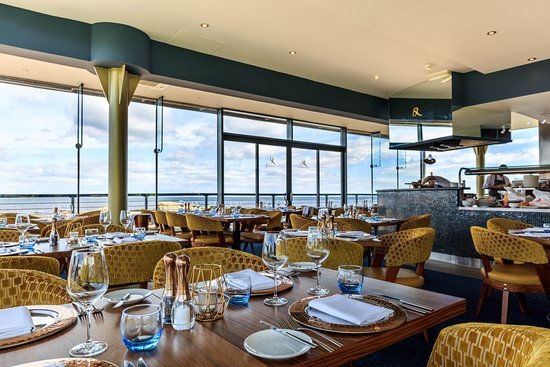
Glass, Steel, and the North Sea
Approach Bruce Embankment on a clear afternoon and the building announces itself before you reach the door. A modernist cube of glass and steel, cantilevered over the shoreline adjacent to the Royal and Ancient Golf Club, it sits at an angle to the rest of St Andrews as though it belongs more to the bay than to the town. Inside, the framing does most of the work: St Andrews Bay fills every window, and the light shifts constantly with the tide and the cloud cover moving in off the North Sea. The dining room received a full refurbishment post-pandemic, and the effect is a room that feels current without erasing its architectural identity. It is the kind of physical setting that carries its own editorial weight, and the kitchen is aware of that pressure.
Cold Water, Italian Logic
The East Neuk of Fife is one of Scotland's most productive fishing coastlines, with working harbours at Pittenweem, Anstruther, and Crail landing day-boat catches that supply some of the country's most serious kitchens. What distinguishes this particular address is the culinary grammar applied to that cold-water provenance. Since 2017, the restaurant has operated under Italian ownership, and the menu reflects that shift in a way that is neither fusion nor compromise. The result sits in a specific and relatively underoccupied niche: Scottish waters, Italian technique.
The shortlist, unlocked.
Hard-to-book tables, cellar releases, and concierge-planned trips.
Get Exclusive Access →In practical terms, that means day-boat halibut from Pittenweem steamed and plated with sea kale, monk's beard, and mussel sauce, where the fish is treated with the restraint that the leading Italian seafood cooking demands. Crab from East Neuk boats appears in agnolotti with Anstruther lobster sauce and sea herbs, a dish that applies northern Italian pasta craft to ingredients that came out of the Firth of Forth that morning. The kitchen also works broader European references into the menu, including a bourride-influenced preparation of brill with violet artichokes and fennel, and occasional meat and game dishes such as Perthshire roe deer with duck liver, celeriac, salsify, and an espresso syrup. Desserts close on Italian terms: vanilla panna cotta with rhubarb crémeux and rhubarb sorbet are representative of what the kitchen describes as pure Italian dolci.
This approach places the restaurant in an interesting position relative to how premium seafood restaurants have developed in the UK. The dominant model at the leading of the market tends toward either pure locality (minimal intervention, named provenance, near-zero miles) or grand classical French technique. Italian-inflected seafood at this level is a smaller category, and the closest international comparisons are coastal Italian addresses such as Gambero Rosso in Marina di Gioiosa Ionica or Alici on the Amalfi Coast, where the sea's immediacy and a light editorial hand on the plate are the shared logic.
Port by Port: Where the Catch Comes From
The fishing villages of the East Neuk operate on different scales to the industrial ports of the west coast. Pittenweem in particular functions as the primary landing hub for the area, with a fish market that supplies restaurants across Fife and Edinburgh. Anstruther, immediately adjacent, has a smaller creel-boat fleet that produces the brown and velvet crab and lobster that appear on menus at this price point. The waters here are cold and tidal, and the North Sea species they yield, halibut, monkfish, brill, langoustines, are not the warm-water equivalents of Mediterranean seafood. They carry more mineral weight and need either more time or more precision to coax. The kitchen's decision to apply Italian technique to these specific species is a calibrated one: the structural clarity of Italian seafood cooking, its preference for olive oil over cream, for sea herbs over compound sauces, suits the flavour profile of North Sea fish more than the richer French classical tradition typically does.
That provenance story connects this kitchen to a wider pattern in Scottish coastal dining, where the quality of landing-to-plate supply chains has become a competitive differentiator. Haar, operating in the same ££££ tier in St Andrews, draws on similar East Neuk supply lines for its modern cuisine menu. The relationship between named harbours and premium restaurant menus is now part of the expected grammar of serious Scottish cooking, in the same way that named fishing grounds are central to how coastal fine dining reads in Norway, Japan, or Brittany.
The Room, the Service, and the Wine
The open kitchen, described in the venue's documentation as a plain-view setup, is part of the dining architecture rather than a theatrical addition. Watching preparation happen against the backdrop of St Andrews Bay is a different experience than the performative open kitchens of urban restaurants, where the drama is contained entirely inside four walls. Service is documented as genuinely warm rather than formally correct, which fits the setting: this is not a room that rewards stiffness.
The wine list earns specific mention in available documentation, and in a way that gives it editorial weight. The list prioritises Italian regional bottles, with a floor of £28, but extends to serious French vintages and international selections for those whose interests run beyond the peninsula. For a restaurant operating in a small Scottish university town rather than a major city, the ambition of the wine program signals a deliberate effort to position the room as a destination rather than a local anchor. Michelin awarded the kitchen a Plate in 2024, which in Michelin's vocabulary signals cooking of good quality in the tier below Bib Gourmand or star recognition. It is a meaningful credential at this price point and in this location, particularly given the competitive quality of the broader Scottish fine dining scene represented by addresses like Restaurant Andrew Fairlie in Auchterarder.
Planning a Visit
Seafood Ristorante sits at Bruce Embankment, St Andrews KY16 9AB, at the water's edge on the town's eastern shore. At the ££££ price point, set lunches represent the more accessible entry to the menu, with similar dishes to the evening offering at better value, and it is worth noting that the same kitchen and the same bay view apply at midday. For first-time visitors, lunch in decent weather, when the light on St Andrews Bay operates at its most useful, makes practical sense. A 4.5 Google rating across 599 reviews, sustained over a period that includes post-pandemic refurbishment, gives a reasonable indication of consistency. Book ahead; a room of this profile in a town this size, with Michelin recognition and a physically distinctive address, fills early, particularly across the summer and during the golf season when St Andrews draws visitors from across the world.
For broader context on eating and drinking in the town, our full St Andrews restaurants guide covers the range from casual to formal. Little Italy Restaurant offers a different register of Italian-inflected dining in the same town. The St Andrews hotels guide, bars guide, and experiences guide complete the picture for visitors planning more than a single meal.
Frequently Asked Questions
- What do people recommend at Seafood Ristorante?
- Documented dishes across published sources point consistently to the agnolotti of East Neuk crab with Anstruther lobster sauce, and the steamed Pittenweem day-boat halibut with sea kale and mussel sauce. Both represent the restaurant's central editorial argument: cold-water Scottish fish handled with Italian structural clarity. The kitchen holds a Michelin Plate (2024), and a 4.5 Google rating across 599 reviews. The cuisine sits at the intersection of Scottish provenance and Italian technique, a narrower niche than the more common local-produce-meets-French-classical model that dominates comparable-tier Scottish restaurants.
- How far ahead should I plan for Seafood Ristorante?
- St Andrews draws visitors year-round around golf, the university, and the coastal scenery, and Seafood Ristorante operates at ££££ in a glass building with no real physical equivalent in the town. That combination, distinctive setting, Michelin Plate recognition, and limited comparable competition from venues like Ondine, means demand is consistent rather than seasonal. Booking several weeks ahead for dinner, and at least a week or two ahead for lunch, is the sensible baseline. The golf season and summer months tighten availability further. For broader trip planning at this level, comparable Scottish fine dining destinations such as Restaurant Andrew Fairlie in Auchterarder typically require longer lead times still.
Just the Basics
A fast peer set for context, pulled from similar venues in our database.
| Venue | Notes | Price |
|---|---|---|
| Seafood Ristorante | This venue | ££££ |
| Haar | Modern Cuisine, ££££ | ££££ |
| Ondine | ||
| Little Italy Restaurant |
Need a table?
Our members enjoy priority alerts and concierge-led booking support for the world's most difficult tables.
Get Exclusive AccessThe shortlist, unlocked.
Hard-to-book tables, cellar releases, and concierge-planned trips.
Get Exclusive Access →