Sal Tang's

Michelin Bib Gourmand
Our verdict
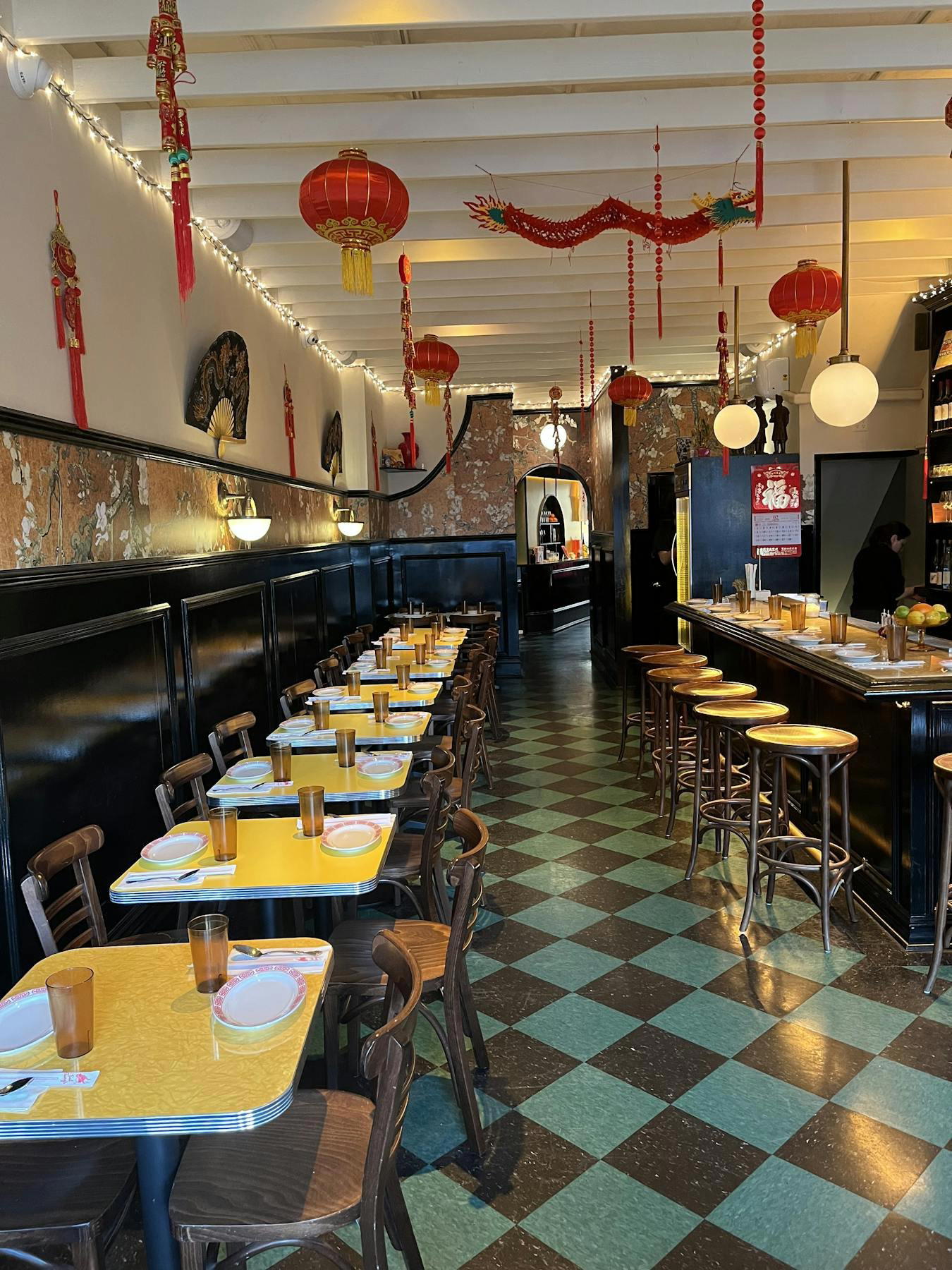
Sal Tang's on Hicks Street brings Cantonese-American cooking into a dining room dressed in red lanterns, paper mâché dragons, and cherry blossom wallpaper. The kitchen leans into nostalgia without getting stuck there, updating familiar dishes like wonton soup and beef and broccoli with a considered hand. It reads as a reliable neighborhood anchor in Carroll Gardens, suited to weeknight dinners and returning regulars alike.

Pearl is the En Primeur Club membership app, where members save venues, book tables and use the concierge.
The menu
What to order
- Hot & Sour Soup
- Egg Roll
- Crystal Shrimp Dumplings
- Crispy Orange Beef
- Sesame Chicken Cutlet
Red Lanterns and a Familiar Order
Walk into 521 Hicks Street on any given weeknight and the room tells you exactly what it is: red lanterns suspended from the ceiling, paper mâché dragons flanking the walls, cherry blossom wallpaper running the length of the dining room, and dark wood underfoot and overhead giving the space a grounded, unhurried weight. In a borough where restaurant interiors frequently chase novelty, Sal Tang's in Carroll Gardens reads as a deliberate act of continuity. The aesthetic is not ironic retro, it is the design vocabulary of Cantonese-American dining as it existed for generations, brought back with enough care that it feels settled rather than staged.
That sense of settled confidence is precisely what keeps a certain kind of diner returning. In New York's outer boroughs, the restaurants that build genuine regulars tend not to be the ones chasing seasonal reinvention. They are the rooms that answer a specific, recurring need, a reliable bowl of wonton soup, a plate of beef and broccoli that tastes the way you remembered it, a weeknight rhythm that doesn't require a reservation made three months in advance. Sal Tang's occupies that position in Carroll Gardens, sitting at a different point on the spectrum from the high-wire tasting menus at places like Atomix in New York City or the precision-led formats at Le Bernardin.
What the Regulars Already Know
The unwritten menu at a place like this is usually shorter than the printed one: three or four dishes that any regular would tell you not to skip, a preferred seat, a preferred night of the week. At Sal Tang's, that logic maps cleanly onto the kitchen's strongest output.
The egg roll is the entry point most regulars would cite first. The shell achieves the kind of audible crunch that signals proper fry temperature and good timing, and the filling is substantial rather than perfunctory, overstuffed in the way that made the dish a fixture of Cantonese-American dining rooms for decades. It is not a refined amuse-bouche; it is an egg roll that means it. That distinction matters in a city where small-plate minimalism has become the default register for restaurants positioning themselves as serious.
Wonton soup follows the same principle. The broth is light and savory without being thin, a balance that requires more restraint in the kitchen than heavier stocks do. The pork wontons sit in that broth with the density that comes from hand-folding rather than mechanical uniformity. For a certain cohort of diners, this bowl functions as a calibration tool: if the wonton soup is right, the rest of the meal is likely in safe hands.
Beef and broccoli closes the main run. As a dish, it has spent decades absorbing the condescension of critics who treat Cantonese-American cooking as a lesser register than its regional Chinese counterparts. What Sal Tang's version does, and this is the move that separates a kitchen that understands the dish from one that merely executes it, is honor the logic of the form. The sauce should coat without smothering, the broccoli should have resistance, the beef should carry some char. The dish earns its place on the repeat order list not by being reinvented but by being done correctly.
Dessert, which is where many Chinese-American restaurants lose momentum, pivots here toward a blood orange sorbet: two scoops, bright acidity, clean finish. It functions as a palate reset rather than a heavy close, which reads as the right call given the richness of what preceded it.
Carroll Gardens Context
Sal Tang's sits within a Brooklyn neighborhood that has shifted considerably over the past two decades, with the dining scene tracking that movement from Italian-American anchors toward a wider mix of cuisines and price points. The block on Hicks Street places it inside a walkable radius of a local population that leans toward regular neighborhood dining rather than destination-seeking. That audience rewards consistency over surprise.
For comparison across Brooklyn's Asian dining options, Enso operates in a different register entirely, and Bong and Glin Thai Bistro serve different cuisine traditions within the borough's broader picture. The full picture is in our full Brooklyn restaurants guide.
The Cantonese-American format Sal Tang's works in has a specific cultural weight in American dining history. From the mid-twentieth century onward, these restaurants were often the primary point of contact between Chinese culinary tradition and mainstream American appetite, producing a hybrid form that critics spent years dismissing and diners spent years loving. The current moment is more favorable to reassessment: dishes like egg rolls, wonton soup, and beef and broccoli are being read less as corruptions of a purer cuisine and more as their own coherent tradition, with their own standards for execution and their own criteria for quality. Sal Tang's positions itself clearly within that reassessment, presenting the food with pride rather than apology.
For those benchmarking against American fine dining at the other end of the scale, the contrast is instructive: The French Laundry in Napa, Alinea in Chicago, Lazy Bear in San Francisco, and Single Thread Farm in Healdsburg represent a format built around transformation and spectacle. Sal Tang's operates in a completely different mode: it earns its regulars through reliability and emotional resonance rather than technical ambition. Both are valid, and each serves a different kind of need.
International reference points, from 8 1/2 Otto e Mezzo Bombana in Hong Kong to Emeril's in New Orleans, underscore how place-specific comfort dining operates across cultures: the leading versions of it are never generic, even when they feel familiar.
Planning a Visit
Sal Tang's is at 521 Hicks Street in Carroll Gardens, Brooklyn. The room and format point toward a neighborhood restaurant that suits weeknight dinners; given the character of the space and the menu's price signals, it also reads as appropriate for families with children. For further context on where to drink and stay nearby, see our full Brooklyn bars guide, our full Brooklyn hotels guide, and for broader exploration, our full Brooklyn wineries guide and our full Brooklyn experiences guide.
Frequently asked questions
Would Sal Tang's be comfortable with kids?
The room at 521 Hicks Street reads as a low-key neighborhood spot rather than a destination restaurant, red lanterns, dark wood, and familiar dishes like egg rolls and wonton soup make it an easy fit for families. Carroll Gardens generally runs relaxed at this register, and nothing about the format suggests children would be out of place.
How would you describe the vibe at Sal Tang's?
Think weeknight neighborhood Chinese, red lanterns overhead, paper mâché dragons and cherry blossom wallpaper on the walls, dark wood grounding the room. It leans into nostalgia without being kitschy, and the pace is closer to a regular's local than a destination with a wait list.
Is Sal Tang's award-winning?
Sal Tang's has received recognition including: It's classic Cantonese American with a modern twist at Sal Tang's, where everything from the dining room to the kitchen's dishes feels nostalgic, albeit with a refined, modern twist. Red lanterns are suspended from the ceiling, paper mâché ….
What's the must-try dish at Sal Tang's?
The egg roll is the clearest signal of what the kitchen prioritizes: a properly crispy shell with a generously filled interior. The wonton soup, a light, savory broth with pork wontons, runs close behind, and blood orange sorbet closes the meal on a sharp, palate-clearing note.
Where exactly is Sal Tang's?
Sal Tang's is located at 521 Hicks St, Brooklyn, NY 11231, Brooklyn.
The Essentials
Comparable venues nearby, for context on price, style, and recognition.
| Venue | Cuisine | Price | Awards | Notes |
|---|---|---|---|---|
| Sal Tang'sThis venue (the venue you are viewing) | Modern Cantonese American | $30–50 | Michelin Bib Gourmand | Not listed |
| Enso | Modern Edomae Omakase | $150–200 | Michelin Plate | Williamsburg, Modern Edomae Omakase |
| Claro | Modern Oaxacan | $100–150 | Michelin Plate | Gowanus, Michelin-starred Oaxacan Mexican |
| Kelang | Malaysian with Brooklyn & Caribbean Influences | $30–50 | Star Wine List | Greenpoint, Malaysian with Brooklyn & Caribbean Influences |
| 6 Restaurant | Contemporary European-American Fine Dining | $150–200 | Michelin Plate | Carroll Gardens, Contemporary European-American Fine Dining |
| Sukh | Regional Thai | $20–30 | Not listed | Fort Greene, Regional Thai |
Recognition history
Dated appearances from independent guides and award organizations, with the underlying list record or original source where available.
Michelin Bib Gourmand
Michelin
Continue exploring
More in Brooklyn
Restaurants in Brooklyn
All restaurants in Brooklyn →

Bars in Brooklyn
All bars in Brooklyn →






Details
- Cozy
- Trendy
- Lively
- Casual Hangout
- Group Dining
- Date Night
- Open Kitchen
- Craft Cocktails
- A La Carte
- Small Plates
- Lychee Martini
- Gluten Free Options
Current opening hours
- Monday
- Closed
- Tuesday
- Closed
- Wednesday
- 5–9 PM
- Thursday
- 5–9 PM
- Friday
- 5–10 PM
- Saturday
- 5–10 PM
- Sunday
- 5–9 PM
Hours can change for holidays and private events. Hours as of .
Charming dining room with bright yellow tables, green and black vinyl floors, glowing Chinese-style lamps, and a sexy bar creating a nostalgic, cozy, family-oriented atmosphere.