
Our verdict
Lisbon's most referenced pastry address has operated from the same Belém bakery since 1837, producing egg custard tarts under a recipe that remains tightly held within the original production team. Ranked #4 on Opinionated About Dining's Cheap Eats in Europe list for 2024 and #5 in 2025, it occupies a tier entirely its own: a working institution that serious food lists keep returning to.

Pearl is the En Primeur Club membership app, where members save venues, book tables and use the concierge.
The menu
What to order
- Pastel de Belém
- Croquetes de Carne
- Bola de Berlim
The Queue as Context
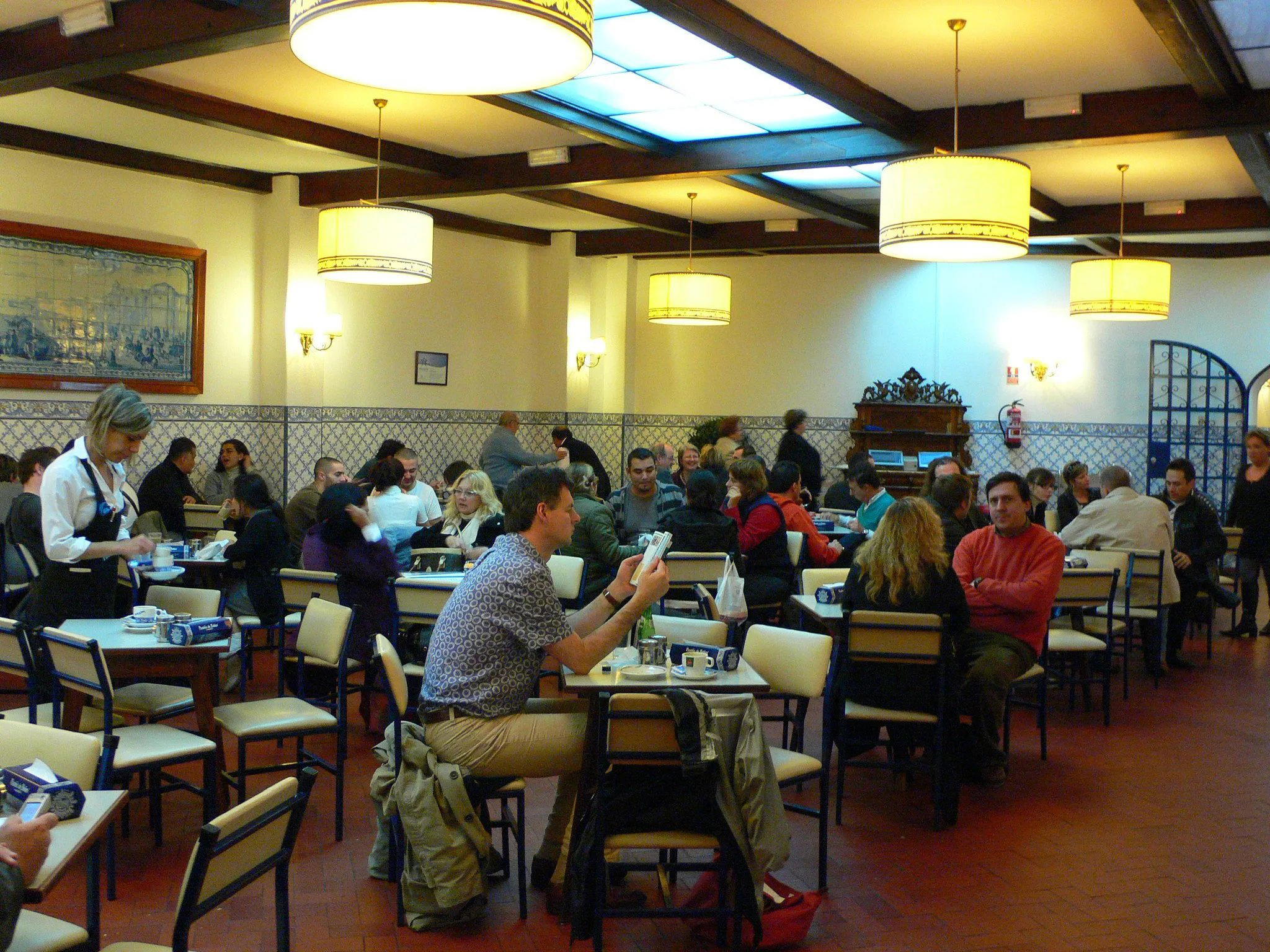
On any given morning in Belém, the line outside R. de Belém 84-92 forms before the ovens reach full temperature. This is not a curated tourist ritual. It is the operating reality of a bakery that has been producing pastéis de nata from a single Lisbon address since 1837, when the recipe passed from the Jerónimos Monastery to a nearby sugar refinery owner. The physical approach tells you something about the category: this is egg custard at a scale and consistency that no small artisan operation has managed to replicate at the same address for nearly two centuries. The tiled interior, with its blue-and-white azulejo panels across multiple interconnected rooms, functions as both dining hall and production facility. You are eating in proximity to the kitchen that makes what you are eating. That is rarer than it sounds in a city where pastry cases are pre-filled by central commissaries.
Egg Custard as a Protected Tradition
The pastel de nata is one of Portugal's most exported food ideas, reproduced across every continent in varying degrees of approximation. The version produced here, formally distinguished as pastel de Belém rather than the generic nata, is the anchor point against which all others are measured. The distinction matters beyond branding. The recipe, held by a small number of pastry workers trained within the bakery itself, involves a laminated pastry shell and a custard set at temperatures that produce the characteristic scorched caramel surface without over-firming the interior. The sourcing of eggs and dairy, in a preparation this structurally simple, carries disproportionate weight: the custard has no place to hide weak ingredients. This is the editorial logic of the pastel de Belém as a food object, it is an exercise in ingredient discipline at scale, not a showcase of technique complexity.
For context on where this sits relative to Lisbon's wider dining range: the city also holds serious tasting-menu addresses, Belcanto at the fine-dining end of Modern Portuguese, CURA for contemporary cuisine with precise sourcing credentials, and 50 Seconds from Martin Berasategui for Progressive Spanish at the leading price tier. Pastéis de Belém operates in an entirely different register, one where the credential is not the chef's lineage but the longevity and consistency of a single preparation.
What the Awards Measure
Opinionated About Dining's Cheap Eats in Europe rankings place Pastéis de Belém at #23 in 2023, #4 in 2024, and #5 in 2025. The upward trajectory between 2023 and 2024 is significant: OAD's methodology aggregates assessments from a network of dedicated diners and critics, not a single editorial voice, which makes a jump of that scale across a continent-wide list a meaningful signal rather than a one-cycle anomaly. The 2025 slight retreat to #5 keeps it firmly in the top tier of the European cheap-eats category. It is a stable, high-traffic consensus figure.
For comparison, Portugal's broader restaurant scene includes Michelin-starred addresses spread across the country: Vila Joya in Albufeira, Antiqvvm in Porto, Casa de Chá da Boa Nova in Leça da Palmeira, Il Gallo d'Oro in Funchal, and The Yeatman in Vila Nova de Gaia. Pastéis de Belém ranks on a different axis entirely, but the OAD recognition places it in a conversation that spans both fine-dining precision and accessible daily eating as legitimate categories of serious food.
The Bakery in Lisbon's Pastry Ecosystem
Lisbon's café and pastry culture is one of the densest in southern Europe. The city supports a full spectrum from grand salon-style pastelarias, Pastelaria Versailles on Avenida da República represents the gilded-mirror, chandelier-hung tradition, to neighbourhood tascas where a single pastry sits under glass at the counter. Belém occupies its own geographic and historical node. The district sits west of the historic centre, closer to the Tagus estuary, and its identity is shaped by the Age of Discovery monuments that surround it. The monastery connection gives the pastel de Belém a provenance story that most pastries cannot claim, but the production team does not trade on historical theatre inside the bakery. The operation is functional and high-volume. Cinnamon and icing sugar sit on the tables as standard accompaniment. Tables turn continuously. The atmosphere reads as a working Lisbon institution that happens to have been discovered by food lists, not a heritage attraction that has learned to look like a bakery.
Creative Lisbon Beyond the Tart
Visitors who use Belém as a morning starting point are well-positioned to connect with the broader Lisbon food program. The city's creative dining end runs from addresses like 2Monkeys to the kind of international reference-point restaurants that place Lisbon in the same conversation as other European capitals with serious fine-dining density. For those building a full itinerary, EP Club's full Lisbon restaurants guide maps the city's dining across price tiers and styles. Supplementary guides cover hotels, bars, wineries, and experiences for those treating the city as a longer stay rather than a transit stop.
For reference on what serious cheap-eats recognition looks like at an international scale, OAD's methodology is comparable to the frameworks that govern lists like the World's 50 Best, even if the price tier differs sharply. Restaurants like Le Bernardin in New York and Atomix in New York occupy the other end of the price and format spectrum, but the underlying principle of sustained recognitionacross multiple assessment cycles as a signal of genuine quality applies at every level.
Planning a Visit
The bakery opens at 8 am daily and runs through to 9 pm seven days a week, which means early arrival is the reliable strategy for avoiding the longest queues. Mid-morning on weekdays is the inflection point: after 10 am, particularly on weekends, wait times extend. The address is R. de Belém 84-92, in the Belém district, accessible via the tram lines and suburban rail that connect the waterfront to central Lisbon. No reservation system exists; this is a walk-in operation by design, which makes timing the single most consequential planning variable. The combination of early arrival, a table in one of the tiled back rooms, and an order taken directly from the production line is as close to the intended experience as the format allows.
Frequently asked questions
Is Pastéis de Belém family-friendly?
Given the low price point and walk-in format, Pastéis de Belém is one of the more accessible stops in Lisbon for mixed-age groups. The setting is a high-volume working bakery rather than a sit-down restaurant, which means the atmosphere is informal and fast-moving. Children are present at most hours. The format suits a brief stop rather than a long meal, which aligns well with family itineraries covering Belém's wider district.
What is the atmosphere like at Pastéis de Belém?
The interior is tiled throughout in the traditional Portuguese azulejo style and divided across several rooms, which means the space absorbs volume better than it appears from the entrance queue. The noise level is high, the pace is fast, and the decor functions as historical backdrop rather than designed hospitality environment.
What is the must-try dish at Pastéis de Belém?
The pastel de Belém is the reason the address appears on any list, and there is no practical argument for ordering around it. The egg custard tart, distinguished from the generic pastel de nata by a recipe held within a small trained team, is the preparation that earned the OAD Cheap Eats in Europe rankings of #4 in 2024 and #5 in 2025. Cinnamon and icing sugar arrive on the table as standard accompaniments, applied to taste.
Compact Comparison
A quick peer list to put this venue’s basics in context.
| Venue | Cuisine | Price | Awards | Notes |
|---|---|---|---|---|
| Pastéis de BelémThis venue (the venue you are viewing) | Traditional Portuguese Pastel de Nata Bakery | $10–20 | Not listed | Not listed |
| Belcanto | Contemporary Portuguese Fine Dining | $200–300 | 2 Michelin Stars · World's 50 Best #42 | Modern Portugese, Creative |
| 50 seconds from Martin Berasategui | Avant-Garde Spanish Fine Dining | $200–300 | 2 Michelin Stars · La Liste Top Restaurants | Progressive Spanish |
| Eleven | Sophisticated Modern Mediterranean | $150–200 | 1 Michelin Star · Falstaff Restaurant - 93 Falstaff Points | Portugese, Creative |
| Feitoria | Modern Portuguese Fine Dining | $50–100 | 1 Michelin Star · La Liste Top Restaurants | Modern Cuisine |
| Grenache | Contemporary French Fine Dining | $150–200 | 1 Michelin Star | French Contemporary |
Recognition history
Dated appearances from independent guides and award organizations, with the underlying list record or original source where available.
Opinionated About Dining Cheap Eats in Europe Ranked #4
Opinionated About Dining
Full recognition history (4 entries)
Opinionated About Dining Cheap Eats in Europe Ranked #5
Opinionated About Dining
Opinionated About Dining Cheap Eats in Europe Ranked #4
Opinionated About Dining
Opinionated About Dining Cheap Eats in Europe Ranked #23
Opinionated About Dining
Continue exploring
More in Lisbon
Restaurants in Lisbon
All restaurants in Lisbon →
Bars in Lisbon
All bars in Lisbon →

Details
- Classic
- Well Known
- Cozy
- Casual Hangout
- Brunch
- Historic Building
- A La Carte
- Vegetarian Friendly
Current opening hours
- Monday
- 8 AM–9 PM
- Tuesday
- 8 AM–9 PM
- Wednesday
- 8 AM–9 PM
- Thursday
- 8 AM–9 PM
- Friday
- 8 AM–9 PM
- Saturday
- 8 AM–9 PM
- Sunday
- 8 AM–9 PM
Hours can change for holidays and private events. Hours as of .
Cozy traditional Portuguese cafe with blue and white azulejo tiles charming historic interiors and a bustling atmosphere.