Musaafer

Musaafer holds a Michelin star for good reason: its kitchen approaches Indian regional cooking through the disciplined architecture of spice, layering whole, ground, tempered, and bloomed aromatics across every dish in a setting that rivals the cooking for drama. Located inside the Galleria, the grand hall's arches and labyrinthine rooms serve as an unlikely but convincing backdrop for particularly considered Indian food in Texas.
Pearl is the En Primeur Club membership app — saves, bookings, and concierge access live there. Same editors, same standards.
- Address
- Suite C-3500, 5115 Westheimer Rd, Houston, TX 77056, United States
- Phone
- +1 713-242-8087
- Website
- musaaferhouston.com
- Directions
- Get directions
 Saves & bookings on Pearl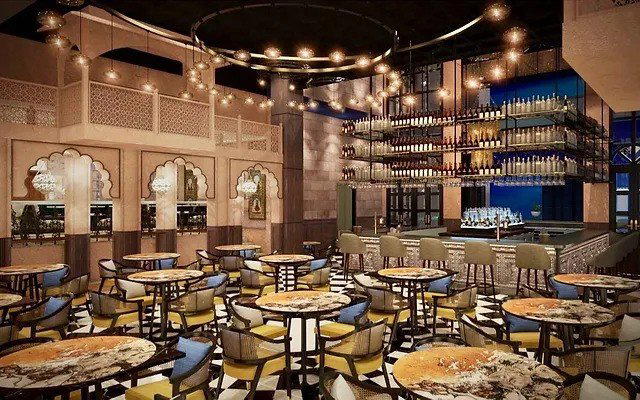
A Palace Inside a Mall
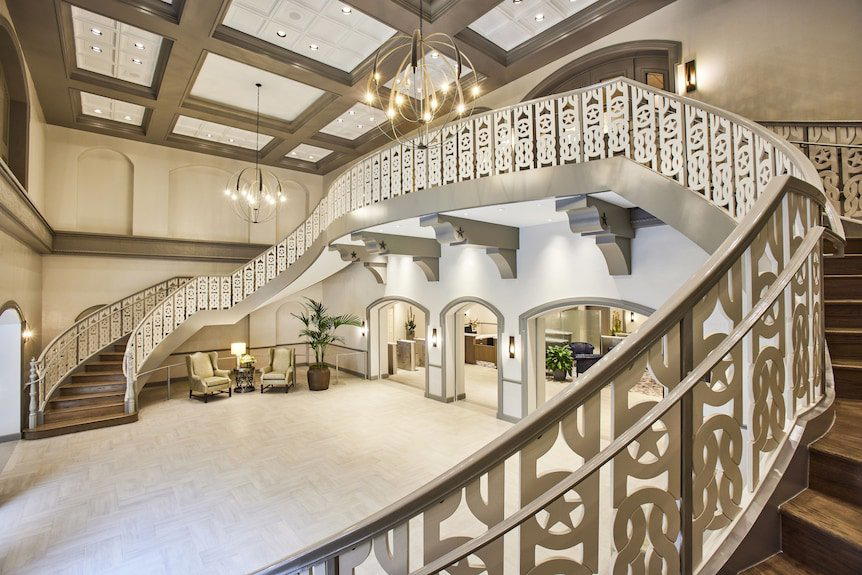
Houston's Galleria is not an obvious address for serious cooking. The retail complex on Westheimer Road draws millions of visitors annually, and most of its dining options reflect that traffic-driven logic. Musaafer occupies Suite C-3500 within that same building, which makes its interior all the more arresting on arrival: arched ceilings, towering windows, and an elaborate lattice of patterns suggest a Mughal-era reception hall rather than a mall restaurant. The scale is not incidental. It frames the meal before the first dish lands, signalling that what follows is intended to be read at a different register than the surrounding retail.
Houston's fine-dining tier has expanded considerably in the past decade, and the city now holds multiple Michelin-starred addresses across European and contemporary American formats. In that company, Musaafer represents the strongest argument for Indian cooking at the $$$$ price point. The 2024 Michelin star formalised what many Houston diners had observed for some time: that the kitchen's approach to spice is not decorative but structural, and that the results justify comparison with ambitious fine-dining rooms in any cuisine category. Among Houston's peer group of premium independents, including BCN Taste & Tradition and March, Musaafer occupies a distinct niche: regional Indian cooking presented with the technical rigour that fine-dining audiences now expect from any starred kitchen.
The Architecture of Spice
Indian cooking in the United States has long been flattened into a set of broadly familiar preparations, where heat level and sauce richness stand in for actual spice work. Musaafer operates from a different premise. Under Chef Mayank Istwal, the kitchen treats spice as a structural element, not a seasoning afterthought, deploying whole aromatics, ground blends, tempered oils, and bloomed spices as distinct layers within a single dish. The effect is that flavours arrive in sequence rather than simultaneously: a leading note of something volatile, a mid-register of ground complexity, a base built from long-cooked depth.
The 24-spice onion xuixo is the dish that most clearly demonstrates this approach. The deep-fried orb arrives dusted in a blend of two dozen spices, encasing a filling of potato and onion, accompanied by tamarind and mint chutney. The chutney pairing is not accidental: tamarind's sourness and mint's green sharpness are calibrated to cut the richness of the fry and to reset the palate before the next sequence of spicing. This kind of architectural thinking, where each component in a dish serves a function in the overall spice progression, is what Michelin's inspectors tend to reward, and what separates the kitchen's output from more casual Indian restaurants.
The prawn preparation in coriander, coconut milk, and curry leaves illustrates a different register of the same discipline. Coconut milk is a carrier medium that softens heat without masking it; curry leaves, bloomed in oil, contribute a volatile aromatic that dissipates quickly unless managed correctly. The kitchen's handling of that combination produces a sauce that is elegant in the Michelin sense: each element identifiable, none dominant, the whole coherent. For context on how this approach compares internationally, the commitment to technical spice discipline places Musaafer in conversation with addresses like Trèsind Studio in Dubai and Opheem in Birmingham, two of particularly referenced starred Indian kitchens outside India.
Dal demonstrates what happens when time itself becomes a spice variable. Cooking dal for 72 hours with tomato, butter, and smoked chili produces a texture and depth that no amount of added spice can replicate from a shorter cook. The smoke comes from the chili rather than a wood source, which keeps the aromatic profile within the dish's own logic rather than importing an external flavour. This is disciplined restraint applied to a dish that most Indian restaurants treat as a backdrop.
Houston's Indian Dining Context
Houston has one of the largest South Asian diaspora populations in the United States, which means the city's Indian restaurant scene runs wide and deep across price points. Himalaya on Southwest Freeway has served Houston's Pakistani and Indian communities for decades and maintains a devoted following at accessible prices. Pondicheri in Uptown takes a more casual, all-day approach to South Indian flavours. Musaafer's $$$$ positioning places it at the other end of that spectrum, where the question is not just whether the cooking is good but whether the ambition is matched by execution at a price point that competes with any fine-dining table in the city.
Review volume at that level implies a dining room that turns meaningful covers, which in a space of Musaafer's scale is operationally significant. Fine-dining rooms that maintain rating consistency over thousands of reviews have generally solved the consistency problem that undermines many ambitious kitchens. That practical signal matters as much to a first-time visitor as the Michelin star itself.
Within the broader context of Houston's premium dining tier, Musaafer is doing something structurally different from its comparably priced peers. Le Jardinier Houston works within a French vegetable-forward tradition; March explores Venetian and Adriatic references. The cooking at Musaafer draws from a subcontinent's worth of regional traditions and spice systems, which means the kitchen's range of reference points is substantially wider. That breadth, executed with the precision the Michelin star signals, positions the restaurant as a significant address not just within its cuisine category but within Houston's fine-dining tier overall.
How It Compares Nationally
The emergence of starred Indian restaurants in American cities reflects a broader shift in how Michelin's US guides assess non-European fine-dining traditions. Restaurants like Le Bernardin in New York City, Alinea in Chicago, and The French Laundry in Napa have defined what rigorous fine dining means in American contexts. The conversation around Indian cooking at that level is newer and smaller, which makes Musaafer's 2024 star meaningful beyond Houston. It is one of a short list of American restaurants demonstrating that the spice complexity and regional depth of Indian cuisine can be presented with the technical consistency that starred recognition requires.
For readers who track ambitious American kitchens across formats, Lazy Bear in San Francisco, Emeril's in New Orleans, and Single Thread Farm in Healdsburg each represent different expressions of what fine dining can look like when a kitchen commits fully to a culinary tradition. Musaafer belongs in that discussion, operating from a different tradition but with comparable levels of structural intent.
Planning Your Visit
Musaafer opens for dinner from Monday through Thursday, 5 PM to 10 PM, and extends service on Friday evenings until 11 PM. Weekend hours run longer, with the kitchen open from noon on both Saturday and Sunday, Saturday until 11 PM and Sunday until 10 PM. The midday service on weekends offers a lower-pressure entry point than a Friday or Saturday dinner booking, when the dining room operates at peak volume. The Galleria address at 5115 Westheimer Road, Suite C-3500, is accessible by car with mall parking, and the Uptown/Galleria area is among the more hotel-dense corridors in Houston, making it a practical anchor for a dining-focused visit.
In Context: Similar Options
Comparable venues nearby, for context on price, style, and recognition.
| Venue | Cuisine | Price | Awards | Notes |
|---|---|---|---|---|
| MusaaferThis venue — the venue you are viewing | Modern Indian Fine Dining | $$$$ | Michelin 1 Star | Not listed |
| Le Jardinier Houston | Contemporary French Fine Dining | $$$$ | Michelin 1 Star | Museum District |
| Tatemó | Modern Mexican Heirloom Corn Tasting Menu | $$$$ | Michelin 1 Star | Spring Branch East |
| BCN Taste & Tradition | Modern Spanish Tapas | $$$ | Michelin 1 Star | Museum District |
| Bludorn | French-Inspired New American | $$$ | Michelin Plate | Neartown |
| Mala Sichuan Bistro | Authentic Sichuan Bistro | $$ | Bib Gourmand | Memorial |
Recognition history
Dated appearances from independent guides and award organizations, with the underlying list record or original source where available.
Michelin 1 Star
Michelin
Michelin 1 Star
Michelin
Continue exploring
More in Houston
Restaurants in Houston
Browse all →
Bars in Houston
Browse all →
Hotels in Houston
Browse all →
At a Glance
- Elegant
- Sophisticated
- Ornate
- Special Occasion
- Date Night
- Celebration
- Private Dining
- Craft Cocktails
- Extensive Wine List
Current opening hours
- Monday
- 5–10 p.m.
- Tuesday
- 5–10 p.m.
- Wednesday
- 5–10 p.m.
- Thursday
- 5–10 p.m.
- Friday
- 12–11 p.m.
- Saturday
- 12–11 p.m.
- Sunday
- 12–10 p.m.
Hours can change for holidays and private events. Last verified .
Glamorous and luxurious with intricate tiles, golden framed art, dramatic decor evoking India, and dramatic lighting, though occasionally loud with background music.