
Michelin Plate
Our verdict
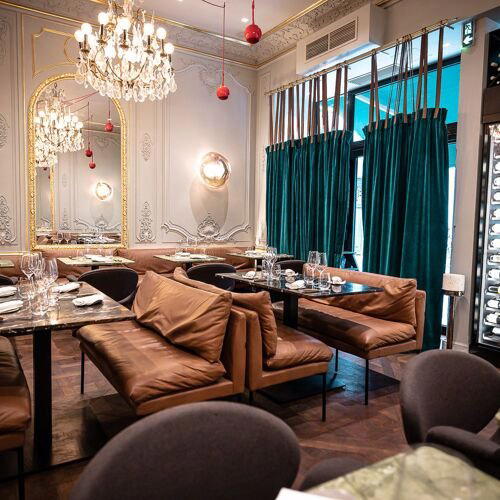
A Michelin Plate holder on Rue Biot in Paris's 17th arrondissement, Le Cyrano represents the kind of accessible modern cuisine that has quietly redefined the neighbourhood bistro format in the city's less-toured districts.

Pearl is the En Primeur Club membership app, where members save venues, book tables and use the concierge.
The menu
What to order
- Potato millefeuille
- Oeufs mayonnaise
- Leeks mimosa
The 17th Arrondissement and the Reinvention of the Neighbourhood Table
Paris has spent the better part of two decades sorting its dining scene into recognisable tiers: the palace restaurants of the 8th and 1st, the natural wine canteens of the 11th, the destination omakase counters of the Marais. What has received less attention is the quieter transformation happening in the 17th arrondissement, where streets like Rue Biot have become testing grounds for a different kind of ambition. Here, the question is not how to compete with 114, Faubourg or the formal registers of Paul Bocuse - L'Auberge du Pont de Collonges, but how to build something that earns repeat custom from a local crowd while still clearing the bar for recognition. Le Cyrano, holding a Michelin Plate in 2025, is evidence that this balance is achievable at a €€ price point.
From Neighbourhood Fixture to Recognised Kitchen
The Michelin Plate is a signal worth reading carefully. It does not carry the weight of a star, but in 2025 it represents something specific: the Guide's acknowledgment that a kitchen is producing food of consistent quality and intention. For a restaurant operating at a mid-range price in a residential pocket of the 17th, that recognition marks a meaningful evolution. The Batignolles quarter, which surrounds this stretch of Rue Biot, has traditionally been the kind of area where locals eat rather than where critics travel. That dynamic has been shifting, and Le Cyrano's Plate sits within that broader pattern of outer-arrondissement kitchens drawing institutional attention for the first time.
The trajectory here mirrors what has happened across comparable neighbourhood-anchored restaurants in Paris over the past decade. Places that once operated in comfortable anonymity have, through consistent kitchen work and a sharper articulation of their offer, moved into a tier where Michelin inspectors and informed visitors take notice. Accents Table Bourse and Anona represent different points on a similar arc: modern cuisine restaurants that have refined their direction over time and arrived at a recognisable identity. Le Cyrano operates in that company, though at a more accessible price tier.
What Modern Cuisine Means at This Level
Classification of "Modern Cuisine" in Paris covers a wide range. At one end, you have the intensely technique-driven kitchens of Kei or the creative format of Alléno Paris, where the budget runs to €€€€ and the experience is architected around a singular vision. At the other end, modern cuisine becomes shorthand for French classicism updated with lighter saucing, seasonal sourcing, and a less formal service rhythm. Le Cyrano occupies the latter position. The Michelin Plate signals that the kitchen has moved beyond the generic and found a coherent approach, without the pricing or format infrastructure of the starred tier.
The comparison worth making is not to the palace dining of Le Cinq or the rarefied classicism of L'Ambroisie, but to what serious cooking looks like when it operates without the infrastructure of a grand hotel or a multi-decade reputation.
In the context of Paris dining, where the review culture is unforgiving and locals are not inclined to inflate scores out of neighbourhood loyalty, this figure points to a kitchen and front-of-house operation that has consistently delivered across a wide range of expectations. That kind of sustained approval is harder to achieve than a burst of early enthusiasm, and it speaks to an evolution in the restaurant's consistency over time.
How This Fits into Paris's Broader Scene
Paris operates multiple dining cultures simultaneously. The international visitor often orbits the starred addresses and the well-publicised bistros of the tourist corridors. The informed traveller, and the local who eats seriously, tends to build a map that runs further into the arrondissements, tracking Michelin Plates, Bib Gourmands, and word-of-mouth kitchen momentum. That second map is where Le Cyrano sits. It is the kind of address that appears in conversations rather than headlines, recommended by someone who ate there twice last month rather than by a travel supplement running its annual Paris feature.
The contrast with France's multi-generation destination restaurants is instructive. Troisgros - Le Bois sans Feuilles, Bras in Laguiole, and Auberge de l'Ill in Illhaeusern each carry decades of documented legacy. Le Cyrano operates in a different mode entirely: a city-embedded address at a price point that allows for repeat visits, earning recognition through accumulation rather than founding mythology. That is a different kind of restaurant, and arguably a more useful one for a visitor building a week in Paris around eating well without the formality or expense of a starred institution.
For context on what modern cuisine looks like at the international end of the register, Frantzén in Stockholm and FZN by Björn Frantzén in Dubai or Mirazur in Menton define the category at its most ambitious end. Le Cyrano is emphatically not in that bracket. What it offers is something different: modern cuisine as a living format in a city neighbourhood, priced for access, recognised for quality, and shaped by whatever evolution the kitchen has undergone to arrive at its current form. And Flocons de Sel in Megève demonstrates what that arc of consistent refinement can ultimately produce when given time and the right context.
Know Before You Go
| Address | 3 Rue Biot, 75017 Paris, France |
|---|---|
| Arrondissement | 17th (Batignolles quarter) |
| Price Range | €€ (mid-range) |
| Awards | Michelin Plate (2025) |
| Cuisine | Modern Cuisine |
| Booking |
For more on eating, drinking, and staying in Paris, see our full Paris restaurants guide, our full Paris hotels guide, our full Paris bars guide, our full Paris wineries guide, and our full Paris experiences guide.
Frequently asked questions
How much does it cost to eat at Le Cyrano?
Pricing at Le Cyrano is listed as €€.
What's the address for Le Cyrano?
Le Cyrano is located at 3 Rue Biot, 75017 Paris, France, Paris.
In Context: Similar Options
Comparable venues nearby, for context on price, style, and recognition.
| Venue | Cuisine | Price | Awards | Notes |
|---|---|---|---|---|
| Le CyranoThis venue (the venue you are viewing) | Modern French Bistro | $30–50 | Michelin Plate | Not listed |
| Blé Sucré | French Patisserie | $10–20 | Not listed | Bastille |
| Isolé | Seasonal French Bistro | $20–30 | Michelin Plate | Montreuil |
| Savarin | Classic French Bistro | $30–50 | Michelin Bib Gourmand | 9th Arrondissement (Pigalle) |
| Chez Eugène | Classic French Brasserie | $30–50 | Star Wine List | Montmartre |
| À l’Épi d’Or | Traditional French Bistro | $30–50 | Michelin Plate | Les Halles |
Recognition history
Dated appearances from independent guides and award organizations, with the underlying list record or original source where available.
Michelin Plate
Michelin
Full recognition history (2 entries)
Michelin Plate
Michelin
Continue exploring
More in Paris
Restaurants in Paris
All restaurants in Paris →
Bars in Paris
All bars in Paris →
Hotels in Paris
All hotels in Paris →



Details
- Classic
- Cozy
- Elegant
- Intimate
- Date Night
- Casual Hangout
- Group Dining
- Historic Building
- Natural Wine
- Local Sourcing
- A La Carte
- Small Plates
- Natural Wine
- Vegetarian Friendly
- Gluten Free Options
Current opening hours
- Monday
- 9 AM–12:30 AM
- Tuesday
- 9 AM–12:30 AM
- Wednesday
- 9 AM–1 AM
- Thursday
- 9 AM–2 AM
- Friday
- 9 AM–2 AM
- Saturday
- 9 AM–2 AM
- Sunday
- 10 AM–1 AM
Hours can change for holidays and private events. Hours as of .
Charming Art Deco setting with frescoes, spotted mirrors, mosaic tile floors, and tightly packed tables creating a lively, historic atmosphere.