





Three Michelin stars and a 95-point La Liste score place Lasarte among Barcelona's most decorated tables. Under Paolo Casagrande, a protégé of Martín Berasategui, the Eixample address translates Basque-rooted fine dining into a more avant-garde register, with a private dining format called Il Milione available for those who want to take the experience further.
 Discover on Pearl
Pearl is the En Primeur Club membership app — saves, bookings, and concierge access live there. Same editors, same standards.
- Address
- Carrer de Mallorca, 259, Eixample, 08008 Barcelona, Spain
- Phone
- +34 934 45 32 42
- Website
- restaurantlasarte.com
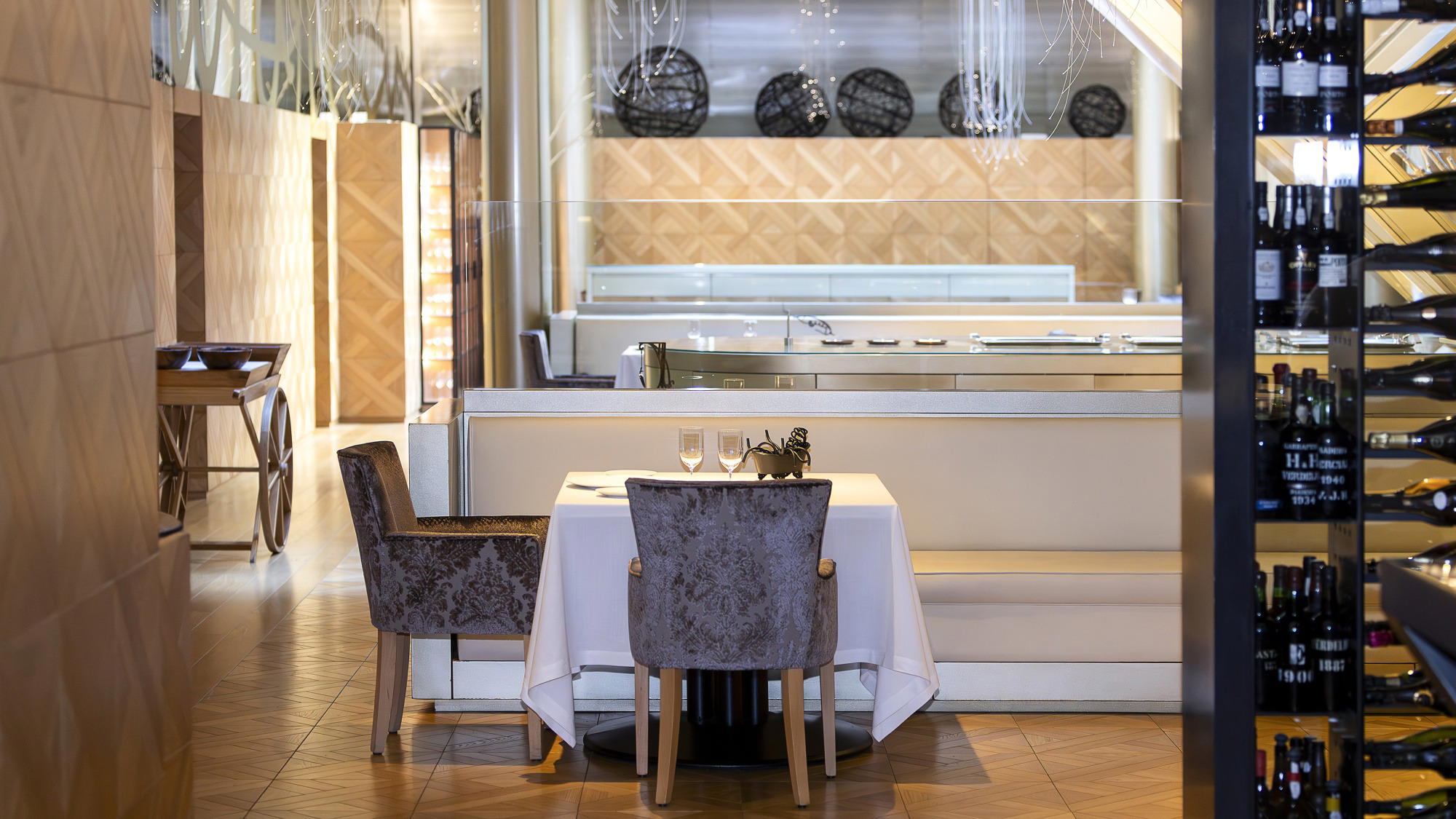
Where the Eixample Meets the Basque Country's Long Shadow
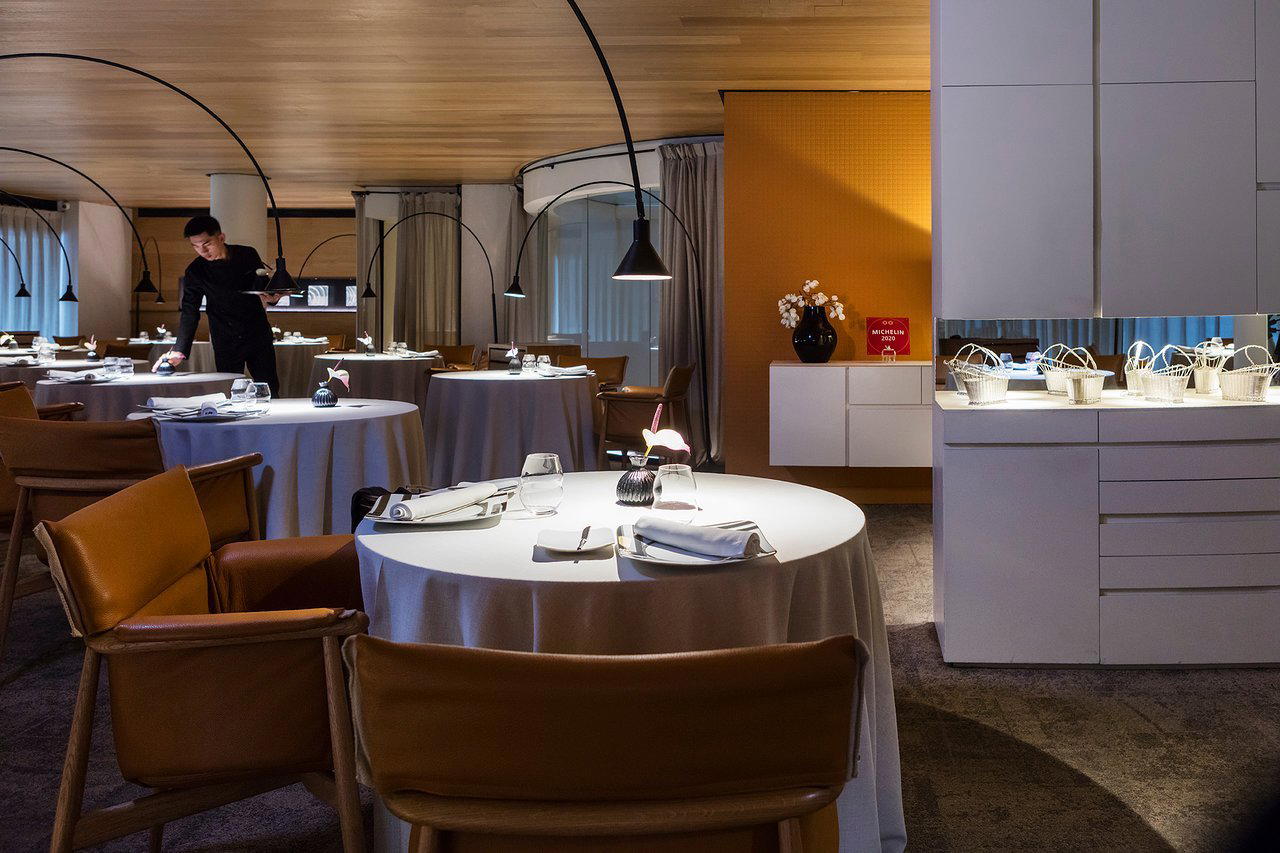
The ceiling at Lasarte moves. Undulating panels designed to suggest wave forms catch the light differently depending on where you sit, and the pendant lamps, translucent, irregular, read as jellyfish suspended mid-drift. Before a single dish arrives, the room has already made an argument: that Spanish fine dining, at this address on Carrer de Mallorca, sits closer to installation art than to the tablecloth traditionalism that still defines three-star dining in other European capitals. Lasarte is a three-Michelin-star restaurant in Barcelona’s Eixample district, where Paolo Casagrande leads modern Basque-Mediterranean fine dining. Barcelona's top tier of creative restaurants has long operated in this register. Disfrutar (Progressive, Creative) and Enigma (Creative) share a similar conviction that the physical environment is part of the proposition, not an afterthought. Lasarte belongs to that cohort.
What distinguishes it within that group is provenance. The restaurant takes its name from Lasarte-Oria, the town south of San Sebastián where Martín Berasategui built his flagship, and where the culinary logic underpinning this Barcelona address was first developed. The Basque Country's grip on Spanish haute cuisine is well documented. Arzak in San Sebastián and Azurmendi in Larrabetzu are part of the same generational tradition of encoding regional ingredient knowledge inside technically demanding, forward-looking menus. Lasarte Barcelona carries that lineage into a Catalan context, and the tension between those two strong culinary identities is one of the more interesting dynamics the room contains.
Local Ingredients, Transferred Technique
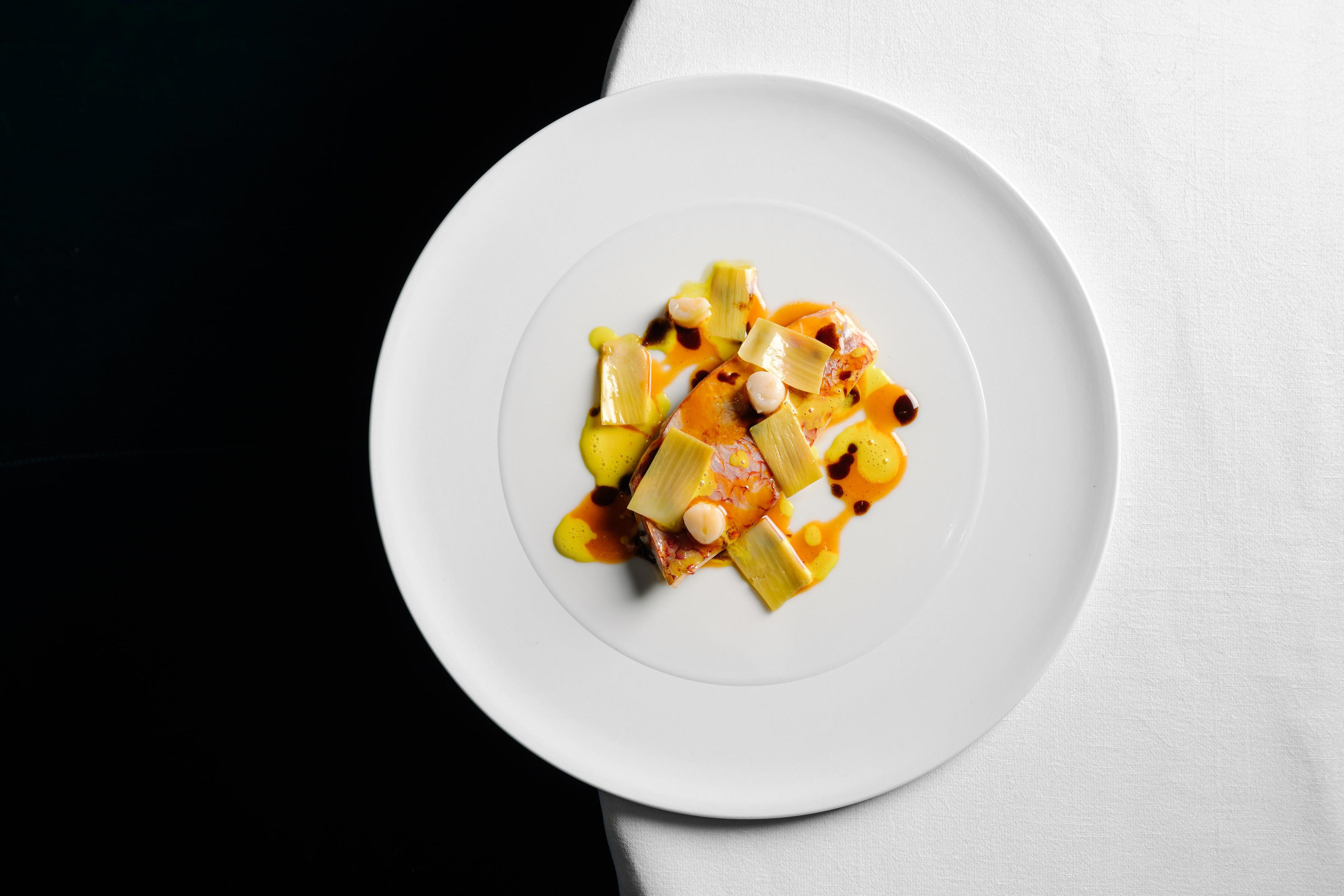
Progressive Spanish cooking at this level has always operated at the intersection of place and method: the product anchors the dish to a specific geography, while the technique can arrive from anywhere. That principle runs through the work of chefs trained under Berasategui, where precision-driven preparation, low-temperature cookery, precise emulsifications, textural contrast engineered at a granular level, serves as a frame rather than a statement in itself. The goal is to make the ingredient more legible, not to obscure it behind process.
Paolo Casagrande, who leads the kitchen, has trained within that school long enough that its grammar is entirely his own. The menu is co-credited to both Casagrande and Berasategui, which is an unusual arrangement at this level and tells you something about how the kitchen treats the relationship between origin and evolution: it doesn't pretend the lineage doesn't exist, and it doesn't allow that lineage to calcify into repetition. What that means in practice is a menu that holds Basque technique and Catalan raw material in deliberate dialogue rather than resolving the tension prematurely. Fish and meat remain structurally central to the menu; For guests whose preference runs toward plant-forward progression, the sister address Oria (also within the Berasategui network) may be the more relevant reference point.
For a broader view of how Barcelona's creative restaurants handle the same ingredient-technique question from different starting points, Cocina Hermanos Torres (Creative) and ABaC (Creative) offer useful comparisons within the city's four-star tier. Further afield, Quique Dacosta in Dénia and Aponiente in El Puerto de Santa María show how the same Iberian-technique tradition plays out when the anchor ingredient shifts to Mediterranean seafood and Atlantic marine products respectively. Across the peninsula, El Celler de Can Roca in Girona and DiverXO in Madrid mark the outer poles of how far Spanish creative cooking is willing to move from its regional bases.
The Awards Record and What It Confirms
Lasarte holds three Michelin stars, and Google users rate it 4.7 across 1,403 reviews. The Google rating across 1,364 reviews sits at 4.7, which is a meaningful signal at this price point: three-star restaurants attract guests with high baselines, so sustained satisfaction at that score implies consistent execution rather than occasional excellence.
That consistency is itself a form of argument. Spin-off addresses, restaurants operating under a flagship chef's name at a secondary city, frequently underperform the original over time, as kitchen attention and talent concentrate back at the source. The accumulated award history at this address suggests that pattern has not taken hold here. Within Barcelona's current creative tier, Lasarte's three-star status puts it alongside Disfrutar at the upper end of the city's formal fine dining spectrum, while addresses like Cinc Sentits (Modern Spanish, Creative) operate at a high level with a different tasting-menu format and a somewhat different price-to-formality register. For anyone mapping Barcelona's restaurants by creative ambition and award density, our full Barcelona restaurants guide is the most efficient place to start.
Il Milione and the Private Dining Tier
A format called Il Milione occupies a distinct position within the restaurant's structure. Named in reference to Marco Polo's account of his travels, it functions as a private dining room operating independently of the main dining room, the former chef's table reconfigured as a self-contained experience. The concept is framed around the idea of guiding guests through ingredients, technique, and creative logic as a sequential narrative rather than a conventional tasting menu. At this price tier, private formats of this kind have become one of the clearer differentiators among restaurants that already offer comparable food quality in their main rooms. Il Milione represents the address's highest-formality option for groups or guests who want a more controlled environment.
Planning Your Visit
Lasarte operates Wednesday through Saturday, with lunch seatings from 1 to 3 pm and dinner from 8 to 10 pm. The restaurant is closed Monday, Tuesday, and Sunday. The address on Carrer de Mallorca, 259 places it in the Eixample grid, within reasonable distance of the city's main hotel cluster and well-served by metro. The price range is at the upper end of Barcelona's dining spectrum, consistent with three-star positioning, so budget expectations should align with comparable addresses in the city. There is an à la carte option alongside the set menu, which gives the room a slightly wider range of guest types than pure tasting-menu formats allow.
For those building a longer Iberian itinerary, Culler de Pau in O Grove represents one of the more interesting progressive Spanish addresses outside the main urban centres.
In Context: Similar Options
Comparable venues nearby, for context on price, style, and recognition.
| Venue | Cuisine | Price | Awards | Notes |
|---|---|---|---|---|
| LasarteThis venue — the venue you are viewing | Modern Basque-Mediterranean Fine Dining | $$$$ | Michelin 3 Star | |
| ABaC | Modern Catalan Fine Dining | $$$$ | Michelin 3 Star | Sant Gervasi - la Bonanova |
| Enigma | Modern Spanish Avant-Garde Tasting Menu | $$$$ | Michelin 2 Star | Sant Antoni |
| Cocina Hermanos Torres | Modern Spanish Fine Dining | $$$$ | Michelin 3 Star | les Corts |
| Can Fabes | Modern Catalan Fine Dining | $$$$ | World's 50 Best #11 | la Nova Esquerra de l'Eixample |
| Moments | Modern Catalan Fine Dining | $$$$ | Michelin 1 Star | la Dreta de l'Eixample |
Continue exploring
More in Barcelona
Restaurants in Barcelona
Browse all →
Bars in Barcelona
Browse all →
Hotels in Barcelona
Browse all →
At a Glance
- Elegant
- Sophisticated
- Modern
- Special Occasion
- Date Night
- Business Dinner
- Hotel Restaurant
- Private Dining
- Chefs Counter
- Extensive Wine List
- Sommelier Led
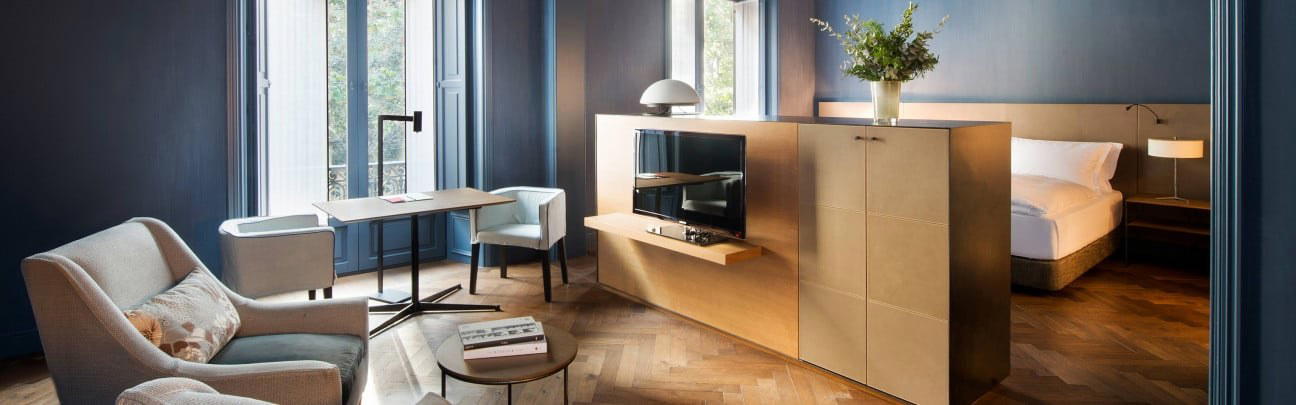
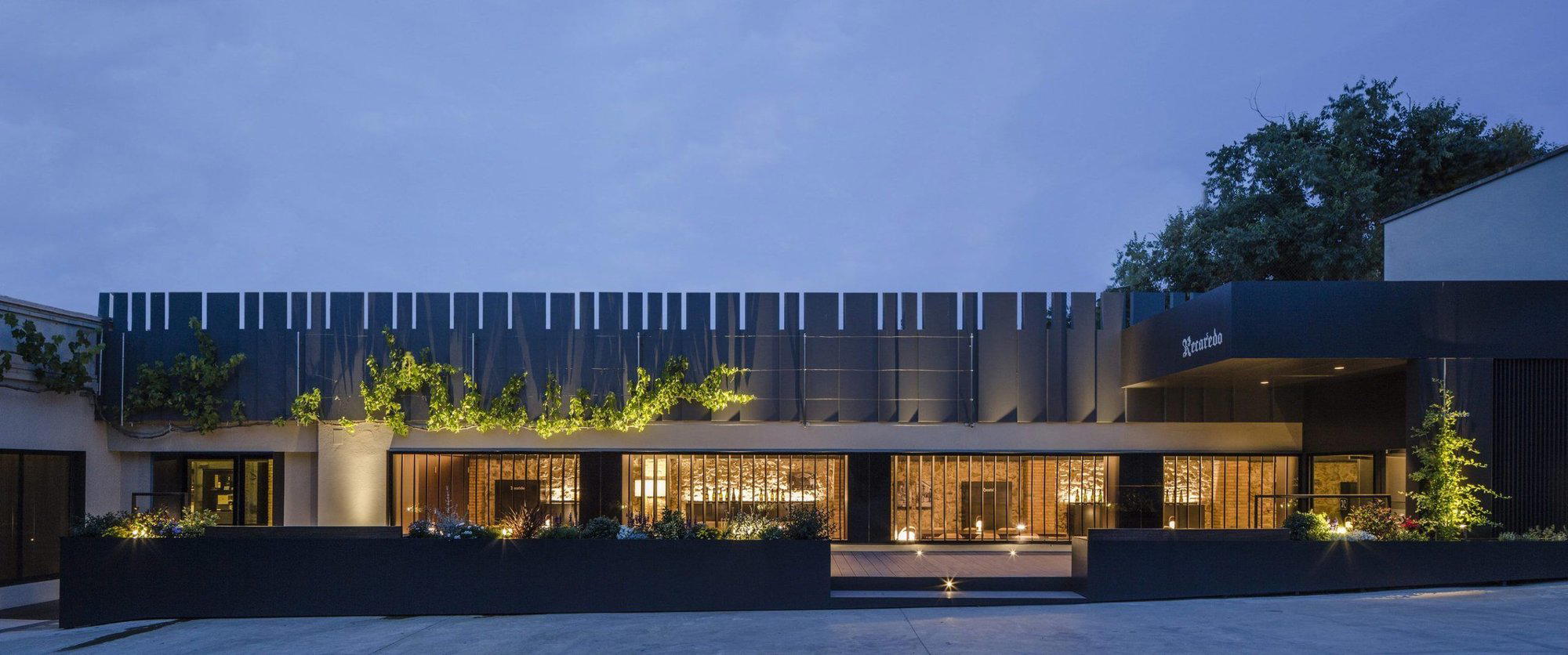
Modern and avant-garde with spacious, bright rooms featuring careful lighting, oak wood textures, undulating ceilings mimicking waves, ethereal jellyfish-like lamps, and golden tones.