

Our verdict
A serious mountain-region dining address in Toyama, L'évo cuisine régionale. places Eiji Taniguchi’s innovative cooking inside the wider argument for rural Japanese gastronomy. Its 2026 Opinionated About Dining ranking at No. 17 in Japan gives the restaurant a national signal, while the Nanto setting keeps the focus on regional identity rather than city-restaurant polish.

Pearl is the En Primeur Club membership app, where members save venues, book tables and use the concierge.

The approach to Toyama changes the terms of dining before the first plate arrives. This is not Tokyo’s dense counter culture or Kyoto’s choreographed hotel dining, but a quieter, more exposed Japanese restaurant experience shaped by distance, weather, and the agricultural communities around the city and prefecture. L'évo cuisine régionale. belongs to a newer category of destination dining in Japan where the region is not background decoration but the organising principle.
That matters because regional Japanese gastronomy has become one of the country’s most interesting high-end movements. The old model sent ambitious chefs to major cities while provinces supplied ingredients. The newer model reverses that line: chefs build in the producing region and let the kitchen’s vocabulary follow what the place can sustain. In Toyama, that means local produce, rural rhythms, and a broader food culture shaped by coast, mountains, and inland communities.
Mountain-region cooking, not city luxury relocated to the hills
“Innovative” can be soft when applied to Japanese restaurants, but here it separates the experience from fixed kaiseki, sushi, or French fine-dining templates. The point is not novelty. It is how a regional kitchen borrows technique from outside Japan without losing its local grammar. At this level, the better question is not whether the cooking is French, Japanese, or modernist, but whether the meal could make sense in another prefecture. In Toyama, that is a useful test.
Eiji Taniguchi matters, though the restaurant need not be read as a personal origin story. Chef-led rural dining in Japan works when technique structures local supply rather than turning the countryside into scenery. Taniguchi’s kitchen follows that discipline: regional cooking with enough formal ambition to register nationally, and a name that declares local intent. The French phrasing of “cuisine régionale” is not cosmetic; it signals a European idea of place-based cooking translated into a Japanese regional context.
The restaurant’s inclusion in the 2026 Opinionated About Dining Top Restaurants in Japan list, ranked No. 17, gives that regional argument weight beyond Toyama. OAD’s Japan list tends to reward serious diner-led consensus rather than mass familiarity, so the placement helps travellers decide whether a remote meal justifies the logistics. It also places the restaurant in Japan’s national conversation, not only a local tourism frame.
Toyama is often reduced to seafood in travel shorthand because the bay has a clear identity in Japanese food culture. The more interesting reading is broader. The prefecture has coastal, river, mountain, and snow-country influences in close range, and a restaurant in Toyama redirects attention from the obvious bay narrative to a deeper agricultural and upland identity. That shift is the editorial reason to pay attention.
Why the chef's route matters in Toyama's current dining scene
High-end Japanese regional restaurants increasingly depend on chefs technically fluent enough to compete with metropolitan dining rooms, but patient enough to let smaller communities set the pace. The strongest avoid both folklore theatre and urban transplantation. They make the region legible through structure, sourcing logic, and restraint. L'évo cuisine régionale. fits because its ambition is inseparable from Toyama, not placed there for atmosphere.
For travellers building a Toyama itinerary, this differs from choosing a central-city restaurant after a museum or station arrival. The meal asks for planning around the region, not slotting between errands. That is the format, not a flaw. A destination restaurant should change the day’s shape. The reward is not convenience, but a clearer reading of Toyama dining outside urban expectations.
The wider Toyama table is worth mapping with that distinction. Other Toyama dining rooms speak to different parts of the prefecture’s dining culture, from everyday local appetite to more specialised formats. Together, they make Toyama less a single-dish destination than a compact food region with sharply different registers.
For broader planning, Our full Toyama restaurants guide is the useful starting point, with adjacent context in Our full Toyama hotels guide, Our full Toyama bars guide, Our full Toyama wineries guide, and Our full Toyama experiences guide. Those categories matter because a restaurant outside the urban core benefits from an itinerary built around sleep, transport, and timing, not just appetite.
How to read the experience before committing the time
The right expectation is a serious regional meal with national recognition, not a casual detour. Price details are not published here, so the better signal is category: innovative destination dining, chef-led, and ranked in a national OAD list. That combination usually belongs to a planning-first tier, especially outside a major station district. Diners wanting spontaneity, broad à la carte choice, or a child-first room will likely be better served elsewhere in the city.
The editorial value is clearest for travellers who already care how Japanese regional cooking is changing. Toyama is not imitating Tokyo’s luxury signals here. Its strength is compressed landscape and food culture: bay, mountains, snow, farms, villages, and small cities in close proximity. A meal here gives that geography a formal dining language.
Japan’s broader innovative-dining category is large and uneven, which is why regional specificity matters. For contrast outside Toyama, EP Club’s Japan and Asia archive ranges across other dining rooms in major and regional cities, while international examples show how the same label can mean completely different things once local context takes over.
The case for L'évo cuisine régionale. is specific rather than universal. It suits a traveller who wants Toyama to explain itself through a composed meal, and who values a chef’s technical evolution in service of place. In a country where many ambitious restaurants cluster around familiar luxury districts, this one makes the region the central argument.
Frequently asked questions
Would L'évo cuisine régionale. be comfortable with kids?
The setting in Toyama and the OAD-ranked dining format suggest a serious meal rather than a casual family stop. For children, the fit depends on whether they can handle a formal multi-course service and the pace of an innovative restaurant.
What's the vibe at L'évo cuisine régionale.?
Expect a regional dining room in Toyama with a chef-led, innovative approach from Eiji Taniguchi. The 2026 OAD ranking signals a restaurant taken seriously by diners who plan ahead.
What type of food is L'évo cuisine régionale. known for?
L'évo cuisine régionale. serves Innovative cuisine.
What is L'évo cuisine régionale. known for?
L'évo cuisine régionale. is primarily known for Innovative in Toyama.
Comparable Venues Nearby
Comparable venues nearby, for context on price, style, and recognition.
| Venue | Cuisine | Price | Awards | Notes |
|---|---|---|---|---|
| L'évo cuisine régionale.This venue (the venue you are viewing) | Avant-Garde Regional Japanese-French Fine Dining | $200–300 | Not listed | Not listed |
| KAWAZ | French with Toyama Ingredients | $100–150 | Not listed | Sogawa |
| シンポジウム | Vegetable-Focused Italian Regional Cuisine | $100–150 | Not listed | Hommachi |
| 鮨し人 | Edomae Sushi Omakase | $150–200 | Not listed | Nishinakanomachi |
| Tempura Koizumi Takano | Seasonal Kansai-style Tempura Omakase | $100–150 | Tabelog 100 #79 | Toyama Station area |
| Oryori Fujii | Toyama Kaiseki | $200–300 | Tabelog Silver #23 | Iwase |
Recognition history
Dated appearances from independent guides and award organizations, with the underlying list record or original source where available.
Opinionated About Dining Top Restaurants in Japan Ranked #17
Opinionated About Dining
The Japan Times Destination Restaurants Destination Restaurants Selection #1
The Japan Times Destination Restaurants
Continue exploring
More in Toyama
Restaurants in Toyama
All restaurants in Toyama →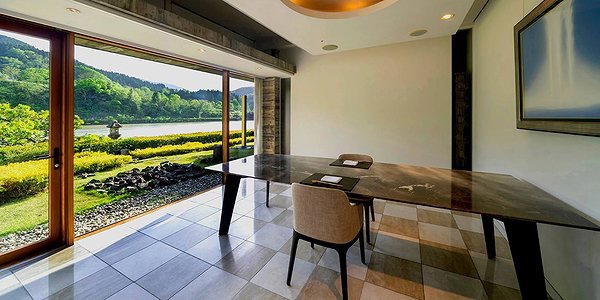
Hotels in Toyama
All hotels in Toyama →
Wineries in Toyama
All wineries in Toyama →
L'évo cuisine régionale.
The wine
- Extensive wine list
- Sommelier-led
- Sake program
Details
- Sophisticated
- Quiet
- Scenic
- Modern
- Romantic
- Special Occasion
- Celebration
- Date Night
- Private Event
- Hotel Restaurant
- Standalone
- Design Destination
- Extensive Wine List
- Sommelier Led
- Sake Program
- Local Sourcing
- Farm To Table
- Organic
- Mountain
- Tasting Menu
- Prix Fixe
- Wine
- Sake
- Vegetarian Friendly
- Allergy Accommodating
Quiet, nature-immersed, and intimate, with a refined, modern-rustic auberge feel shaped by mountain scenery and seasonal surroundings.