
Tabelog 100 #97
Our verdict
Kanransha places Hiroshima okonomiyaki in its proper register: not as tourist shorthand, but as a compact dining ritual built around the griddle, counter pacing, and a low-cost everyday format with serious local recognition. Its Tabelog 100 Okonomiyaki selection in 2025 puts it in the city’s narrower group of specialist addresses rather than the broader casual field.

Pearl is the En Primeur Club membership app, where members save venues, book tables and use the concierge.
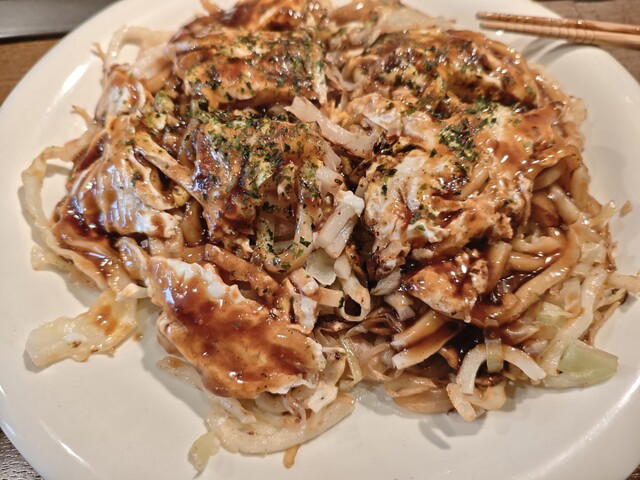
The room explains itself before the first order: a compact Hiroshima restaurant, diners close to the teppan, and a scale that keeps the meal near the work surface. Hiroshima okonomiyaki needs that proximity. Unlike Kansai-style mixing, it is layered in sequence and watched as much as eaten: batter, cabbage, noodles, egg, sauce, the press and turn of the spatula. A griddle seat turns casual lunch into civic craft.
In Hiroshima, okonomiyaki is not novelty food. It is everyday cooking with its own hierarchy, from quick counters to specialist rooms where regulars care about texture, timing, and cleanly held layers. Kanransha belongs to the latter. Its Tabelog 100 Okonomiyaki 2025 selection gives it an external credential in a category where local familiarity can blur into folklore. Its 3.67 listing score matters less as a number than as a signal: not luxury dining, but respected inside a competitive comfort-food genre.
Hiroshima okonomiyaki as a counter ritual, not a casual pancake
The outsider mistake is treating Hiroshima okonomiyaki as a loose, sauced street-food plate. The city’s version is disciplined. Layers cook at different speeds without collapsing, and noodles change the dish’s weight. At the counter, those decisions become legible: the cook’s sequence is part of the meal, and the diner’s role is codified: watch, wait, eat while the structure holds.
Kanransha’s compact footprint reinforces that etiquette. The room feels closer to a workshop than a dining hall, with the meal organized around the griddle rather than around spectacle. Different kinds of diners can coexist because the food sets the tempo. The restaurant sits within a city where okonomiyaki ranges from a quick everyday meal to a focused specialist experience.
The format stays casual rather than ceremonial. That restraint fits. Hiroshima okonomiyaki is not imitating kaiseki ceremony or Tokyo counter theatre; its confidence comes from repetition, affordability, and a room built around heat. In a Hiroshima itinerary, the contrast helps: the city’s dining stretches into many registers, but okonomiyaki remains the form locals most immediately recognize as their own.
Why recognition matters in a category built on repetition
A Tabelog 100 selection means something different in okonomiyaki than in fine dining. There is no tasting-menu scaffolding, lengthy wine pairing, or theatrical service arc to hide behind. The measure is consistency within a familiar template. When a Hiroshima specialist appears in the 2025 Okonomiyaki list, the implication is credibility within repetition, not reinvention.
That separates Kanransha from Hiroshima restaurants built around occasion dining. Comparison venues including 野趣 拓, イプシロン, Tyra Restaurant, シェモモ, and レストラン シャンボール answer a different reader decision: longer meals, different service expectations, and more emphasis on restaurant identity. Okonomiyaki asks a simpler but less forgiving question: can a familiar dish justify a trip across town in a city with countless versions? Recognition answers part of it; the format answers the rest.
The price band also shapes the read. Hiroshima has restaurants that require scheduling and expense management; this category does not. Low-cost specialist dining carries different pressure: the room turns on core technique rather than luxury cues. Close-up griddle work and compact service matter more than ceremony. For days built around museums, riverside walks, and evening drinks, the value is not only the bill but seeing a regional staple performed close up.
For broader planning, Our full Hiroshima restaurants guide gives the wider dining context, while Our full Hiroshima bars guide and Our full Hiroshima hotels guide place the meal within a night out or short stay. Visitors building a fuller regional view can also compare food-focused stops with Our full Hiroshima experiences guide and Our full Hiroshima wineries guide.
A compact specialist for diners who want the griddle in view
Read Kanransha as a specialist address inside Hiroshima’s everyday canon. The compact setting, griddle orientation, and Tabelog 100 Okonomiyaki 2025 recognition all point to diners who care about form over spectacle. The pleasure is procedural, and the room makes the procedure visible.
That does not narrow the audience. The listing places Kanransha in an accessible dinner and lunch budget band of JPY 1,000 - JPY 1,999, matching how okonomiyaki works in Hiroshima: quick enough for a weekday, specific enough for visitors, social without requiring a formal occasion. The trade-off is scale. Small specialist rooms reward timing and flexibility, especially when busy, and suit diners comfortable with close quarters and a focused menu category.
Hiroshima’s food culture is clearer when okonomiyaki sits beside other Japanese regional and global formats, not as a postcard dish. A griddle counter differs from formal dining rooms, seafood-focused counters, café meals, curry specialists, and drinking-led stops. Kanransha’s place is more direct: layered okonomiyaki, cooked close to the diner, with technique carrying the experience rather than décor or ceremony.
Within Hiroshima, the surrounding itinerary can move easily between categories, from regional drinking culture to sweets and contemporary dining. Against that range, Kanransha’s value is direct: it anchors the trip in the city’s defining griddle tradition without turning the meal into ceremony for its own sake.
Frequently asked questions
Is Kanransha a family-friendly restaurant?
Kanransha is an accessible okonomiyaki specialist in Hiroshima. For family use or current practical details, check the venue's official channels before visiting.
What is the atmosphere like at Kanransha?
It is a compact Hiroshima okonomiyaki restaurant where the griddle-focused format suits casual meals. The Tabelog 100 Okonomiyaki 2025 selection gives it additional weight for diners looking for a recognized specialist in Hiroshima.
What price level is Kanransha?
Pricing at Kanransha is listed as JPY 1,000 - JPY 1,999, with both dinner and lunch in the JPY 1,000 - JPY 1,000 - JPY 1,999 budget band.
What time does Kanransha open and close?
Current opening hours are not provided here. Check Kanransha's official channels or current listings before visiting.
Cuisine and Credentials
Nearby venues at a similar price tier for orientation.
| Venue | Cuisine | Price | Awards | Notes |
|---|---|---|---|---|
| KanranshaThis venue (the venue you are viewing) | Hiroshima-Style Okonomiyaki | $1–10 | Tabelog 100 #97 | Not listed |
| Soba Kiri Gin | Traditional Japanese Soba | $10–20 | Tabelog 100 #69 | Minami |
| Hiroshima Marukajiri Naka-chan | Hiroshima okonomiyaki & teppanyaki izakaya | $20–30 | Tabelog 100 #15 | Naka |
| Okonomiyaki Junior | Hiroshima-style okonomiyaki & teppanyaki counter | $10–20 | Tabelog 100 #100 | Naka |
| 和牛lab K | Sakakiyama Beef Yakiniku | $50–100 | Tabelog Bronze #509 | Nishi |
| Masaru | Hiroshima Okonomiyaki | $10–20 | Tabelog 100 #30 | Higashi |
Recognition history
Dated appearances from independent guides and award organizations, with the underlying list record or original source where available.
Tabelog 100 #97 · No. 97
Tabelog · Tabelog 100 - Okonomiyaki - 2025
Continue exploring
More in Hiroshima
Restaurants in Hiroshima
All restaurants in Hiroshima →
Bars in Hiroshima
All bars in Hiroshima →
Details
- Cozy
- Classic
- Solo
- Family
- Casual Hangout
- Standalone
- Beer Program
- A La Carte
- Counter Dining
- Beer
Current opening hours
- Monday
- Closed
- Tuesday
- 11:30 AM–1 PM, 6–7:30 PM
- Wednesday
- 11:30 AM–1 PM, 6–7:30 PM
- Thursday
- 11:30 AM–1 PM, 6–7:30 PM
- Friday
- Closed
- Saturday
- 11:30 AM–1 PM, 6–7:30 PM
- Sunday
- 11:30 AM–1 PM, 6–7:30 PM
Hours can change for holidays and private events. Hours as of .
A small, casual house restaurant with counter seating and a relaxed, neighborhood feel.