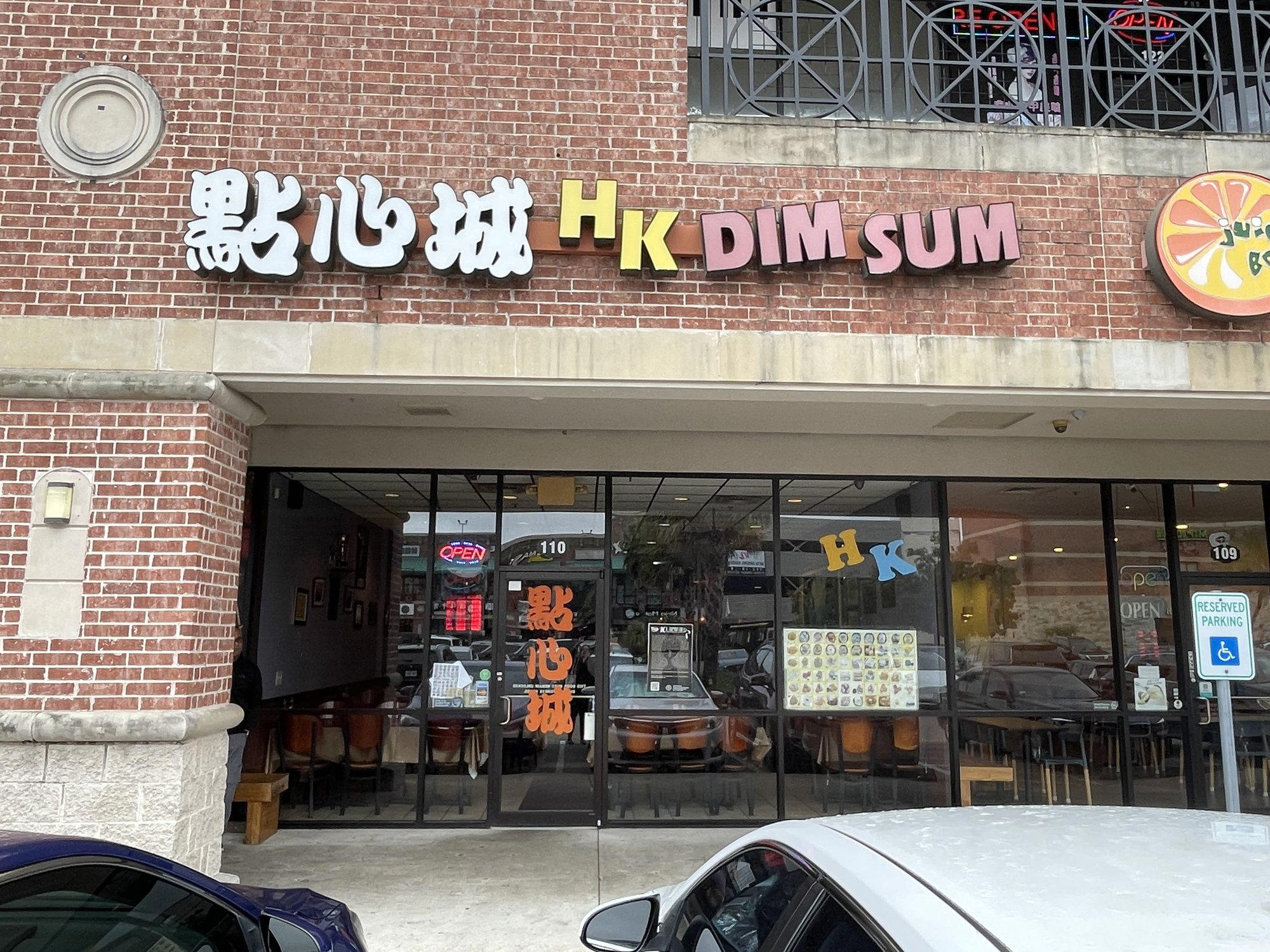
HK Dim Sum
Our verdict
On Bellaire Boulevard, Houston's de facto Cantonese corridor, HK Dim Sum operates within a dining tradition where the food does the talking and the room fills fast. The format is classic Hong Kong-style service: carts, steam, and the particular rhythm of a table that orders by pointing. For anyone tracking where Houston's Chinese diaspora community actually eats, this address on the 9889 Bellaire stretch is a reliable reference point.

Pearl is the En Primeur Club membership app — saves, bookings, and concierge access live there. Same editors, same standards.
- Address
- 9889 Bellaire Blvd STE 110, Houston, TX 77036, USA
- Phone
- (713) 777-7029
- Hours
- Mon–Wed 10 AM–5 PMThu–Sun 10 AM–9 PM
- Website
- hkdimsum.kwickmenu.com
- Directions
- Get directions
The menu
What to order
- Steamed Shrimp Dumpling
- Steamed Chicken Feet
- Shrimp & Pork Dumpling
Bellaire Boulevard and the Logic of Houston's Cantonese Belt
Houston's Chinese dining geography has a center of gravity, and it runs along Bellaire Boulevard through the Sharpstown and Chinatown corridor southwest of downtown. This stretch, sometimes called the "New Chinatown," holds a higher concentration of Cantonese, Sichuan, Shanghainese, and Taiwanese restaurants per block than almost any comparable strip in the American South. Within that corridor, dim sum is not a weekend novelty but a weekly ritual for tens of thousands of Houston residents with roots across Guangdong, Hong Kong, and the broader Cantonese diaspora. HK Dim Sum, at 9889 Bellaire Boulevard, sits inside that tradition rather than outside it, which is precisely what makes it worth understanding on its own terms.
The competitive set here is not the hotel brunch dim sum of midtown Manhattan or the chef-driven small-plates format that borrows dim sum's aesthetic for a different audience. The peers are the family-run, high-turnover Cantonese houses that have served this corridor for two and three decades, where the measure of quality is fidelity to technique and the speed of the cart, not the price of the tasting menu. For comparison, the fine-dining tier of Houston dining, including venues like March and Le Jardinier Houston, operates on an entirely different axis of ambition and price. HK Dim Sum answers a different question: where do you go when you want the real thing, served the traditional way, in a room full of people who have been eating this food their whole lives?
The Rhythm of a Dim Sum Room
Walking into a functioning dim sum house at peak service on a Saturday or Sunday morning is one of the more kinetic dining experiences in any city. The sound profile alone, the Cantonese spoken at volume, the clatter of bamboo steamers, the squeak of cart wheels on tile, tells you immediately whether a room is operating at full register. Dim sum at this level is not a composed, paced dining experience in the way that an omakase counter or a tasting menu is. It is organized around availability and timing: what arrives at your table is partly what you ordered and partly what the kitchen has moving at that moment.
The format at traditional Hong Kong-style houses like this one places the front-of-house team at the center of the meal in a way that formal Western service does not. Cart operators are the interface between kitchen output and table, making judgment calls on timing, reading which tables are ready, and managing the pace of a room that may be turning over dozens of covers simultaneously. That team dynamic, between kitchen production and floor delivery, is what determines whether the har gow arrives at the right temperature or sits cooling in a cart queue for too long. In the leading dim sum operations, the coordination is nearly invisible. The food lands when it should.
What the Cuisine Asks of Its Kitchen
Cantonese dim sum is technically demanding in ways that are easy to underestimate. The dough work alone, the translucent wrapper of a properly made har gow, the layered pastry of a wife cake, the precise pleat count on a siu mai, requires a level of hand skill that takes years to develop and does not benefit from shortcuts. The Cantonese culinary tradition prizes subtlety of flavor and precision of texture over the assertive spicing that characterizes other regional Chinese cuisines. A well-made piece of cheung fun should have exactly the right tension in the rice noodle, enough to hold together but yielding immediately. These are not effects you can achieve with inferior ingredients or rushed preparation.
Houston's Bellaire corridor has enough volume and enough community knowledge to support kitchens that maintain these standards. The diaspora audience is not forgiving of technical failure in the way that a tourist-facing restaurant can sometimes be. This is an important context for understanding why the dim sum houses along this stretch, including HK Dim Sum, operate the way they do: the customer base knows the benchmark.
Placing HK Dim Sum in the Houston Dining Picture
Houston's restaurant scene has earned sustained national attention across multiple categories. The city's Indian dining, represented at the high end by Musaafer, its Spanish tradition through BCN Taste & Tradition, and its masa-focused Mexican work at Tatemó, all reflect a city with genuine culinary range. But much of what makes Houston's food culture substantive happens at the neighborhood level, in the diaspora-serving restaurants along corridors like Bellaire, where the food is not aimed at a national audience and the standards are set by the community itself.
HK Dim Sum belongs to that neighborhood tier, which is not a diminishment. Some of the most technically rigorous cooking in any American city happens in exactly these contexts, where the kitchen has no reason to adjust the food for outside expectations. For travelers and locals who have been through the fine-dining circuit, from Le Bernardin in New York to The French Laundry in Napa to Providence in Los Angeles, a meal at a well-run Cantonese dim sum house offers something those rooms do not: the particular pleasure of food that is not performing for you, but simply doing what it has always done. You can also explore more of what the city offers through our full Houston restaurants guide.
Planning Your Visit
Dim sum service in Chinese dining tradition typically runs from mid-morning through early afternoon, with peak hours on weekends drawing the longest waits at the most established houses. Arriving early, by 10am on a Saturday or Sunday, is the standard strategy for avoiding a queue. Groups of four to six make sense for this format because the number of dishes you can reasonably sample scales directly with table size. HK Dim Sum is located at 9889 Bellaire Boulevard, Suite 110, in the heart of the Bellaire corridor, accessible by car with parking available in the surrounding commercial complex. For current hours and reservation policy, contacting the venue directly is the most reliable approach, as dim sum houses in this corridor do not always maintain updated third-party listings.
Frequently asked questions
How do I find HK Dim Sum?
HK Dim Sum is located at 9889 Bellaire Blvd STE 110, Houston, TX 77036, USA, Houston.
How does HK Dim Sum compare to other dim sum restaurants along Houston's Bellaire Boulevard corridor?
The Bellaire Boulevard stretch through Sharpstown and the Houston Chinatown corridor hosts a concentration of Cantonese dim sum houses that is among the densest outside of major coastal cities, making it a genuine peer comparison rather than a binary choice. HK Dim Sum at 9889 Bellaire Blvd Suite 110 sits within this competitive cluster, where proximity means kitchens are held to consistent community standards. Regulars in this part of Houston tend to rotate between two or three preferred houses rather than committing exclusively to one.
What's the must-try dish at HK Dim Sum?
The kitchen sits squarely in the Cantonese tradition, which means the benchmark dishes are the dough-intensive ones: har gow and siu mai are the standard by which any dim sum house is judged in this corridor. On Bellaire Boulevard, where competition among Cantonese kitchens is dense, these are the dishes that separate a serious operation from a casual one. Order them first and judge from there.
Should I book HK Dim Sum in advance?
Dim sum houses in the Bellaire Boulevard corridor typically do not take reservations in the conventional sense — weekend morning service runs on a first-come basis, and peak hours between 10am and noon draw the longest waits. Arriving before 10am on a Saturday or Sunday is the practical way to avoid a queue. Weekday visits move considerably faster.
What's the defining dish or idea at HK Dim Sum?
HK Dim Sum operates within the Cantonese yum cha format, where the defining idea is quantity across categories rather than a single signature plate. The kitchen's range across steamed, fried, and baked preparations is what the format demands, and the address on Bellaire Boulevard places it directly inside Houston's most competitive Chinese dining stretch. The translucent wrapper on a properly made steamed dumpling remains the clearest measure of technical execution.
Is HK Dim Sum good for vegetarians?
Traditional Cantonese dim sum menus include vegetable dumplings, tofu preparations, and steamed rice rolls that contain no meat, though the broader menu skews heavily toward pork, shrimp, and seafood. Vegetarians can typically assemble a workable selection, but the format is not designed around plant-based dining. Confirming specific options on arrival is advisable.
Is a meal at HK Dim Sum worth the investment?
Dim sum on Bellaire Boulevard has historically represented some of the stronger value in Houston dining — the format produces a full table of food at a per-person cost that most sit-down restaurants cannot match. HK Dim Sum at 9889 Bellaire Blvd operates in one of the city's most competitive Chinese dining corridors, which keeps quality expectations high across the board. The question is less about price and more about timing your visit to avoid the weekend rush.
In Context: Similar Options
| Venue | Cuisine | Price | Awards | Notes |
|---|---|---|---|---|
| HK Dim SumThis venue — the venue you are viewing | Hong Kong Dim Sum | $10–20 | Not listed | Not listed |
| Musaafer | Modern Indian Fine Dining | $100–150 | 1 Michelin Star | Indian |
| March | Modern Mediterranean Tasting | $200–300 | 1 Michelin Star · Star Wine List | Venetian |
| Nancy's Hustle | Modern American Bistro | $50–100 | Michelin Bib Gourmand | Not listed |
| Theodore Rex | Modern American Small Plates | $50–100 | Michelin Bib Gourmand · Resy Best of the Hit List | Not listed |
| Hidden Omakase | Modern Japanese Omakase | $150–200 | Michelin Plate | Not listed |