Hattie B's Hot Chicken - Nashville - West
Our verdict
Among Nashville's proliferating fast-casual chicken counters, Hattie B's West location on Charlotte Avenue holds its ground as a benchmark for the city's signature hot chicken tradition. The format is counter-service and deliberately stripped back, with heat levels that range from mild to the kind of 'Shut the Cluck Up' register that demands respect. It sits in a different tier from white-tablecloth Southern dining, but it answers the same question about Tennessee flavor with equal seriousness.

Pearl is the En Primeur Club membership app — saves, bookings, and concierge access live there. Same editors, same standards.
- Address
- 5209 Charlotte Ave, Nashville, TN 37209
- Phone
- (615) 576-3900
- Hours
- Mon–Thu 10:45 AM–10 PMFri–Sat 10:45 AM–11 PMSun 10:45 AM–10 PM
- Website
- hattieb.com
- Directions
- Get directions
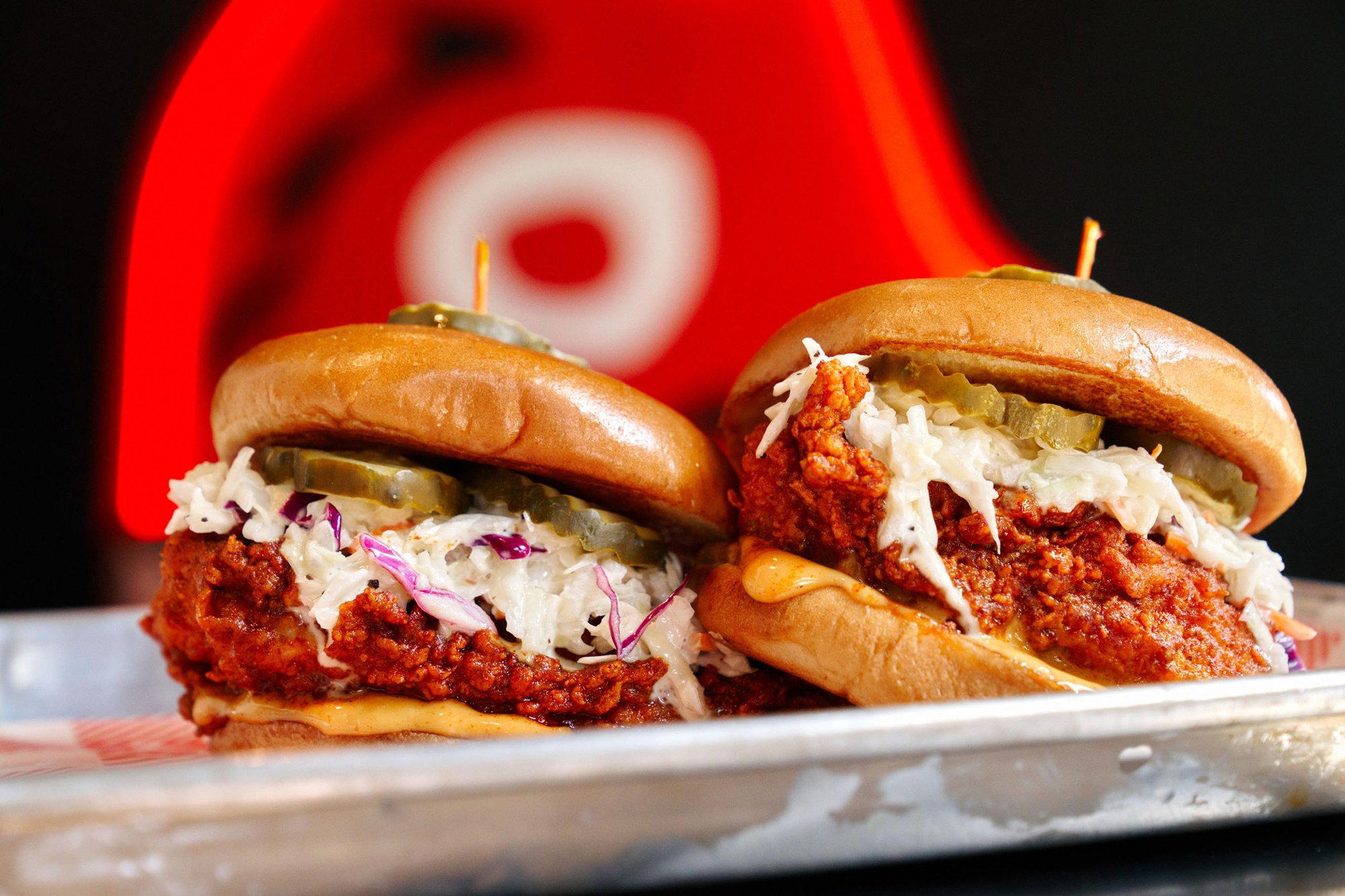
The menu
What to order
- Hot Chicken Sandwich
- Chicken Tenders
- Half Bird
- Chicken and Waffles
Nashville's Hot Chicken Tradition and Where It Lives Now
Nashville hot chicken is one of the few American regional dishes with a documented origin story, a defined technique, and a civic pride that borders on constitutional. The cayenne-forward paste applied to fried chicken — in graduated heat levels, served on white bread with pickle chips — emerged from the city's Black culinary tradition decades before it became a national obsession. Today the format has been adopted by fast-food chains, replicated in cities from Portland to London, and commodified at every price point. Against that backdrop, Hattie B's Hot Chicken on Charlotte Avenue in West Nashville remains one of the addresses where the tradition holds a recognizable shape.
The West Nashville location sits at 5209 Charlotte Ave, in a part of the city that has shifted considerably over the past decade as the broader metro area has absorbed new residents and new money. Charlotte Avenue itself runs through a corridor that is neither the tourist-dense Lower Broadway strip nor the polished 12 South block, it occupies a grittier, more functional stretch that reflects the working-city Nashville that predates the honky-tonk tourism wave. That context matters. Hot chicken, in its original form, was never a restaurant-district food; it was a neighborhood food, and the West location's address carries some of that character.
The Format and What It Represents
Counter-service fried chicken operations occupy a specific and honest place in American dining culture. There is no tasting menu architecture here, no sommelier pairing, no tableside theater. The discipline is entirely in the fry and the spice paste, in consistency, heat calibration, and the quality of the bird itself. Nashville's hot chicken circuit, anchored by operators like Hattie B's alongside older institutions and newer competitors, functions as a parallel track to the city's growing fine-dining scene. You can spend an evening at Bastion ($$$$, Contemporary) or sit at the counter at The Catbird Seat, but the hot chicken counter answers a different appetite entirely, one that does not require ceremony to be taken seriously.
The heat-level spectrum is a defining structural element of Nashville hot chicken as a category. From mild through medium, hot, damn hot, and into the extreme register, these gradations are not marketing theater, they represent genuinely different chemical experiences, calibrated by the ratio and type of cayenne and other peppers worked into the finishing paste. Ordering in this system requires some honesty about your own tolerance. Experienced diners at this end of the spectrum tend to treat the upper heat levels with the same considered approach they might bring to very high-Scoville condiments: as something to be respected rather than conquered on a dare.
Sourcing, Sustainability, and the Ethics of Fried Chicken
The sustainability conversation in American dining has largely centered on fine-dining operations with the margin to absorb regenerative sourcing costs, places like Blue Hill at Stone Barns in Tarrytown, Single Thread Farm in Healdsburg, or Smyth in Chicago, all of which have built supply-chain ethics into their editorial identity. The fast-casual end of the market faces a structurally harder problem: the economics of high-volume fried chicken push toward commodity poultry supply chains, and operators at this price tier rarely publish sourcing data with the granularity that premium tasting-menu restaurants do.
That tension is worth naming honestly. Hot chicken, by definition, depends on volume. The cayenne paste, the fryer oil, the bread, the pickles, all of these represent supply decisions made at scale. What distinguishes operators in this category over time is less about declared sustainability frameworks and more about operational consistency: whether the fry oil is managed carefully, whether the bird quality is held at a floor, whether waste from high-volume service is handled with any intention. These are not glamorous metrics, but they are the ones that separate a disciplined operation from a careless one in the fast-casual tier. For diners who apply environmental filters to their choices, fast-casual chicken sits in an honest gray zone, less resource-intensive per meal than a full steakhouse or elaborate tasting menu, but without the supply-chain transparency that places like Addison in San Diego or Providence in Los Angeles have built into their procurement stories.
Nashville's Dining Spectrum in Context
Understanding where Hattie B's West sits requires mapping the full range of Nashville's dining options. The city has built a credible fine-dining cohort over the past decade, Locust with its progressive format, Peninsula in the Southern American register, and 12 South Taproom and Grill at the more casual end, alongside the counter-service and meat-and-three tradition that has defined the city's everyday food culture for generations. Arnold's Country Kitchen represents the meat-and-three anchor; Hattie B's represents the hot chicken pillar. These are not the same thing, but they serve the same function: preserving a cooking tradition that predates Nashville's reinvention as a tourism and transplant destination.
Nationally, the conversation about American regional cooking and its place in serious dining has expanded considerably. Operations that once occupied only the fast-casual tier, barbecue joints, chicken shacks, taco counters, have received coverage in publications that previously confined themselves to white-tablecloth establishments. The James Beard Foundation has increasingly recognized operations across price points and formats, signaling that culinary merit is not indexed to check size. Against that broader shift, Nashville's hot chicken tradition deserves to be read as a legitimate culinary form, not a stepping stone to something more refined. Compared to what you might find at Le Bernardin in New York City, The French Laundry in Napa, or Atomix in New York City, the operation here is categorically different, but the question it answers, about what a place tastes like and what its food means to the people who grew up eating it, is the same question.
Planning Your Visit
The West Nashville location at 5209 Charlotte Ave operates as a counter-service format, which means no reservations and queuing as the standard entry protocol. Waits at peak times, weekend afternoons, Friday evenings, can run long, and arriving early or mid-week typically shortens the process. The price point sits well below Nashville's fine-dining tier, making it accessible for groups and families without the planning overhead that a reservation-required dinner requires. Parking on Charlotte Ave follows standard urban street patterns: available but not guaranteed, particularly during busy service periods. For a fuller map of where this fits in Nashville's dining geography, see our full Nashville restaurants guide. Those building a broader Southern food trip with stops in New Orleans should also consult Emeril's in New Orleans and, for a West Coast equivalent of farm-to-counter discipline, Lazy Bear in San Francisco or Atelier Moessmer Norbert Niederkofler in Brunico for the European end of ethical sourcing in a regional cooking tradition.
Frequently asked questions
Is Hattie B's Hot Chicken - Nashville - West a family-friendly restaurant?
The counter-service format at 5209 Charlotte Ave suits families well — there is no formal seating process, no dress code, and no pressure around pacing. Younger diners should note that the heat scale runs from plain Southern to 'Shut the Cluck Up,' so ordering strategy matters when children are involved. The casual, high-turnover environment keeps things relaxed.
What's the overall feel of Hattie B's Hot Chicken - Nashville - West?
The West Nashville location on Charlotte Ave operates as a straight counter-service spot — order at the counter, collect your tray, find a seat. There is no tableside service and no reservation system, which means the queue is part of the experience, particularly during peak hours. The format reflects the civic tradition of hot chicken as everyday Nashville food rather than a restaurant-industry production.
How does Hattie B's West Nashville compare to other hot chicken spots in the city for first-time visitors?
Nashville's hot chicken category includes several long-standing operations, but Hattie B's has become the most consistent entry point for visitors precisely because its Charlotte Ave location runs the same heat-scale format as its other sites, offering a standardized benchmark for comparing the dish across the city. For anyone mapping Nashville's hot chicken tradition geographically, the West location at 5209 Charlotte Ave puts the dish in a working residential corridor rather than a tourist-facing strip, which changes the context of the meal. It is a useful reference point before exploring Prince's Hot Chicken or Bolton's Spicy Chicken, which each represent distinct expressions of the same civic tradition.
What should I eat at Hattie B's Hot Chicken - Nashville - West?
The chicken itself is the point — specifically the bone-in pieces rather than the tenders, which give the cayenne-heavy crust a better surface-to-meat ratio. First-timers should resist ordering at the top of the heat scale; 'Hot' or 'Damn Hot' gives a clearer read on the kitchen's technique before heat becomes the dominant sensation. Classic sides — pimento mac and cheese, coleslaw, baked beans — are load-bearing parts of the plate, not afterthoughts.
The Short List
| Venue | Cuisine | Price | Awards | Notes |
|---|---|---|---|---|
| Hattie B's Hot Chicken - Nashville - WestThis venue — the venue you are viewing | Nashville Hot Chicken | $10–20 | Not listed | Not listed |
| Locust | Modern Fusion with Japanese and Irish Influences | $100–150 | 1 Michelin Star · World's 50 Best #20 | Progressive |
| Arnold’s Country Kitchen | Southern Meat-and-Three | $10–20 | Michelin Plate · James Beard Award America's Classics | Southern |
| FOLK | Contemporary Italian with Neapolitan Pizza | $50–100 | Michelin Plate | Italian |
| Yolan | Refined Italian Fine Dining | $50–100 | Star Wine List · Forbes 4-Star | New American |
| Biscuit Love Gulch | Southern Breakfast & Brunch | $20–30 | Not listed | Biscuits |
Continue exploring
More in Nashville
Restaurants in Nashville
Browse all →
Bars in Nashville
Browse all →
Hotels in Nashville
Browse all →


Wineries in Nashville
Browse all →
Details
- Well Known
- Lively
- Casual
- Casual Hangout
- Group Dining
- Family
- After Work
- Standalone
- Open Kitchen
- Craft Cocktails
- A La Carte
- Craft Cocktails
Current opening hours
- Monday
- 10:45 AM–10 PM
- Tuesday
- 10:45 AM–10 PM
- Wednesday
- 10:45 AM–10 PM
- Thursday
- 10:45 AM–10 PM
- Friday
- 10:45 AM–11 PM
- Saturday
- 10:45 AM–11 PM
- Sunday
- 10:45 AM–10 PM
Hours can change for holidays and private events. Last verified .
Laid-back, casual dining atmosphere with a lively energy typical of a popular local favorite; unpretentious and welcoming.