
Sweden's oldest mountain hotel sits above Tänndalen with a lake at its threshold and Norwegian peaks at its back, a setting that shapes everything about how the kitchen here thinks about ingredients. Fjällnäs Restaurant earned consecutive Star Wine List rankings (#1 and #2 in 2024), signalling a wine program operating well above the typical alpine lodge standard. The cooking draws from the sparse, precise pantry that high-latitude Sweden demands.
 Discover on Pearl
Pearl is the En Primeur Club membership app — saves, bookings, and concierge access live there. Same editors, same standards.
- Address
- Malmagsvägen 33, 843 98 Tänndalen, Sweden
- Phone
- +46 684 230 30
- Website
- fjallnas.se
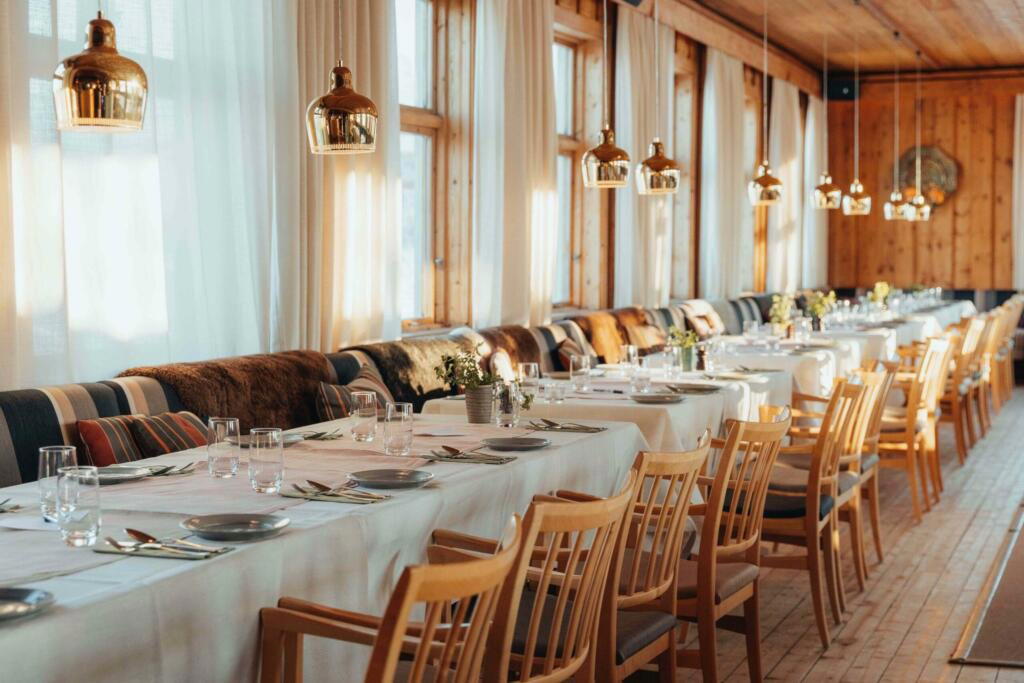
Where the Mountains Set the Menu
Arrive at Tänndalen in the late afternoon, when the light drops behind the Härjedalen fells and the lake below Fjällnäs turns the colour of pewter, and the question of what you will eat that evening answers itself. This is a setting that permits little abstraction. The terrain is immediate, the seasons are compressed, and the kitchen operates within those constraints in ways that many alpine restaurants only gesture toward. The hotel's position close to the Norwegian border places it in a corridor where Scandinavian foraging culture meets the discipline of high-altitude preservation, and the results on the plate reflect that geography directly.
The hotel context here matters: Fjällnäs is not a standalone restaurant dropped into a mountain village. It is the anchor of a property that defines the village's identity, which means the kitchen serves breakfast through dinner for guests who have nowhere else to go in a meaningful sense, and it handles that pressure without retreating to the safe centre of alpine hotel cooking.
Ingredient Logic in the Swedish High Country
Fjällnäs Restaurant's focus is sourcing. At this latitude and altitude, ingredient sourcing is not a marketing choice, it is an operational reality. The growing season in Härjedalen runs short, the supply chains that feed city restaurants do not extend here with the same reliability, and the kitchen's relationship with what grows, swims, and grazes nearby becomes structural rather than optional.
Swedish high-country kitchens working at this level tend to operate within a logic that borrows from both New Nordic discipline and older preservation traditions. Fermentation, curing, cold-smoking, and drying are not stylistic flourishes here; they are how a kitchen maintains depth of ingredient through winter months when fresh supply narrows. The leading parallel elsewhere in Sweden's serious dining tier, places like ÄNG in Tvååker or Knystaforsen in Rydöbruk, demonstrate how rurally situated restaurants have turned geographic constraint into a defining identity. Fjällnäs operates within that same tradition, shaped by conditions that are in some ways more extreme than either of those southern Swedish counterparts.
The Norwegian border proximity adds a further dimension. Cross-border sourcing in this region has a long informal history, particularly for game, freshwater fish, and dairy products. The fell landscape supports reindeer herding, the rivers carry arctic char and trout, and the forests yield berries and mushrooms that arrive in concentrated, intensely flavoured forms that longer-season produce cannot replicate. A kitchen that pays attention to this geography has access to a pantry that is narrow in variety but high in character.
The Wine Program as a Separate Signal
The clearest external validation of what Fjällnäs Restaurant is doing comes not from food awards but from its wine recognition. Receiving both the Star Wine List number one and number two rankings in 2024 is an unusual outcome for a mountain hotel restaurant in a village of this size, and it signals a program built with curatorial intent rather than assembled from a distributor's standard list. Star Wine List assessments weight list depth, producer selection, and pricing structure; a double ranking suggests the Fjällnäs cellar is doing something methodical across all three.
In Sweden's broader fine dining context, wine programs at this level tend to appear at restaurants with urban footprints and higher volume. Comparing Fjällnäs to Stockholm's top tier, where places like Frantzén operate with deep cellar resources and sommelier teams built over decades, highlights how much the Tänndalen property is punching above its geographic weight. The double recognition also places it ahead of wine programs at several well-regarded Swedish addresses in more accessible locations, including peers such as Vollmers in Malmö and VYN in Simrishamn in terms of list recognition for this specific award cycle.
For guests staying at the hotel, the wine program is a meaningful part of the overall spend. A cellar built for this level of recognition typically means access to producers and vintages that do not appear on standard Systembolaget shelves, which matters in Sweden's state-retail environment where restaurant wine lists carry curatorial value over retail alternatives.
Setting, Season, and When to Go
Tänndalen operates on two distinct calendars. The winter season, running roughly from late November through April, draws skiers and snow-sport visitors to the Funäsdalen area's interconnected lift system, and Fjällnäs sits within comfortable range of that activity. The summer season, shorter and quieter, brings hikers and those seeking the particular stillness of Swedish mountain lakes in July and August. Each window produces a different kitchen, not because the philosophy changes but because the available ingredients shift entirely between seasons.
Winter visits mean game, preservation-led preparations, root vegetables, and the kind of cooking that makes sense when temperatures outside are consistently below freezing. Summer visits open access to foraged greens, fresh berries, and river fish at their peak. Neither is inherently superior, but guests with an interest in the sourcing logic that defines this kitchen will find the summer-to-autumn shoulder period, roughly late August into September, particularly instructive: the overlap between late-season forage and early preservation work produces the most layered version of what the kitchen can do.
Reaching Tänndalen from the south requires planning. The nearest major city with regular flight connections is Östersund, approximately two hours by road, and driving through Härjedalen in winter requires appropriate tyres and attention to road conditions. The hotel context means accommodation is integrated, and staying on-property eliminates the question of transport after dinner, which at a restaurant with a wine list of this ambition is not a trivial consideration.
Fjällnäs sits in a category with very few peers at this altitude and latitude. Restaurants at the same recognition level in Sweden tend to cluster in Malmö, Gothenburg, and Stockholm, with a secondary ring in coastal and lake-district settings. Properties like Signum in Mölnlycke, PM & Vänner in Växjö, or Hotell Borgholm in Borgholm represent the rural-hotel dining format elsewhere in the country, but none operate at quite the same remove from urban supply chains. The altitude, the latitude, and the Norwegian border proximity make Fjällnäs's sourcing situation specific in ways that are worth travelling to understand directly.
Planning Your Visit
Given the hotel format and the remote location, advance booking is advisable. Winter weekends in particular fill early, particularly during Swedish school holiday windows in February and late December. The integrated hotel-restaurant structure means dinner reservations for non-staying guests should be confirmed directly; the property is not operating at urban restaurant scale, and walk-in access during busy periods is unreliable.
Comparison Snapshot
Comparable venues nearby, for context on price, style, and recognition.
| Venue | Cuisine | Price | Awards | Notes |
|---|---|---|---|---|
| Fjällnäs RestaurantThis venue — the venue you are viewing | Modern Fine Dining | $$$$ | 2 recognitions | |
| Fäviken Magasinet | Hyper-local Swedish Avant-Garde | $$$$ | , | Järpen |
| Högfjällshotellet | Mountain Grill & Seafood | $$$ | 2 recognitions | Högfjället |
| Åre Nature Studio | Nordic Seasonal Tasting Menu | $$$$ | 1 recognition | Duved |
| Albert Kök, Hotell & Konferens | Modern Nordic Gastronomy | $$$$ | 1 recognition | Strömsberg |
| Bjertorp Slott | Modern Swedish Fine Dining | $$$$ | , | Kvänum |
Continue exploring
More in Tänndalen
Restaurants in Tänndalen
Browse all →
At a Glance
- Scenic
- Cozy
- Elegant
- Rustic
- Special Occasion
- Date Night
- Hotel Restaurant
- Terrace
- Panoramic View
- Extensive Wine List
- Mountain
- Garden
Cozy and elegant atmosphere with fireplace, terrace, and scenic surroundings enhanced by artful plating and wine pairings.