Fish Market
Fish Market on Market Street in Fort Mill, SC brings the American seafood-house tradition to a town that sits squarely between Charlotte's suburban expansion and the Catawba River corridor. The address at 990 Market St places it within reach of Fort Mill's growing dining scene, making it a practical anchor for those seeking fresh-catch cooking outside the city proper.
Pearl is the En Primeur Club membership app — saves, bookings, and concierge access live there. Same editors, same standards.
- Address
- 990 Market St, Fort Mill, SC 29708
- Phone
- +18035474024
- Website
- fishmarketbarandgrill.com
- Directions
- Get directions
 Saves & bookings on Pearl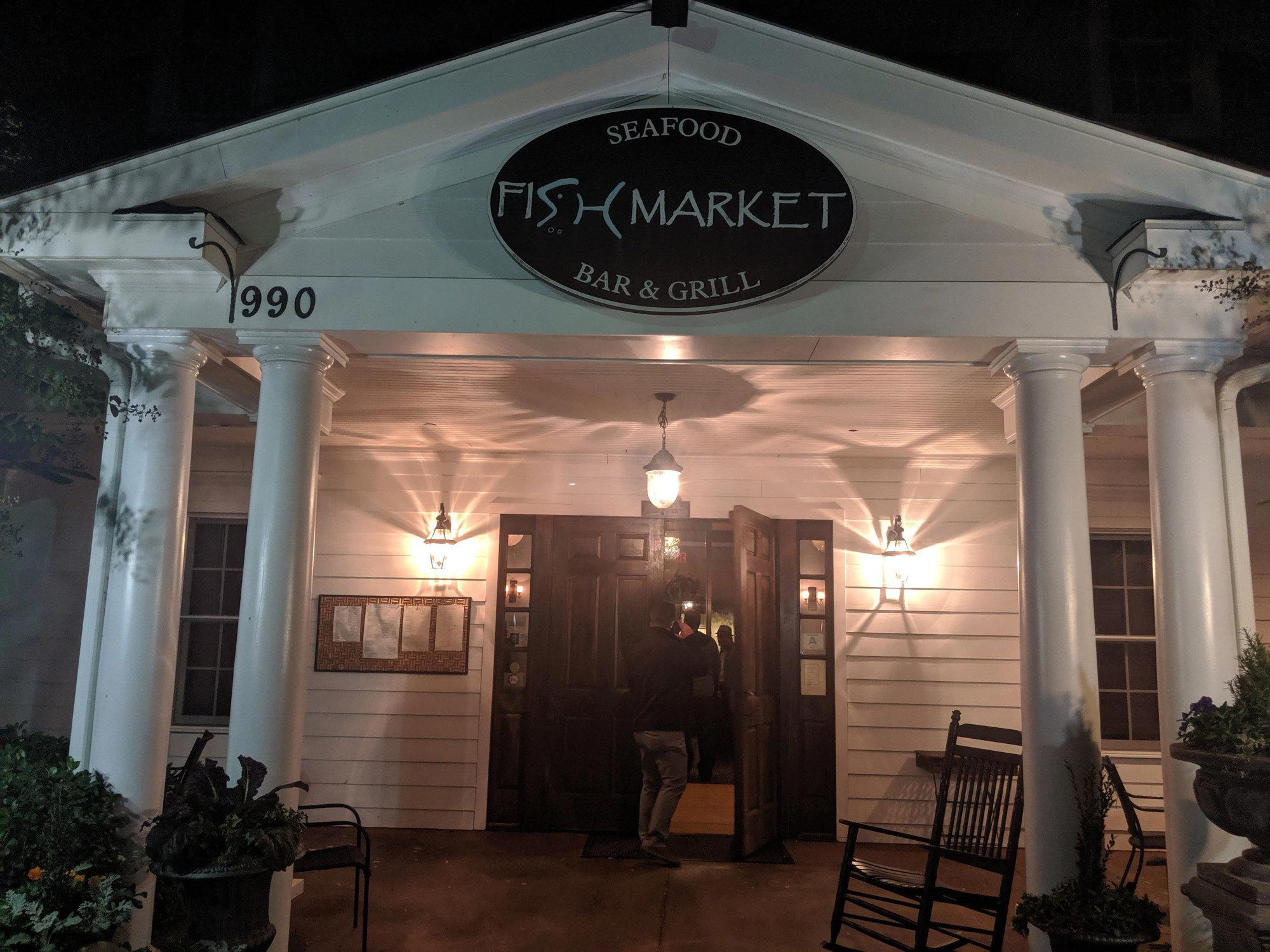
Seafood in the Piedmont: What Draws a Fish House This Far Inland
The assumption that good fish requires an ocean address has been steadily dismantled over the past two decades, as cold-chain logistics matured and inland markets grew sophisticated enough to support it. Fort Mill, South Carolina sits roughly two hundred miles from the nearest Atlantic port, yet the presence of a dedicated fish-focused address at 990 Market St signals something meaningful about how this corner of the Carolina Piedmont has developed its dining expectations. The town has grown quickly, pulled northward by Charlotte's suburban spread across the state line, and with that growth has come a restaurant scene that now extends beyond steakhouses and fast-casual chains. Fish Market occupies that developing middle register.
For context on what surrounds it, Epic Chophouse at Kingsley anchors the higher end of Fort Mill's sit-down dining, while FM Eatery operates in a more casual neighbourhood register. Fish Market slots into this local map as the seafood-specific option, a category that most suburban markets of Fort Mill's size support with at most one or two dedicated addresses.
The American Fish House as a Culinary Form
It predates the fine-dining era and has outlasted several waves of culinary fashion, precisely because the format is tied to something functional: the need to move fresh product efficiently and serve it to people who want direct preparations with clear sourcing. From the fried-fish counters of the Gulf South to the raw bars of New England, the format varies considerably by region, but the underlying logic holds. Preparations tend to respect the fish rather than obscure it. Saucing is restrained. Fry technique, when used, is a test of oil temperature discipline and batter weight. Steaming and broiling remain common because they make the quality of the raw material plainly visible.
This is a different tradition from the haute seafood register represented by Le Bernardin in New York City, where French technique produces intricate constructions at the summit of the price tier, or from the ambitious tasting-menu approach of Providence in Los Angeles. The fish house is a democratic form, and its value to a community is measured less by critical decoration than by reliability and access.
Seafood Culture in the Carolinas
South Carolina's seafood identity is coastal by history, built around shrimp, oysters, blue crab, and the flounder and grouper that come out of the Lowcountry and the Grand Strand. Inland, that tradition attenuates, but it does not disappear. The state's barbecue culture and its seafood culture have always coexisted, and the fried-fish tradition runs deep through the Pee Dee and the Midlands in ways that are distinct from the upscale preparations found at coastal resort towns. Fort Mill, sitting at the northern tip of the state, draws both the Carolina coastal tradition and the Charlotte metropolitan palate, which is more accustomed to multi-cuisine variety. That overlap produces a market where a fish-focused restaurant can draw from two different sets of expectations simultaneously.
For reference points across the American seafood-and-produce continuum, Single Thread Farm in Healdsburg and Blue Hill at Stone Barns in Tarrytown represent the farm-and-ocean-to-table end of the spectrum, where sourcing traceability is itself part of the editorial proposition. At Fish Market's address on Market Street, the proposition is more direct: a community that wants fresh seafood cooking does not need to drive to Charlotte or travel to the coast to find it.
The Broader Dining Moment in Fort Mill
Fort Mill's restaurant development over the past several years mirrors a pattern visible across fast-growing Southern suburbs. As population density increases and household incomes rise in communities adjacent to major metros, the dining scene tends to pass through a predictable sequence: fast-casual proliferation, then steakhouse and chain Italian, then an independent layer that fills category gaps. The seafood-house gap is one of the last to close in markets like this, because it requires consistent supply relationships and kitchen skill sets that are harder to sustain than a burger or pizza concept. When an address dedicates itself to that category, it tells you something about the market's maturity.
That dynamic plays out differently at the highest end of American dining, where restaurants like Addison in San Diego, Smyth in Chicago, and The Inn at Little Washington have built multi-year reputations around sourcing precision and technical execution. The comparison is not direct, but the underlying logic connects: every tier of the American dining market is, in its own way, resolving the question of what fresh, carefully sourced food should look like in a specific place and for a specific community. In Fort Mill, the restaurant at 990 Market St represents that resolution for the seafood category.
Other reference points in this broader American dining conversation include Lazy Bear in San Francisco, Emeril's in New Orleans, The French Laundry in Napa, Frasca Food and Wine in Boulder, The Wolf's Tailor in Denver, ITAMAE in Miami, Atomix in New York City, and Atelier Moessmer Norbert Niederkofler in Brunico, all of which illustrate how fish and seafood feature across formats and geographies at wildly different price points and levels of formality.
Planning Your Visit
The restaurant is located at 990 Market St, Fort Mill, SC 29708. Current hours are Mon to Thu 11 AM to 3 PM and 4 PM to 8 PM, Fri 11 AM to 3 PM and 4 PM to 9 PM, Sat 10 AM to 2 PM and 4 PM to 9 PM, and Sun 10 AM to 2 PM. Reservations are recommended, and the price tier is $40 per person. Fort Mill is accessible from Charlotte via I-77 South, a drive of roughly twenty minutes depending on traffic, making it a practical option for Charlotte-based visitors looking for a dinner outside the city without a long commute. Given Fort Mill's growth trajectory, weekends tend to draw heavier local traffic across the restaurant strip, so midweek visits typically offer a calmer experience.
Cost and Credentials
Comparable venues nearby, for context on price, style, and recognition.
| Venue | Cuisine | Price | Notes |
|---|---|---|---|
| Fish MarketThis venue — the venue you are viewing | Not listed | $$ | Not listed |
| Epic Chophouse at Kingsley | Kingsley, Classic Steakhouse | $$$$ | Not listed |
| FM Eatery | Not listed | $$ | Historic Downtown Fort Mill, Global Small Plates with Southern Comfort Dishes |
| Wylie's Eats and Drinks | Not listed | $$ | Lake Wylie, American Scratch Kitchen Tacos |
| The Pearl | Not listed | $$ | Old Town Bluffton, Coastal Seafood and Steakhouse |
| The Pump House | Not listed | $$ | :null, Southern-inspired American |
Continue exploring
More in Fort Mill
Restaurants in Fort Mill
Browse all →

Bars in Fort Mill
Browse all →

At a Glance
- Cozy
- Classic
- Special Occasion
- Family
- Date Night
- Open Kitchen
- Craft Cocktails
- Beer Program
- Local Sourcing
Current opening hours
- Monday
- 11 AM–3 PM, 4–8 PM
- Tuesday
- 11 AM–3 PM, 4–8 PM
- Wednesday
- 11 AM–3 PM, 4–8 PM
- Thursday
- 11 AM–3 PM, 4–8 PM
- Friday
- 11 AM–3 PM, 4–9 PM
- Saturday
- 10 AM–2 PM, 4–9 PM
- Sunday
- 10 AM–2 PM
Hours can change for holidays and private events. Last verified .
Comfortable and warm setting with moderate noise levels and welcoming atmosphere praised for special occasions.