Farmer Brown
Farmer Brown occupies a corner of the Tenderloin at 25 Mason St, where Southern-inflected cooking has built a loyal following in one of San Francisco's most unfiltered neighbourhoods. The room draws a cross-section of the city, regulars who return for the familiar weight of the cooking rather than novelty. It holds a distinct position in a city whose fine-dining tier runs from Michelin-counted omakase counters to the tasting-menu formalism of Lazy Bear and Atelier Crenn.
Pearl is the En Primeur Club membership app — saves, bookings, and concierge access live there. Same editors, same standards.
- Address
- 25 Mason St (at Market St.), San Francisco, CA 94102
- Directions
- Get directions
 Saves & bookings on Pearl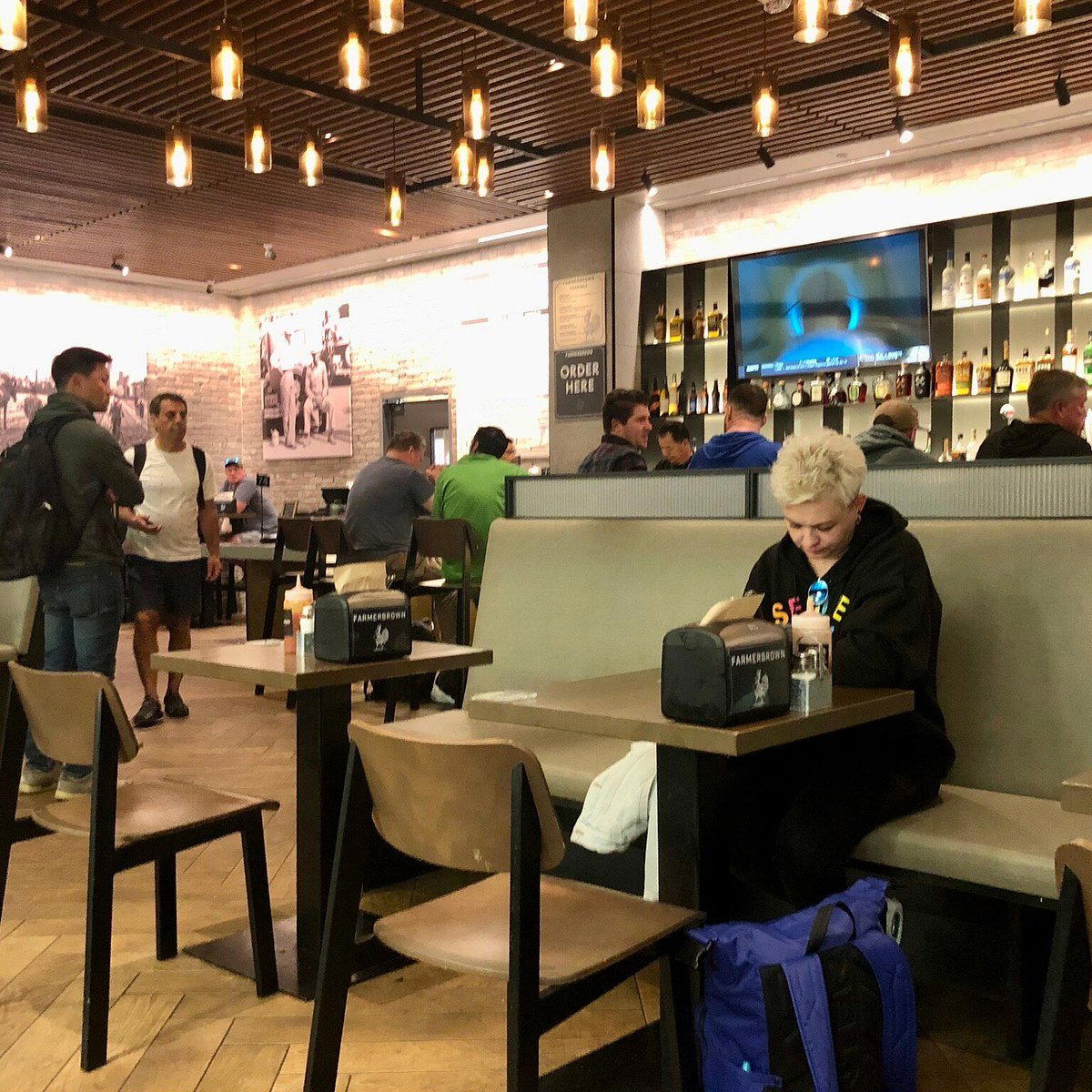
A Corner of the Tenderloin That Pulls People Back
Farmer Brown is a restaurant in San Francisco's Tenderloin, serving Southern American comfort food, with a price tier around $25 per person. The Tenderloin runs on its own logic, bail bondsmen, SRO hotels, Burmese lunch counters, and the kind of foot traffic that makes the neighbourhood feel more like a working city than a curated destination. Farmer Brown sits inside that reality rather than apart from it, and that positioning is not incidental. In a city where the dining conversation is dominated by the tasting-menu formalism of places like Lazy Bear, the technical ambition of Atelier Crenn, or the Franco-Chinese precision of Benu, a room built around Southern American cooking occupies a different register.
The physical approach matters. Walking from the Powell Street BART exit, you pass through a stretch that feels nothing like the Ferry Building farmer's market San Francisco often uses to represent itself. Farmer Brown's corner location on Mason reads as deliberate rootedness rather than oversight, the kind of address that accumulates regulars rather than rotating tourist traffic.
What the Regulars Are Actually Coming Back For
In most cities, the restaurants that build deep repeat clientele are not the ones with particularly elaborate menus. They are the ones that offer consistency of a specific kind: familiar flavour anchors, a room that feels owned rather than borrowed, and a sense that the kitchen knows what it is doing and is not trying to reinvent itself each season. The restaurant operates on that register. Southern American cooking, when executed with attention, is among the more demanding comfort-food traditions to sustain, fried chicken, for instance, has a near-zero tolerance for error at the table level, and the soul food canon rewards regulars who know what the dish should taste like far better than it rewards first-timers who have no reference point.
San Francisco's comfort-food tier sits in interesting tension with its fine-dining one. The city that produced the farm-to-table movement through places like Saison also has a long tradition of neighbourhood restaurants that prioritise accessibility over statement-making. The restaurant occupies the latter position. The regulars who return are not chasing novelty; they are returning to something they already know works. That kind of loyalty is harder to build than Michelin recognition and, in many ways, more durable.
For context on how this compares to approaches taken at other American comfort-food institutions, Emeril's in New Orleans has spent decades navigating the same tension between Southern culinary tradition and the expectations of a destination-dining crowd. The comparison is instructive: restaurants that anchor in a regional American food tradition tend to develop regulars with genuine emotional investment in the cooking, not just habitual convenience.
Where Farmer Brown Sits in the San Francisco Dining Map
San Francisco's dining scene stratifies sharply. At the summit tier, Quince and the aforementioned Benu and Atelier Crenn operate in the Michelin multi-star bracket alongside The French Laundry in Napa, which anchors the broader Bay Area fine-dining conversation. Below that sits a dense mid-market of neighbourhood restaurants competing on locality, ingredient sourcing, and atmosphere. The restaurant does not compete in the tasting-menu tier, its reference points are different, and its regulars are drawn from a different segment of the city's dining population.
The Tenderloin address is relevant here. Restaurants that plant themselves there and survive do so by serving the community around them rather than positioning for media attention. That dynamic tends to produce a more stable, committed regular base.
Across the broader American farm-to-table and Southern comfort spectrum, the comparison set extends beyond San Francisco. Blue Hill at Stone Barns in Tarrytown and Single Thread Farm in Healdsburg represent the agrarian end of American cooking pushed toward luxury format. The restaurant operates at the opposite end of that axis: Southern cooking rooted in accessibility and familiarity rather than tasting-menu architecture. Both approaches take ingredient sourcing seriously; they simply present it in entirely different registers.
Other American cities have their own equivalents of this kind of anchored neighbourhood restaurant. Smyth in Chicago, Providence in Los Angeles, and Addison in San Diego each represent the high-formality end of their city's dining. The mid-tier, neighbourhood-committed equivalent in each city tends to attract less editorial attention but more genuine community loyalty. The restaurant fits that pattern in San Francisco.
Internationally, the contrast is even sharper. Atelier Moessmer Norbert Niederkofler in Brunico and Frasca Food and Wine in Boulder illustrate how regional culinary identity can be pushed toward fine-dining ambition. The restaurant moves in the opposite direction, using Southern American cooking as an anchor for community rather than as a vehicle for critical recognition.
The Tenderloin's Place in the City's Food Story
San Francisco has spent the last two decades building an international fine-dining reputation, while the city's food identity also depends on neighborhood restaurants in places like the Mission, the Richmond, and the Tenderloin. But the city's food identity was never only about that tier. The Mission's taquerias, the Richmond's dim sum houses, and the Tenderloin's Southeast Asian lunch spots form an equally important layer of the city's eating culture. The restaurant's position in the Tenderloin connects it to that tradition: cooking that is specific about its culinary roots and committed to its neighbourhood, rather than oriented toward the next wave of food media attention. Atomix in New York City represents the peak of format-driven fine dining; the restaurant is a useful reminder that particularly durable restaurants often operate with entirely different measures of success.
What It’s Closest To
Comparable venues nearby, for context on price, style, and recognition.
| Venue | Cuisine | Price | Notes |
|---|---|---|---|
| Farmer BrownThis venue — the venue you are viewing | Southern American Comfort | $$ | Not listed |
| Ironwoods | New American | $$ | Presidio |
| Brenda's Meat & Three | Southern Meat & Three | $$ | Western Addition |
| Dolores Park Cafe | American Cafe | $$ | Mission |
| Breadwinner | American Deli / Sandwiches | $$ | Presidio |
| Joe's Cable Car Restaurant | Classic American Burgers | $$ | Outer Mission |
Continue exploring
More in San Francisco
Restaurants in San Francisco
Browse all →
Bars in San Francisco
Browse all →
Hotels in San Francisco
Browse all →
At a Glance
- Rustic
- Cozy
- Casual Hangout
- Brunch
- Open Kitchen
- Craft Cocktails
- Farm To Table
- Local Sourcing
Funky and eclectic with rusty decor and lime green ceiling, offering a soulful casual atmosphere.