
Tabelog 100 #96
Our verdict
Chonan Montaichio gives Ichikawa a serious ramen counter rather than a commuter-stop noodle shop, with tsukemen and ramen recognised in Tabelog’s Ramen EAST 100 for 2025. The draw is ingredient-led: seafood and pork-bone broth, thick noodles, and a compact nine-seat format that puts sourcing and timing ahead of ceremony.

Pearl is the En Primeur Club membership app, where members save venues, book tables and use the concierge.
The menu
What to order
- Tokusei tsukemen
- Tonkotsu gyokai tsukemen
- Mitarashi shoyu abura soba
The approach is pure suburban Chiba rather than theatrical Tokyo dining: station exits, narrow streets, a ground-floor shopfront, then a small counter where ramen’s working rhythm takes over. In Ichikawa, that matters. The city’s dining strength is not grand dining-room spectacle but tightly focused places built around repetition, speed, and local regulars. Chonan Montaichio belongs to that category, with a nine-seat room, counter seating, and a reputation tied to tsukemen and ramen rather than chef mythology.
Ichikawa sits close enough to Tokyo to feel the gravitational pull of its ramen culture, but the better suburban noodle shops often compete on a different scale. They do not need tasting-menu choreography; they need broth discipline, noodle texture, and a reason for diners to choose one station-adjacent counter over another. Recognition in Tabelog’s Ramen EAST 100 for 2025 places this shop inside a serious regional conversation, and its 3.73 Tabelog score gives a useful signal in a category where small differences in execution are scrutinised hard.
Seafood, pork bone and thick noodles define the argument
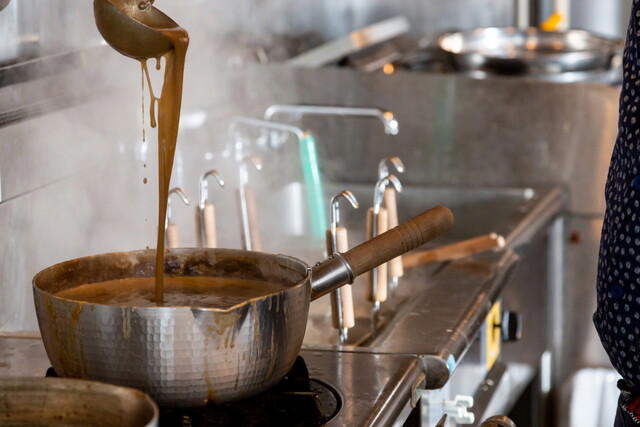
Tsukemen is a test of structure. Because noodles and soup arrive separately, weak broth cannot hide behind heat alone, and limp noodles have nowhere to disappear. The format asks for concentration: a dipping broth with enough density to cling, and noodles with enough body to stay interesting from first lift to final mouthful. Chonan Montaichio’s listed focus is seafood and pork-bone tsukemen, with thick noodles delivered fresh from Asakusa Kaika Sakura. That supplier detail is not decorative; in ramen, noodle provenance shapes chew, hydration, and how the soup reads on the palate.
The broth story also points to a particular East Japan preference: layered animal richness cut by marine savour, a style that can feel excessive when balance is off but compelling when the components stay in line. The shop’s own highlight describes a rich tonkotsu seafood broth prepared over three days. That is a sourcing-and-process claim rather than a romantic flourish, and it explains why this address has travelled beyond simple neighbourhood convenience.
Ramen in greater Tokyo has become intensely segmented. Some counters chase clear chintan precision; others push miso, niboshi, chicken paitan, or spicy miso into specialist territory. Tsukemen occupies its own lane, especially when thick noodles are the point rather than an afterthought. The appeal here is not breadth. It is a narrow proposition, repeated in a compact space, with ingredient choices doing the work.
Ichikawa's ramen map rewards small formats
The local comparison is useful. Ichikawa’s dining scene ranges from everyday Japanese cooking to curry, pizza, cafés, and specialist noodle counters, but ramen has a particular advantage in this city because short-format meals suit the station geography. A counter near Keisei Yawata and Motoyawata can serve solo diners, families, and commuters without diluting the kitchen’s core task. The listed occasions, family friendly and solo dining friendly, match that urban pattern.
Chonan Montaichio is also a reminder that price does not always track ambition in Japanese ramen. The listed budget sits at JPY 999, while review-based spending is shown at JPY 1,000 to JPY 1,999. In many cities, that price band would suggest convenience food. In Japan, it can still mean a highly specialised bowl or dipping-noodle set, because the format compresses labour, space, and service into a few seats.
Against Ichikawa peers, the distinction is category focus. Jagaimo operates in a higher local price bracket, while places such as Saryo Ren, Pizzeria Canto Della Terra, and Tomino Ya Motoyawata honten occupy different everyday-dining roles. Nearby ramen interest also includes China Soba Komuro, a useful reference point for how narrow noodle specialisation can carry a restaurant’s identity in Ichikawa. For a wider read of the city, start with our full Ichikawa restaurants guide.
How to read the room before going
This is a compact restaurant, not a long-session dining room. Reservations are unavailable, cards and electronic payments are not accepted, and parking is not provided, although coin parking is listed nearby. The address is one minute on foot from Keisei Yawata Station’s South Exit 2, two minutes from Motoyawata Station on the Shinjuku Line via Exit A6, and five minutes from the north exit of JR Motoyawata Station. Those details make it unusually workable for travellers crossing between Tokyo and Chiba, provided expectations are set around a small counter rather than a leisurely table.
The weekly rhythm also matters. Thursday service is listed as Mitarashi Soy Sauce Abura Soba only, with tsukemen unavailable, while Monday in May has included curry tsukemen. That kind of schedule is common in ramen culture, where specials and operational changes can be part of the draw, but it rewards diners who check current service notes before setting out. The shop is non-smoking, take-out is listed, private rooms are unavailable, and children, strollers, and wheelchairs are accepted, all practical signals that broaden the audience beyond ramen obsessives.
The editorial case is clear: Chonan Montaichio is for diners who care about the mechanics of tsukemen, especially noodle sourcing and broth concentration, more than the social theatre of a destination restaurant. It fits an Ichikawa day built around trains, short meals, and category-specific eating rather than an evening planned around a long reservation. For adjacent planning, see our full Ichikawa hotels guide, our full Ichikawa bars guide, our full Ichikawa wineries guide, and our full Ichikawa experiences guide.
Further restaurant reading: Enak Enak, Gyotoku Biryani House, Open Oven, -Grilled beef Sukiyaki- KAMAKURA TANUKIAN 鎌倉 たぬき庵 in Kamakura. 鮪と炭火焼き うお炭 秋葉原店 in Tokyo.cafe in Osaka.know in Kumamoto, (Shoku) Vietnam in Kawasaki, [Curry Senmon Ten] Maruyama Kyoju. in Sapporo, Jōdo Saké Bar in Los Angeles, and Onigiri Time in Pasadena.
Frequently asked questions
Is Chonan Montaichio a family-friendly restaurant?
Yes. The venue lists children welcome, including babies, preschoolers, and school-age children, plus stroller access. With 9 seats in Ichikawa, it works for quick family meals rather than long sittings.
What's the vibe at Chonan Montaichio?
It is a compact, non-smoking noodle shop with counter seating and 9 seats, a few minutes from Keisei Yawata Station in Ichikawa. Reservations are unavailable, and the setup suits solo diners as much as families.
What price level is Chonan Montaichio?
Pricing at Chonan Montaichio is listed as - JPY 999 - JPY 999.
When is Chonan Montaichio open?
Hours at Chonan Montaichio: Mon: 11 AM–2:50 PM, 5:30–9 PM; Tue: 5:30–9 PM; Wed: 11 AM–2:50 PM, 5:30–9 PM; Thu: 11 AM–2:50 PM, 5:30–9 PM; Fri: 11 AM–2:50 PM, 5:30–9 PM; Sat: 11 AM–8 PM; Sun: 11 AM–8 PM.
Where is Chonan Montaichio located?
Chonan Montaichio is located in Ichikawa.
What has Chonan Montaichio built its reputation on?
Its 2025 selection in Tabelog Ramen EAST "Tabelog 100" is the clearest marker. The menu focus is tsukemen and ramen, with a broth-led style and thick noodles that define the house approach.
A Quick Peer Check
Comparable venues by cuisine and price in the same metro.
| Venue | Cuisine | Price | Awards | Notes |
|---|---|---|---|---|
| Chonan MontaichioThis venue (the venue you are viewing) | Tsukemen ramen shop | Not listed | Tabelog 100 #96 | Not listed |
| China Soba Komuro | Classic Japanese Ramen | $10–20 | Tabelog 100 #35 | Suehiro |
| Shokudo Otsuka | Japanese cafeteria set-meal (shokudo) | $10–20 | Tabelog 100 #82 | Gyotoku |
| Open Oven | Artisanal Bakery & Cafe | $1–10 | Tabelog 100 #23 | Ichikawa |
| Saryo Ren | Dining | Not listed | Tabelog 100 #25 | Ichikawa |
| Steak Ishii | Casual Japanese Steakhouse & Hamburg | $10–20 | Tabelog 100 #73 | Gyotoku |
Recognition history
Dated appearances from independent guides and award organizations, with the underlying list record or original source where available.
Tabelog 100 #96 · No. 96
Tabelog · Tabelog 100 - Ramen - EAST - 2025
Continue exploring
More in Ichikawa
Restaurants in Ichikawa
All restaurants in Ichikawa →






Details
- Lively
- Cozy
- Solo
- Casual Hangout
- Late Night
- After Work
- Chefs Counter
- Standalone
- A La Carte
- Counter Dining
Current opening hours
- Monday
- 11 AM–2:50 PM, 5:30–9 PM
- Tuesday
- 5:30–9 PM
- Wednesday
- 11 AM–2:50 PM, 5:30–9 PM
- Thursday
- 11 AM–2:50 PM, 5:30–9 PM
- Friday
- 11 AM–2:50 PM, 5:30–9 PM
- Saturday
- 11 AM–8 PM
- Sunday
- 11 AM–8 PM
Hours can change for holidays and private events. Hours as of .
Casual, compact ramen shop atmosphere with counter-style, quick-turnover seating, focused on solo diners and small parties rather than lingering meals.