
A Relais & Châteaux property perched above the Indian Ocean on Sri Lanka's southern coast, Cape Weligama pairs private beach access and water sports with a coastal Sri Lankan kitchen under Chef Egon Heiss. The setting frames the food: spice-forward cooking built on the flavours of the surrounding sea and land, with modern technique applied without erasing the regional character.
 Discover on Pearl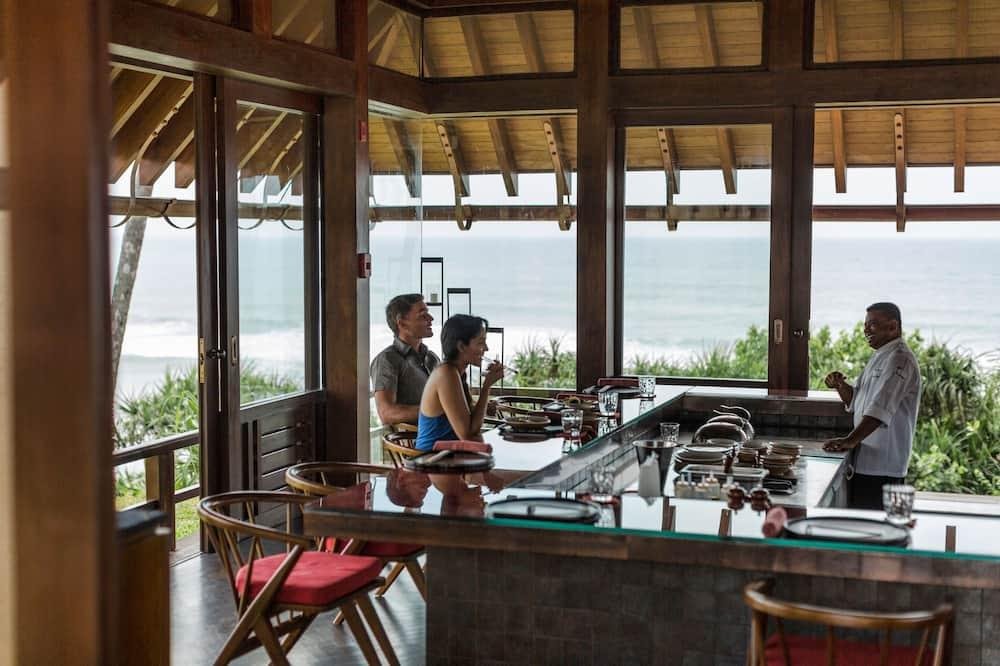
Where the Indian Ocean Sets the Terms
The approach to Sri Lanka's southern coast along the Matara Road gives little warning of what opens up at Weligama. The bay itself is broad and calm enough to have made it a base for traditional stilt fishermen for generations, and the cliff edge above it is where Cape Weligama positions its dining rooms and terraces. Before a plate arrives, the orientation does its work: the horizon is unbroken water, the light in the late afternoon turns the sea from green to copper, and the air carries the salt and humidity that shape what cooks in this part of the island. That context is not incidental — it determines the kitchen's logic.
Cape Weligama is a Relais & Châteaux member property on Abimangama Road, and that affiliation places it in a global peer set defined by independent properties with high standards of hospitality and table. Within Sri Lanka, that cohort is small. The southern coast between Galle and Matara has attracted significant investment in premium hospitality over the past decade, but properties with both a serious culinary program and direct ocean access remain limited. Cape Weligama's private beach and its refined position above the bay give it a physical argument that most competitors along this stretch cannot match on pure geography alone.
The shortlist, unlocked.
Hard-to-book tables, cellar releases, and concierge-planned trips.
Get Exclusive Access →The Spice Architecture of the Southern Coast
Sri Lankan coastal cooking is built on a spice logic that differs fundamentally from the Indian subcontinent's northern traditions, even when the individual ingredients overlap. Here, the layering is horizontal rather than accumulative: mustard seeds bloom fast in hot oil before anything else enters the pan; curry leaf goes in whole and early, releasing its volatile oils into fat rather than water; pandan leaf, almost absent from Indian cooking, runs through rice and coconut-based preparations as an aromatic anchor. The result is a cuisine where heat and fragrance operate on separate tracks, each distinct rather than merged into a single compound flavour.
Chef Egon Heiss works within that framework while applying what the property describes as a modern flair — a phrase worth unpacking carefully. In the Sri Lankan coastal context, modern technique most often means restraint applied to a tradition that doesn't need rescuing: shorter cook times on seafood, spice tempered to reveal rather than dominate, coconut milk used for texture rather than to mask. The risk in any resort kitchen operating in a heritage cuisine is the softening of edges for international palates. The more interesting question, when sitting above the Weligama bay, is whether the spice architecture holds its structure across a full meal. The kitchen's proximity to local catch and the property's positioning within the premium tier suggest the sourcing foundation is there; the cooking choices determine what's built on leading of it.
This is a different register from a Sri Lankan restaurant operating in a metropolitan context. Ministry of Crab in Colombo anchors its identity to a single high-status ingredient and builds around it with precision. COAST in Yala operates within a different ecosystem, with the southern bush rather than the sea as its frame. Cape Weligama's kitchen faces the ocean directly and the menu should read accordingly , seafood caught within a few kilometres of where it's served, spiced in the way this coastline has spiced it for centuries. For a broader survey of what the Weligama dining scene offers across price points and formats, our full Weligama restaurants guide maps the options in detail.
Resort Dining in a Regional Tradition
Premium resort dining in Southeast and South Asia has moved in two directions over the past fifteen years. One cohort imports international reference points , a European-trained chef, a wine list built around Bordeaux and Burgundy, a tasting menu format that could relocate to Singapore without adjustment. The other cohort roots itself deliberately in local tradition, using the resort infrastructure as a platform for regional cooking rather than a replacement for it. Cape Weligama's cuisine classification , Sri Lankan Coastal , signals an intent to sit in the second group, though the Relais & Châteaux framework and the property's premium positioning mean the execution has to satisfy both the regional argument and the service expectations of a global luxury tier.
The comparison with international fine dining is less useful here than a comparison within the Sri Lankan premium tier. The Atlas in Weligama takes Sri Lankan cuisine in a direction informed by its own interpretation of the local pantry. Cape Weligama's coastal specificity , the Indian Ocean as both backdrop and larder , is the differentiating factor, and it is a meaningful one. Coastal Sri Lankan cooking has its own grammar, distinct even from the hill country and the north, and a kitchen positioned directly above the source of its seafood has an argument that is difficult to replicate inland.
Access, Timing, and the Practicalities
Weligama sits on Sri Lanka's southern coast, roughly two and a half to three hours by road from Colombo's Bandaranaike International Airport, depending on traffic and route. The expressway to Matara brings the southern coast considerably closer to Colombo than it was a decade ago, and the drive from Galle , the more immediate gateway for many visitors arriving from the west , takes under forty minutes. The property is reached via Abimangama Road, above the bay.
Sri Lanka's southern coast operates on a seasonal calendar that shapes both availability and experience. The dry season on this stretch runs from November through April, when the ocean is calm, visibility for water sports is high, and the terrace dining conditions are at their most consistent. The southwest monsoon arrives from May and brings rough seas and periodic heavy rain through to September. The property's water sports and private beach access , both cited among its headline attributes , are most fully available in the dry season window. Bookings for the peak December to January period, which coincides with European and North American winter holidays, should be made well in advance. Contact details are available through Resplendent Ceylon at weligama@relaischateaux.com or +94 41 225 3000, with the property website at resplendentceylon.com/capeweligama.
For those building a broader itinerary around the Weligama area, our full Weligama hotels guide, bars guide, experiences guide, and wineries guide cover the full scope of what this stretch of coast offers beyond the property itself. Those with an appetite for how Sri Lankan cuisine performs at its most technique-forward in an urban setting will find the contrast with Colombo's Ministry of Crab instructive.
abimangama road, Weligama, Sri Lanka
+94 412 253 000
Comparison Snapshot
These are the closest comparables we have in our database for quick context.
| Venue | Cuisine | Price | Awards | Notes |
|---|---|---|---|---|
| Cape Weligama | Sri Lankan Coastal | HIGHLIGHTS: • OVERLOOKING THE INDIAN OCEAN • PRIVATE BEACH ACCESS • WATER SPORTS… | This venue | |
| Ministry of Crab | Sri Lankan | World's 50 Best | Sri Lankan | |
| The Atlas | Sri Lankan Cuisine | Sri Lankan Cuisine | ||
| COAST | Southeast Asian | Southeast Asian |
Need a table?
Our members enjoy priority alerts and concierge-led booking support for the world's most difficult tables.
Get Exclusive AccessThe shortlist, unlocked.
Hard-to-book tables, cellar releases, and concierge-planned trips.
Get Exclusive Access →