Bruno's Ristorante
Bruno's Ristorante on North MacArthur Boulevard sits within Irving's growing dining corridor, bringing Italian-American cooking to a suburban Dallas-area market where that tradition remains relatively underrepresented. The restaurant operates in a segment where neighborhood familiarity and consistent execution matter more than theatrical tasting menus, positioning it as a local anchor in a city that increasingly rewards dining with genuine culinary intent.
Pearl is the En Primeur Club membership app — saves, bookings, and concierge access live there. Same editors, same standards.
- Address
- 9462 N MacArthur Blvd, Irving, TX 75063
- Phone
- +19725562465
- Website
- brunosristorante.com
- Directions
- Get directions
 Saves & bookings on Pearl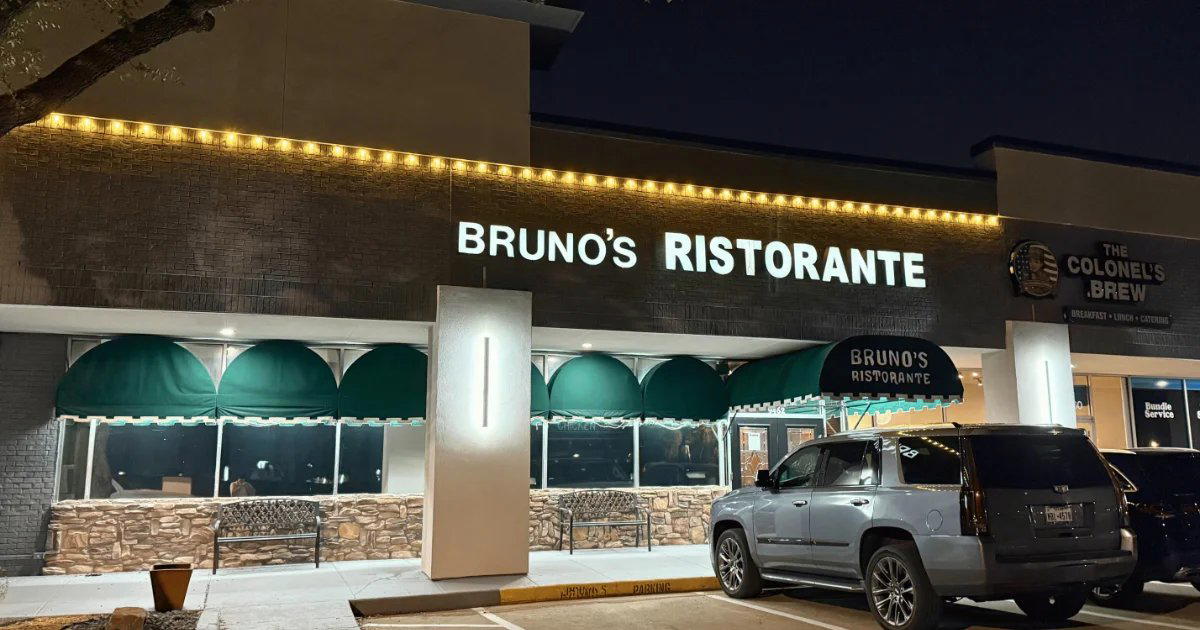
Italian-American Dining in the Dallas Suburbs: Where Bruno's Ristorante Sits
Irving's restaurant scene has developed along a recognizable arc over the past decade: first anchored by Tex-Mex and chain formats, then pulled in more specific directions by independent operators willing to hold a culinary position. The stretch of North MacArthur Boulevard where Bruno's Ristorante operates at 9462 N MacArthur Blvd reflects that shift, sitting within a corridor that now includes a broader cross-section of cooking traditions than the area's suburban geography might initially suggest. For context on the full range of what Irving's independent dining scene now covers, our full Irving restaurants guide maps the city's options across cuisine types and formats.
Italian-American cooking occupies a specific place in suburban American dining culture that is easy to underestimate. Unlike the prix-fixe Italian of major urban centers, the suburban Italian-American tradition draws from a different lineage: red-sauce trattoria cooking, long-simmered ragù, handmade pasta in accessible formats, and a hospitality model built on return visits rather than occasion dining. It is a tradition with roots in mid-century Italian immigration to the northeastern United States that gradually dispersed into regional markets, adapting to local appetites while retaining certain structural commitments, the shared antipasto, the pasta course as centerpiece, the sense that a meal should take time. Bruno's Ristorante operates within that tradition in a market, suburban North Texas, where it has room to mean something to a regular clientele.
The Context of the Room
Approaching a restaurant like Bruno's Ristorante from the North MacArthur corridor, the physical environment signals something about the dining category before you enter: this is not a destination built around visual spectacle or design-led architecture. The Italian-American format in suburban markets typically prioritizes warmth over edge, comfort over provocation. Expect the visual grammar of checked tablecloths or warm lighting, the kind of room that communicates its intentions through familiarity rather than novelty. In a city where Edoko Omakase and Aire Libre are pushing into more format-driven territory, and where Cielito Mexican Flavors anchors the Tex-Mex-adjacent end of the market, a sit-down Italian-American room addresses a different part of the appetite, the one that wants a meal to be settled and unhurried rather than stimulating and brief.
That positioning has value in a suburban dining market. The Italian-American format survives in suburban America precisely because it fulfills a social function that faster or more theatrical formats do not: it makes a midweek dinner or a family occasion feel appropriately considered without demanding specialist knowledge from the diner. The room does the work of signaling that something is happening here beyond convenience food, without requiring the guest to research the menu in advance.
What the Cuisine Tradition Demands
The cultural roots of Italian-American cooking are worth understanding as a frame for how to approach the restaurant. The cuisine that traveled from southern Italy to the United States in the late nineteenth and early twentieth centuries underwent a deliberate transformation: it adapted to American ingredients, American portion expectations, and American appetite for abundance. Tomato sauce became richer and more assertive. Pasta portions grew. Protein moved from accent to centerpiece. The result is a cuisine that is technically Italian in vocabulary but distinctly American in grammar, and it is most honestly appreciated on those terms rather than measured against contemporary Roman or Milanese cooking.
What this means practically is that the measures of quality in Italian-American cooking are execution of fundamentals: the texture of pasta, the depth of a slow-cooked sauce, the quality of the mozzarella, the balance of acidity in a pomodoro. These are not modest standards. Getting them consistently right is what separates a credible Italian-American kitchen from a mediocre one, and it is the dimension along which restaurants in this format differentiate themselves from one another over time. For comparison, operators in other markets who hold that line consistently, places like Emeril's in New Orleans with its sustained commitment to regional American culinary identity, demonstrate what longevity in a format built on consistency looks like.
Irving's Broader Dining Position
Irving sits in a particular position within the Dallas-Fort Worth metro: close enough to the urban core to attract diners with exposure to a wide range of cooking formats, but suburban enough that neighborhood restaurants carry more social weight than they might in a denser market. Delucca Gaucho Pizza & Wine Irving has demonstrated that the market will support a more focused Italian-adjacent product, while Flossie's occupies a different part of the casual-dining register. The restaurant, by holding a full Italian-American format position, addresses a gap in what is still a relatively underdeveloped independent Italian segment in the area.
Nationally, the reference points for fine Italian-American and Italian-influenced cooking in the United States have shifted considerably. Operations like Le Bernardin in New York City and The French Laundry in Napa set benchmarks for technical ambition in American fine dining, while closer to the Italian-American tradition, the question of what integrity looks like at the neighborhood scale is where most of the country's Italian restaurants actually live. For a suburban market like Irving, the relevant comparison is not Michelin-starred Italian but well-executed neighborhood trattoria cooking, a format that has proven its durability in American dining culture across generations.
Planning a Visit
The restaurant is located at 9462 N MacArthur Blvd, Irving, TX 75063, accessible by car from central Dallas and positioned conveniently for diners based in Irving's Las Colinas corridor. The restaurant is open Monday and Tuesday from 5 to 9 PM, Wednesday from 5 to 9 PM, Thursday from 11 AM to 9 PM, Friday from 11 AM to 10 PM, Saturday from 5 to 10 PM, and closed Sunday; reservations are recommended. Dress code in this category is generally smart-casual: the format neither demands nor rewards formality, but the sit-down character of the room suggests moving past completely casual attire.
Cost and Credentials
Comparable venues nearby, for context on price, style, and recognition.
| Venue | Cuisine | Price | Notes |
|---|---|---|---|
| Bruno's RistoranteThis venue — the venue you are viewing | Not listed | $$$ | Not listed |
| Hugo's Invitados | Las Colinas, Modern Mexican | $$$ | Not listed |
| Holiday Events at The Ritz-Carlton Dallas, Las Colinas | Not listed | $$$$ | Las Colinas, Polished Texas-Inspired Holiday Dining |
| Knife Italian Steak | Las Colinas, Modern Italian Steakhouse | $$$$ | Not listed |
| Anjapar Chettinad Elite | Not listed | $$ | Walton Blvd, Chettinad / South Indian |
| Tupelo Honey - Las Colinas | Las Colinas, Southern Kitchen & Bar | $$ | Not listed |
Continue exploring
More in Irving
Restaurants in Irving
Browse all →
Bars in Irving
Browse all →
Hotels in Irving
Browse all →
Wineries in Irving
Browse all →
At a Glance
- Elegant
- Romantic
- Cozy
- Sophisticated
- Date Night
- Business Dinner
- Special Occasion
- Live Music
- Private Dining
- Waterfront
- Extensive Wine List
- Waterfront
Current opening hours
- Monday
- 5–9 PM
- Tuesday
- 5–9 PM
- Wednesday
- 5–9 PM
- Thursday
- 11 AM–9 PM
- Friday
- 11 AM–10 PM
- Saturday
- 5–10 PM
- Sunday
- Closed
Hours can change for holidays and private events. Last verified .
Warm and inviting upscale atmosphere with beautiful canal views, soft live piano music on Fridays and Saturdays, and cozy seating well-suited for intimate conversations.