Brasserie du Molard
Our verdict
Place du Molard has anchored Geneva's left bank since medieval times, and Brasserie du Molard carries that continuity into a dining room where the rhythms of a classic Swiss-French brasserie still hold. Sit at the heart of the old town, order from a menu shaped by the canton's Franco-Swiss culinary inheritance, and experience a meal paced the way brasserie culture always intended — unhurried, convivial, and rooted in place.

Pearl is the En Primeur Club membership app — saves, bookings, and concierge access live there. Same editors, same standards.
- Address
- Pl. du Molard 9, 1204 Genève, Switzerland
- Phone
- +41223111100
- Hours
- Mon–Thu 7 AM–12 AMFri–Sat 7 AM–1 AMSun Closed
- Website
- brasseriedumolard.ch
- Directions
- Get directions
- Booking
- Book on the venue's website
A Square That Has Always Fed the City
Place du Molard sits at the junction of Geneva's medieval harbour district and the old town's commercial core, a square that has functioned as a market, a landing point, and a social crossroads for centuries. The tower at its northern edge dates to the sixteenth century; the surrounding facades have absorbed and shed identities across every shift in the city's fortunes. Brasserie du Molard occupies number nine on that square, and the address itself carries a weight that no interior decorator can manufacture. You arrive at a place the city already knows.
Geneva's dining scene divides into distinct registers. At one end sit the formally structured tasting menus — places like L'Atelier Robuchon (French Contemporary) and Il Lago (Italian), where a meal is a sequenced event with its own internal architecture. At the other end, the city's neighbourhood cafés and quick-service spots function as daily infrastructure. The brasserie format occupies the middle ground: a place where serious food and genuine informality coexist, where you can arrive with a business contact at noon and return with family at seven without the venue feeling incongruous either time. Brasserie du Molard occupies that middle register, and in a city where that register is less populated than it deserves to be, the address carries particular relevance.
The Brasserie Ritual, Lived in Full
The dining customs of the Franco-Swiss brasserie tradition are specific and worth understanding before you sit down. This is not a format built around surprise or revelation. It is built around reliability, repetition, and a particular kind of trust between a diner and a kitchen that has prepared the same dishes many times and knows exactly what it is doing. You do not read the menu hoping to be astonished. You read it looking for the version of something you already want: a steak with proper frites, a lake fish prepared without distraction, a cheese plate assembled with attention to regional provenance.
Pacing matters in this tradition. A brasserie meal is not rushed, but neither is it artificially prolonged. The rhythm moves from aperitif to entrée to plat to fromage or dessert with a naturalness that a structured tasting menu cannot replicate. Wine arrives by the carafe or by the bottle according to the occasion; water is poured without being asked. Service in the brasserie tradition is professional in the French sense — attentive but not intrusive, efficient but not hurried. Geneva's proximity to Lyon, the city that codified brasserie culture into something approaching a civic institution, gives local establishments like this one a direct reference point for what the format should feel like when executed with care.
For readers comparing this to Geneva's more architecturally ambitious tables, Arakel (Modern Cuisine) or L'Aparté (Modern French), the distinction is one of intention rather than quality. The brasserie tradition does not compete with the tasting-menu format on its own terms. It offers something different: a meal embedded in daily life rather than extracted from it.
Franco-Swiss on the Plate
Geneva's culinary inheritance is a genuinely mixed one. The canton sits at the confluence of French, Swiss German, and Italian food cultures, with the French influence dominant in the city centre's more formal establishments. The brasserie format draws most heavily from that French inheritance, charcuterie boards, onion soup, entrecôte, seasonal lake fish, while Swiss specificity enters through ingredients: Gruyère from the alpine pastures to the east, perch from Lac Léman, rösti where it earns its place on the plate.
That combination is more interesting than it might appear on paper. Lac Léman perch, when sourced and cooked with discipline, is a genuinely fine ingredient: delicate, sweet-fleshed, and responsive to simple preparation in the way that most freshwater fish are not. It appears on brasserie menus across the lake's arc from Geneva to Lausanne and Montreux, always pan-fried, almost always with a light cream or lemon butter. The dish is regional in the way that bouillabaisse is regional: tied to a specific water, a specific fishing culture, and a specific way of preparing what that water provides. Elsewhere in the Swiss restaurant circuit, from Hotel de Ville Crissier in Crissier to Schloss Schauenstein in Fürstenau, Swiss ingredients are refracted through haute cuisine technique. At the brasserie level, they are presented more directly, and there is value in that directness.
Geneva's brasserie tradition also handles cheese with appropriate seriousness. A Swiss cheese trolley or board at this level of establishment is not an afterthought. The alpine dairy culture that produces Gruyère, Vacherin Fribourgeois, and Raclette-grade cheeses operates at a standard that rewards attention, and a kitchen that sources regionally and presents the board in good condition is doing something worth noting.
Where This Fits in Geneva's Dining Map
Geneva has a concentrated cluster of serious restaurant addresses in and around the old town and the lakefront. Brasserie du Molard's position on Place du Molard places it within walking distance of the main hotel corridor and the left-bank shopping district, which makes it accessible for both visitors and city professionals. For readers building a Geneva itinerary that reaches beyond the tasting-menu tier, La Micheline (Mediterranean Cuisine) and Brasserie du Molard occupy complementary positions: one Mediterranean-leaning, one Franco-Swiss, both operating at a register where a serious meal does not require a full ceremonial commitment.
Switzerland's fine dining circuit extends well beyond Geneva. Those travelling through the country might also consider Memories in Bad Ragaz, Cheval Blanc by Peter Knogl in Basel, Maison Wenger in Le Noirmont, Einstein Gourmet in Sankt Gallen, Da Vittorio - St. Moritz in St. Moritz, Mammertsberg in Freidorf, La Table du Valrose in Rougemont, and focus ATELIER in Vitznau. For a full picture of Geneva's restaurant offerings, the EP Club Geneva restaurants guide maps the city's key addresses across price tiers and formats.
Internationally, the brasserie format has few genuine equivalents at the high end. Le Bernardin in New York City operates in an entirely different register of formality, and Lazy Bear in San Francisco represents the collaborative tasting-menu format at its most structured. The brasserie sits apart from both: less ceremony, more continuity, and a relationship with its neighbourhood that neither of those formats is designed to replicate.
Planning Your Visit
Brasserie du Molard is located at Place du Molard 9, in Geneva's old town, easily reached on foot from the central station (Cornavin) or by tram along the Rue du Marché corridor. The square itself is pedestrianised, which makes arrival direct. Given its central position and the density of hotel accommodation in the surrounding blocks, the restaurant draws a mixed clientele of residents, professionals, and visitors, a mix that gives the room a lived-in quality that more isolated fine-dining addresses cannot easily achieve.
Frequently asked questions
Is Brasserie du Molard suitable for children?
Place du Molard is a pedestrian square in Geneva's old town, and the brasserie format that defines this address is historically family-oriented — built around long tables, shared timing, and accessible menus rather than hushed tasting-menu protocol. That said, confirm current seating arrangements directly with the venue at Place du Molard 9 before arriving with young children.
How would you describe the vibe at Brasserie du Molard?
The setting on Place du Molard — Geneva's medieval harbour square, functioning as a market and gathering point for centuries — shapes the atmosphere more than any interior design choice. Expect the rhythm of a working Franco-Swiss brasserie: purposeful service, tables that turn, and a room that operates at the pace of the city around it rather than as a destination in itself.
Is Brasserie du Molard a good option for lunch in Geneva's old town?
Place du Molard sits at the junction of Geneva's harbour district and the old town's commercial core, making it one of the most accessible midday addresses in the city centre — walkable from Cornavin station and served by tram along the lakefront. The brasserie format is particularly suited to lunch: it is a tradition built around fixed timing, efficient service, and plats du jour rather than extended tasting sequences. For visitors spending a day in the old town, the address at Place du Molard 9 places the meal within the same quarter as the city's main historic landmarks.
What dish is Brasserie du Molard famous for?
Geneva's Franco-Swiss culinary tradition draws on French brasserie staples alongside local lake fish, fondue heritage, and cross-border Savoyard influence.
Where do I go for Brasserie du Molard?
Brasserie du Molard is located at Pl. du Molard 9, 1204 Genève, Switzerland, Geneva.
What's the best way to book Brasserie du Molard?
For a square-facing table on Place du Molard — particularly during Geneva's busier months when the old town draws significant foot traffic — booking ahead is the practical approach. Phone and online booking details are best confirmed by visiting the venue directly at Place du Molard 9, 1204 Geneva, as contact information is subject to change.
What's Brasserie du Molard best at?
Its position on Place du Molard, one of Geneva's oldest commercial and market squares, gives the brasserie a spatial authority that few city-centre addresses can replicate. The Franco-Swiss brasserie format — structured around the rituals of set service, regional produce, and convivial pacing — is what this address is built around, rather than a single showpiece dish or chef-driven narrative.
Cuisine and Credentials
| Venue | Cuisine | Price | Awards | Notes |
|---|---|---|---|---|
| Brasserie du MolardThis venue — the venue you are viewing | Swiss Brasserie with Craft Beer | $30–50 | Not listed | Not listed |
| Il Lago | Michelin-Starred Italian | $200–300 | 1 Michelin Star · Wine Spectator Best of Award of Excellence | Italian |
| Tsé Fung | Michelin-Starred Cantonese | Not listed | 1 Michelin Star · Falstaff Restaurant - 93 Falstaff Points | Chinese |
| Fiskebar | Nordic Seafood | $100–150 | Michelin Plate | Not listed |
| Le Jardinier | Contemporary Seasonal French | Not listed | Michelin Plate | Not listed |
| L'Atelier Robuchon | Modern French Fine Dining | $200–300 | 2 Michelin Stars · La Liste Top Restaurants | French Contemporary |
Continue exploring
More in Geneva
Restaurants in Geneva
Browse all →
Bars in Geneva
Browse all →
Hotels in Geneva
Browse all →

Details
- Lively
- Classic
- Cozy
- Casual Hangout
- After Work
- Open Kitchen
- Terrace
- Beer Program
- Street Scene
- A La Carte
- Craft Beer
- Vegetarian Friendly
Current opening hours
- Monday
- 7 AM–12 AM
- Tuesday
- 7 AM–12 AM
- Wednesday
- 7 AM–12 AM
- Thursday
- 7 AM–12 AM
- Friday
- 7 AM–1 AM
- Saturday
- 7 AM–1 AM
- Sunday
- Closed
Hours can change for holidays and private events. Last verified .
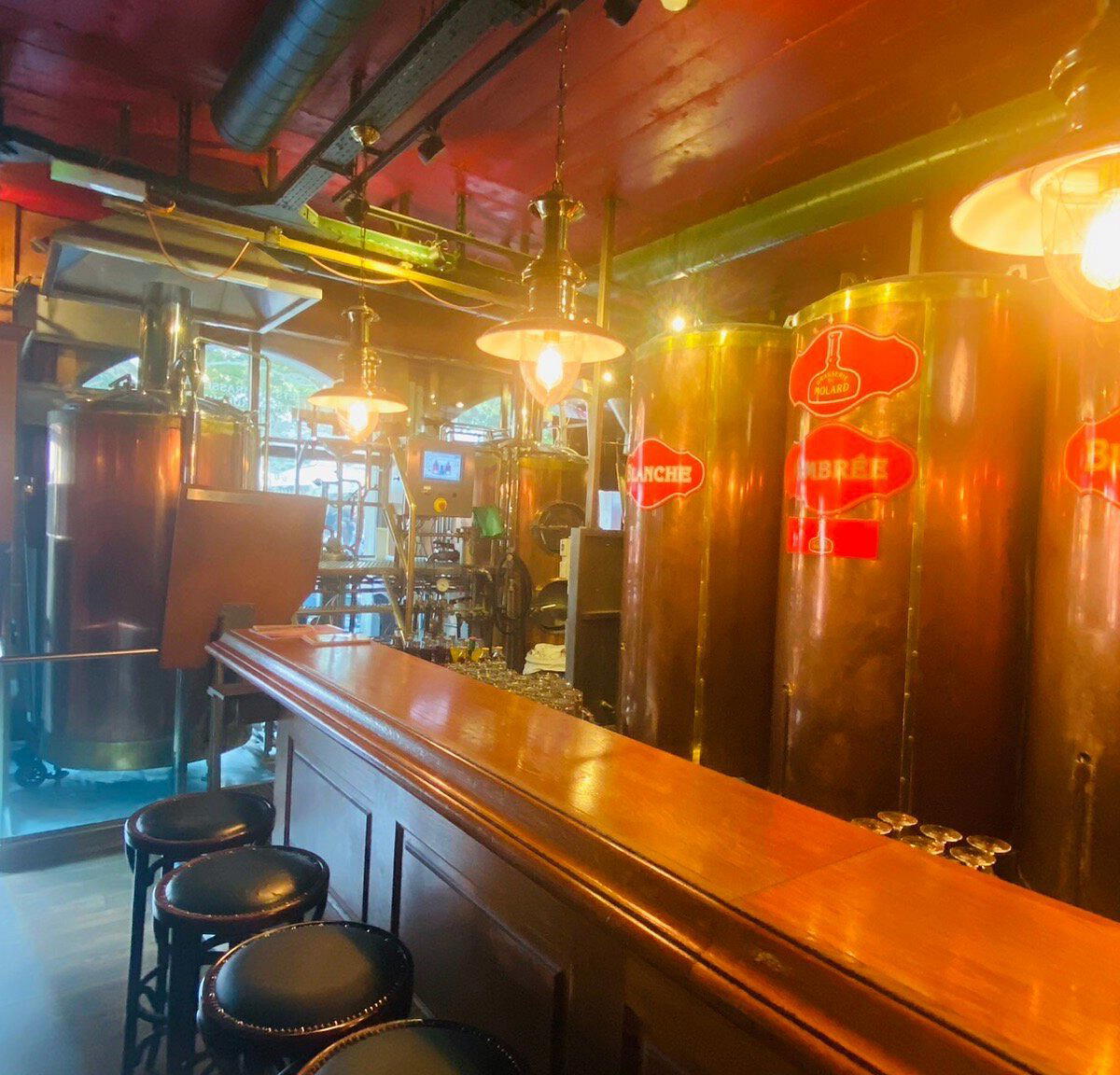
Chaleureuse and convivial atmosphere with a chic brewpub feel, featuring visible copper brewing vessels and patio seating.