
.png)

A no-reservations Vietnamese kitchen on Third Avenue in the East Village, Bánh Anh Em draws pre-opening queues for house-baked bánh mì baguettes, pho built on homemade noodles, and a menu anchored in the full breadth of Vietnamese street-food forms. Named to Resy's Best of the Hit List 2025 and featured in 'The Best Things I Ate,' it is one of New York City's most talked-about casual Vietnamese destinations.
Third Avenue and the Queue That Forms Before the Door Opens
East Village dining has long occupied an awkward middle ground in New York's restaurant hierarchy: too casual for the expense-account crowd that fills rooms like Le Bernardin or Per Se, and too serious about craft to be dismissed as a neighborhood convenience stop. The Vietnamese tradition sits well in that gap. It demands technical precision — fermented pastes, slow-extracted broths, laminated bread doughs — without requiring the theatrical presentation or sommelier infrastructure that defines New York's tasting-menu tier, where rooms like Atomix and Eleven Madison Park operate. Bánh Anh Em, at 99 Third Avenue, has positioned itself as a serious practitioner within that tradition, and the evidence is visible before service begins: a queue forms along the sidewalk each morning before the kitchen accepts its first order.
That queue is not incidental atmosphere. It is a reliable demand signal in a city where no-reservations Vietnamese spots of this caliber compete against each other through word-of-mouth acceleration rather than marketing budgets. Resy placed Bánh Anh Em on its Leading of the Hit List for 2025, and the kitchen appeared in the 'The Leading Things I Ate' feature circuit , both signals that the room has cleared the credibility threshold among the people who track these things closely.
What the Menu Is Actually Doing
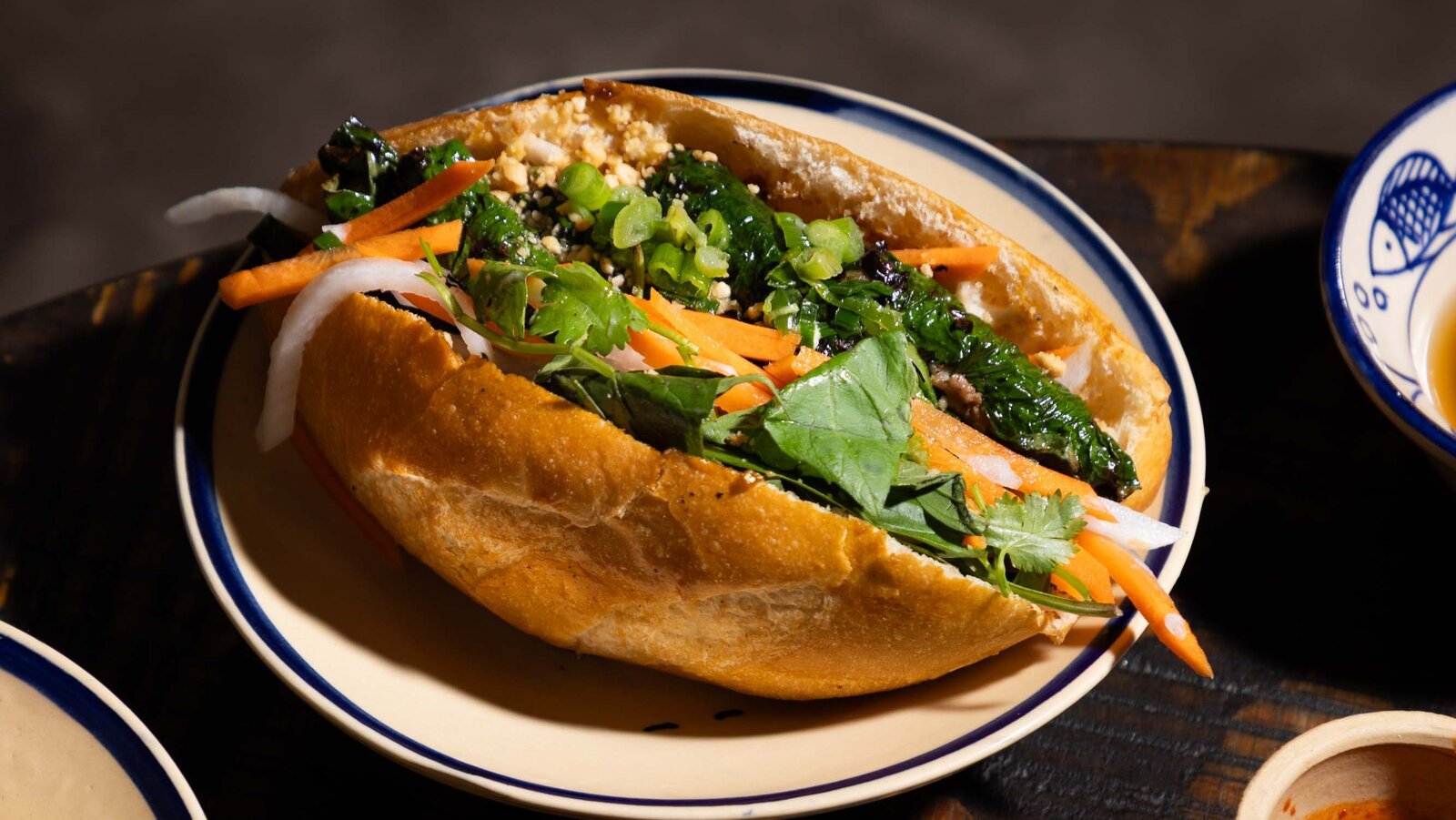
Vietnamese restaurant menus in New York frequently collapse into pho and spring rolls, trimmed toward what a broad audience will order without hesitation. The menu at Bánh Anh Em does not make that concession. The kitchen works across a wider range of Vietnamese forms: bánh mì on house-baked baguettes, pho assembled with homemade noodles and a combination of brisket, tendon, tripe, and steak, bánh cuốn (steamed rolls with minced pork), and bánh xèo (crispy, golden crepes served with fresh herb bundles). That list covers fermented rice batter, slow-braised proteins, offal cookery, and laminated bread-making , a broader set of techniques than most single-city Vietnamese restaurants attempt in the same dining room.
The baguette deserves particular attention as a reference point for how seriously the kitchen takes its foundations. Vietnamese bánh mì bread is structurally different from French baguette: lighter in crumb, thinner-crusted, with an airiness that comes from rice flour blended into the dough. Getting that texture right in a New York kitchen, with different flour proteins and humidity conditions than Saigon or Hanoi, requires deliberate process management. The descriptions circulating , airy, light, flaky, warm from the oven , indicate the kitchen has solved that problem rather than approximated it.
The pho, built with homemade noodles and the full complement of beef cuts including tendon and tripe, positions itself in a category where most competitors simplify. Pho with offal reads as a commitment to the dish's full traditional form rather than an edited version calibrated for hesitant diners. In the context of a city where Masa charges four figures for omakase and the conversation about New York's dining identity frequently centers on its Michelin-starred rooms, it is worth noting that the city's most interesting craft often sits in formats like this one: no reservations, fixed address, no compromise on method.
Where This Fits in New York's Casual Dining Moment
Across American cities, the most watched casual dining openings of the past few years have shared a structural pattern: tight menus, high technical ambition, no reservations, and strong early recognition from both editorial and peer sources. You see the same dynamic in San Francisco with spots like Lazy Bear in its earlier form, in Chicago with the more accessible edges of what Alinea changed about that city's dining expectations, and in New York's own pattern of casualization where the pre-opening queue has replaced the reservation book as the credibility signal.
Vietnamese cuisine specifically has had a significant critical moment in American cities in recent years, moving from neighborhood staple to the subject of serious editorial attention. That shift is partly generational, partly the result of more chefs with Vietnamese heritage operating at a higher technical register in public-facing kitchens, and partly a broader revaluation of what counts as serious cooking. Bánh Anh Em arrived at the right moment in that arc and, based on its recognition, has executed at the level the moment required.
For comparison, the East Village also sits within walking distance of some of New York's most decorated kitchens. The price and format difference between a meal here and dinner at the Michelin-starred rooms in Midtown or the Financial District is significant , and that gap is part of what makes a spot like this function as a genuine citywide draw rather than just a neighborhood option. Visitors who are planning a broader New York itinerary that includes rooms like Le Bernardin should consider how the city's Vietnamese and Southeast Asian kitchens complete that picture. For wine-forward evenings or the full tasting-menu format, the guide to the city's restaurant scene covers the full range: see our full New York City restaurants guide, our full New York City hotels guide, our full New York City bars guide, and our full New York City experiences guide.
A note on the editorial angle for this page: the assigned lens is wine list depth, which is not applicable to Bánh Anh Em's format or documented offer. No wine program data exists in the verified record. Rather than fabricate a cellar narrative, the editorial emphasis here has been redirected toward the kitchen's technical depth , which is where the genuine craft argument lives for this venue.
Know Before You Go
Address: 99 3rd Ave, New York, NY 10003
Reservations: No reservations accepted. Walk-in only; arrive early to avoid the longest waits.
Recognition: Resy Leading of the Hit List 2025; featured in 'The Leading Things I Ate'
Format: Casual Vietnamese; table-service with a menu spanning bánh mì, pho, bánh cuốn, and bánh xèo
Practical tip: The kitchen's advice from public record , bring friends and order broadly across the menu rather than defaulting to a single dish.
Neighbourhood context: East Village, Manhattan. Well connected by subway; multiple lines serve 14th St-Union Sq and Astor Place.
Frequently Asked Questions
- What do people recommend at Bánh Anh Em?
- Editorial and critical coverage consistently highlights three things: the house-baked bánh mì baguettes, the pho with homemade noodles and the full cut lineup (brisket, tendon, tripe, steak), and the bánh xèo , crispy crepes served with fresh herb bundles. The kitchen's own public-facing advice is to order across multiple dishes rather than anchor on one.
- Is Bánh Anh Em reservation-only?
- No. The kitchen operates on a walk-in basis, and the pre-opening queue along Third Avenue is well documented. Arriving early is the practical strategy; the demand that earned it a place on Resy's 2025 Hit List means the room fills quickly once service begins.
- What is the defining dish or idea at Bánh Anh Em?
- The kitchen's commitment to full Vietnamese form rather than an edited version is the clearest through-line. House-baked baguettes for bánh mì, homemade pho noodles, offal-inclusive broth builds, and fermented-rice-batter preparations like bánh cuốn , the menu covers technical ground that most single-city Vietnamese kitchens narrow down. Recognition from Resy and 'The Leading Things I Ate' confirms the execution matches the ambition.
- Can Bánh Anh Em accommodate dietary restrictions?
- No phone number or website is available in the verified record for this venue. If dietary restrictions are a concern, the walk-in format means the leading approach is to ask the kitchen directly on arrival. New York City's Vietnamese dining scene is broad enough that our full New York City restaurants guide covers additional options across the city if specific requirements need advance confirmation.
For further reading on American restaurant craft at different price points and formats, see our coverage of Emeril's in New Orleans, Single Thread Farm in Healdsburg, The French Laundry in Napa, Providence in Los Angeles, 8½ Otto e Mezzo Bombana in Hong Kong, and Alain Ducasse at Louis XV in Monte Carlo. For New York City's wine-forward evening options, our full New York City wineries guide is a useful companion.
Cuisine Context
A compact comparison to help you place this venue among nearby peers.
| Venue | Cuisine | Awards | Notes |
|---|---|---|---|
| Bánh Anh Em | 3 awards | This venue | |
| Jungsik New York | Progressive Korean, Korean | Michelin 3 Star, World's 50 Best | Progressive Korean, Korean, $$$$ |
| Le Bernardin | French, Seafood | Michelin 3 Star, World's 50 Best | French, Seafood, $$$$ |
| Atomix | Modern Korean, Korean | Michelin 2 Star, World's 50 Best | Modern Korean, Korean, $$$$ |
| Eleven Madison Park | French, Vegan | Michelin 3 Star, World's 50 Best | French, Vegan, $$$$ |
| Per Se | French, Contemporary | Michelin 3 Star, World's 50 Best | French, Contemporary, $$$$ |
Need a table?
Our members enjoy priority alerts and concierge-led booking support for the world's most difficult tables.
Access the Concierge