Banyan Tree
Maui's dining identity has long been shaped by what grows and swims within reach of the island, and Banyan Tree operates within that tradition at the upper end of the market. Positioned among Hawaii's premium dining addresses, it draws on the island's agricultural depth and coastal fisheries in a format that rewards guests who engage with where their food actually comes from.

Pearl is the En Primeur Club membership app — saves, bookings, and concierge access live there. Same editors, same standards.
Where the Plate Begins: Ingredient-Led Dining on Maui
Maui's most serious dining rooms share a structural advantage that mainland counterparts spend considerable effort trying to replicate: proximity to ingredients that are genuinely extraordinary before a kitchen touches them. The island sits within reach of deepwater Pacific fisheries, volcanic-soil farms in Kula and Upcountry, and a network of small-scale growers whose produce rarely leaves the island chain. Banyan Tree works within that supply ecosystem, framing its menu around what the land and ocean provide rather than what a fixed culinary identity demands. That orientation puts it in a specific tier of Hawaiian dining: not resort-buffet scale, not tourist-facing plate lunch, but the smaller cohort of restaurants where sourcing decisions are treated as editorial choices rather than logistical ones.
The Physical Approach
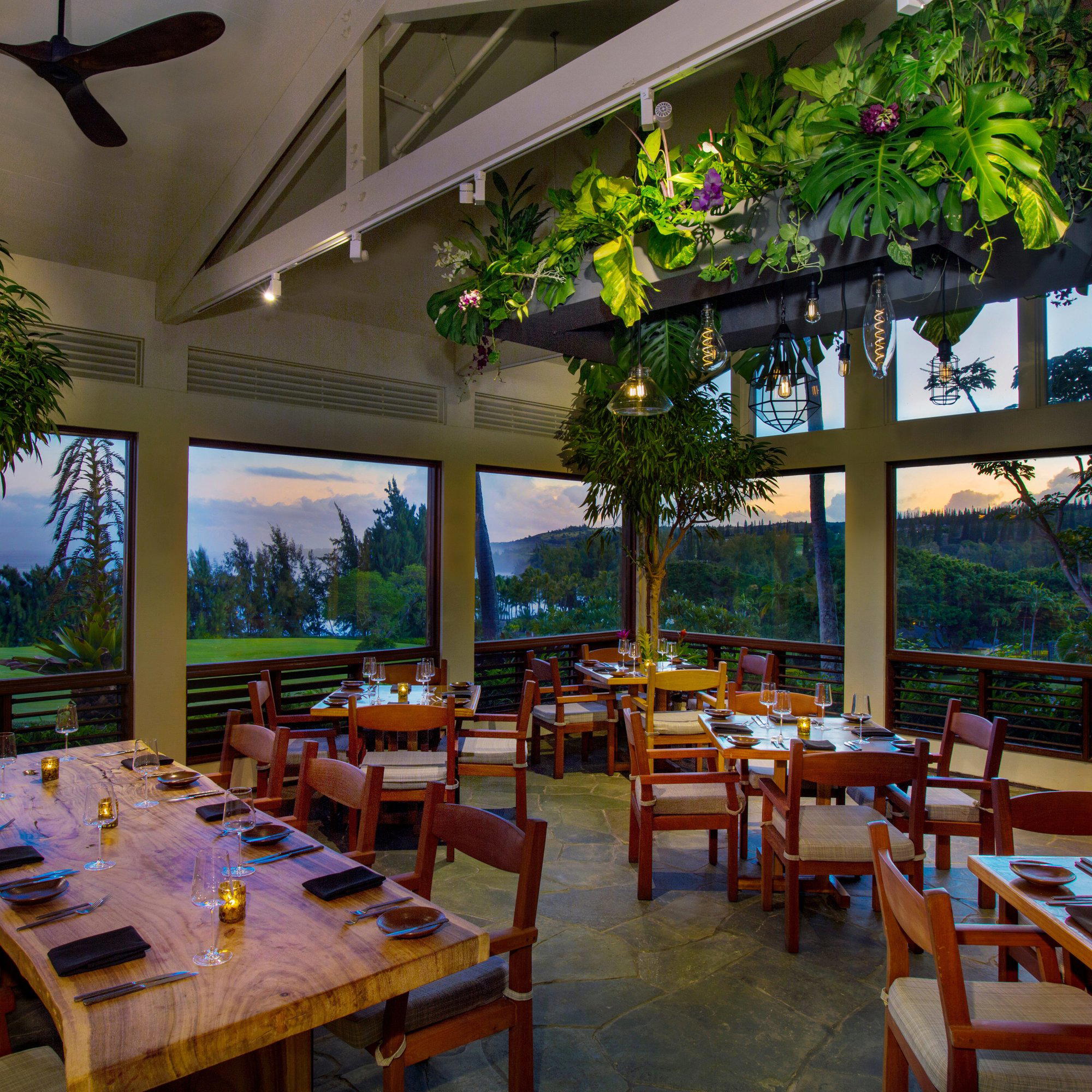
Arriving at Banyan Tree, the architecture of Hawaiian luxury resort dining asserts itself before the food does. The indoor-outdoor flow common to Maui's premium properties means the line between garden and dining room is deliberately soft. The sky, the surrounding plant life, and the quality of evening light all function as part of the setting in a way that enclosed mainland dining rooms, however accomplished, cannot replicate. This format is nearly standard across the island's leading hotel dining operations, but the execution varies considerably. The question for any Maui property in this tier is whether the room earns its context or simply inherits it.
For a guest arriving from the continental United States, the sensory shift is immediate and significant. Hawaii occupies a different relationship to time zones, seasonal rhythms, and food geography than anywhere on the mainland. Restaurants like Banyan Tree operate in that particular context, where the setting itself does part of the hospitality work, and the kitchen's role is to make the sourcing coherent on the plate.
Hawaii's Ingredient Story and Why It Matters Here
The case for Hawaii as a serious dining destination is, at its core, an ingredient argument. The volcanic soil of Upcountry Maui produces onions, strawberries, and greens with a mineral intensity that reflects the land's geological youth. Waiakoa and Kula farms supply particularly sought-after produce in the state. Meanwhile, the surrounding Pacific delivers species unavailable in mainland markets: opah, ono, ahi from local longliners, opakapaka from deeper reef waters. Any kitchen operating at the restaurant's positioning has access to these materials, and the editorial interest lies in how systematically and rigorously that access is used.
This is the axis on which premium Hawaiian dining is most usefully evaluated. Compare a sourcing-serious operation in Maui against farm-to-table programs elsewhere in the United States and the geographic advantage is clear. Blue Hill at Stone Barns in Tarrytown built its entire identity around hyper-local agricultural integration in New York; Single Thread Farm in Healdsburg does the same in Sonoma County. Maui restaurants working the same philosophy have, if anything, a more compressed and biodiverse supply chain to draw from, with the added variable of being an island system, where what doesn't grow here must be flown in at cost and carbon consequence.
That island-supply constraint is, paradoxically, a creative discipline. Kitchens that take it seriously end up with menus that read as genuinely of a place, not merely located in one. The leading comparisons are restaurants like Lazy Bear in San Francisco or Addison in San Diego, where the regional ingredient narrative is structurally built into the tasting format rather than appended as a marketing layer.
Positioning Within the Maui Premium Tier
Maui's upper dining tier is smaller than visitors sometimes expect. The island has significant resort infrastructure but relatively few restaurants operating at the level where sourcing, technique, and format are all calibrated to a sophisticated audience. The restaurant occupies space within that smaller cohort. The relevant comparable set is not the broader Hawaiian restaurant market but the handful of properties where a guest who has eaten at The French Laundry in Napa, Providence in Los Angeles, or Le Bernardin in New York City would find the conversation recognizable, even if the register is different.
That comparable set comparison is not meant to flatten distinctions. Hawaiian luxury dining has its own character: less architectural formality than New York or Chicago, a stronger relationship between indoor and outdoor space, and a food culture shaped by Japanese, Filipino, Korean, Chinese, and Portuguese immigration that gives even fine-dining menus a different set of reference points than their continental equivalents. Restaurants like ITAMAE in Miami or Atomix in New York City demonstrate how non-European culinary lineages are now central to American fine dining, not peripheral to it. The same cultural complexity applies to Hawaii, where the baseline food culture is already a sophisticated hybrid.
Planning a Visit
Maui's premium dining rooms tend to operate on resort cycles, which means dinner service is typically concentrated in the early-to-mid evening, and tables at properties like Banyan Tree are worth securing before arrival rather than on the day.
Guests arriving from cities with dense fine-dining ecosystems, whether that means Alinea in Chicago, Causa in Washington, D.C., Frasca Food & Wine in Boulder, or Bacchanalia in Atlanta, will find that Maui operates at a different pace, with the resort environment shaping service rhythms. That is a trade-off worth understanding before arrival, not a flaw.
- Sashimi Grade Ahi Tuna Poke
- Fresh Catch Sashimi
- Pineapple Scallops
- Steamed Onaga with Spiced Essence
- Crispy Duck Confit and Foie Gras
- Kona Maine Lobster Lumpia
A Quick Peer Check
Comparable venues nearby, for context on price, style, and recognition.
| Venue | Cuisine | Price | Notes |
|---|---|---|---|
| Banyan TreeThis venue — the venue you are viewing | Coastal Seafood & Steakhouse | $$$$ | Not listed |
| Humuhumunukunukuapuaa | Hawaii Regional Seafood and Steakhouse | $$$$ | Wailea |
| Humuhumunukunukuāpua'a | Hawaiian Seafood and Steakhouse | $$$$ | Wailea |
| Banyan Tree | Fusion Seafood Fine Dining | $$$$ | Kapalua |
| Moa Moa | Hawaiian Seafood Fusion | $$$ | Kapaa |
| Plantation Gardens | Pacific Rim Hawaiian Seafood | $$$ | Koloa |
Continue exploring
More in Maui
Hotels in Maui
Browse all →
At a Glance
- Romantic
- Elegant
- Scenic
- Sophisticated
- Date Night
- Special Occasion
- Celebration
- Waterfront
- Open Kitchen
- Hotel Restaurant
- Panoramic View
- Terrace
- Craft Cocktails
- Local Sourcing
- Farm To Table
- Waterfront
Casual elegance with open walls, glossy wood tables, lush living walls, glowing sunset skies, and sweeping ocean views creating a tranquil, sophisticated atmosphere.