Our verdict
A Volta serves French Mediterranean with local Corsican products at Pl. Chanoine Mattei in Cargèse, with waterfront views and conversational pacing for lunch or dinner.

Pearl is the En Primeur Club membership app — saves, bookings, and concierge access live there. Same editors, same standards.
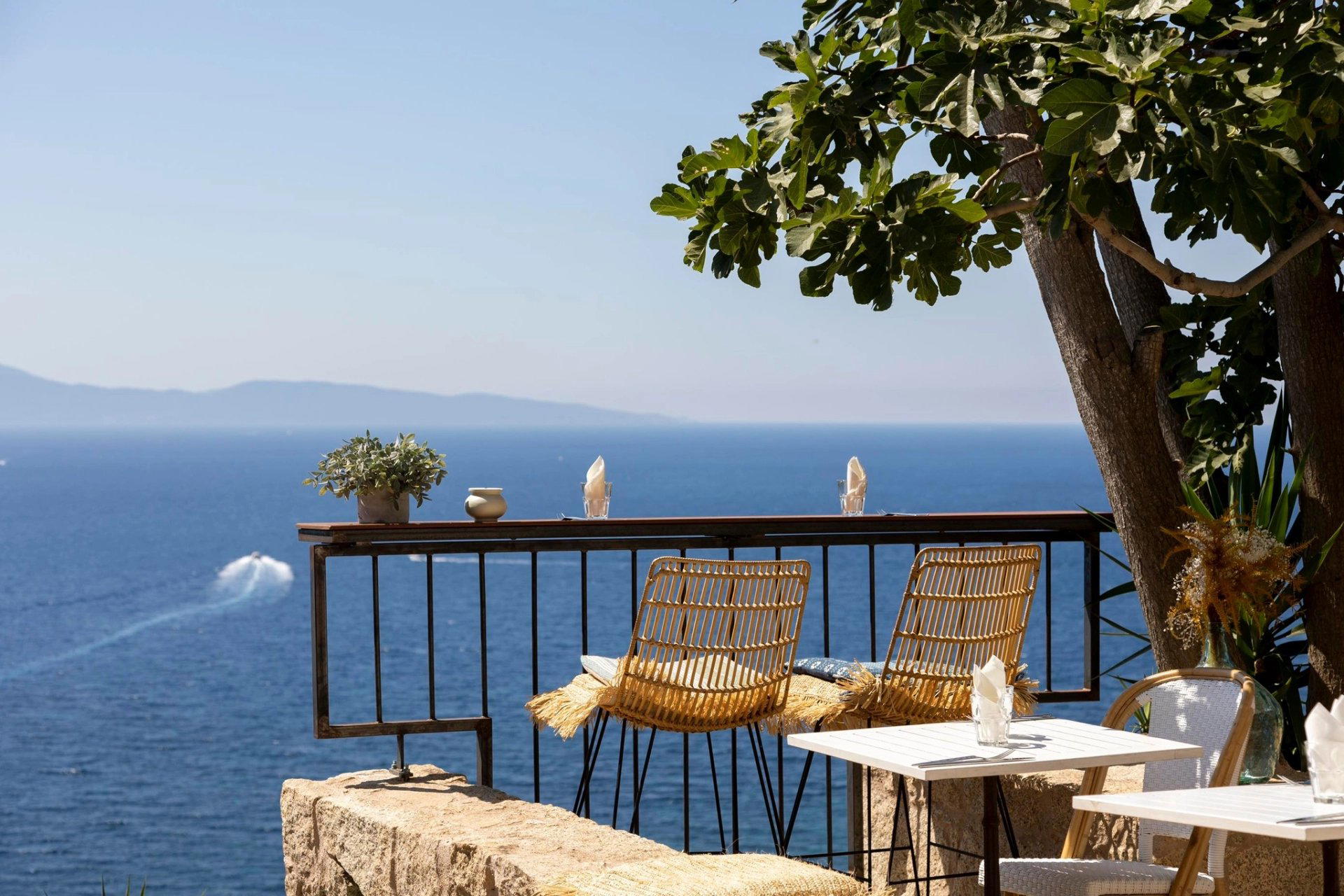
Where the Corsican Interior Meets the Sea
Cargèse sits on the western coast of Corsica in a way that makes most other French coastal towns feel overproduced. The village is small, Greek-rooted in its history, and positioned on a promontory between two bays where the maquis scrubland runs almost to the shoreline. Pl. Chanoine Mattei, the square that anchors the old centre, is the kind of address that functions as both a geographical and social coordinate — the place where the village slows down in the early evening, where locals settle in without any particular urgency. A Volta occupies that address, which tells you something about how it fits into the town before you have eaten a single thing.
Corsican restaurant culture, particularly in smaller communes away from Ajaccio and Bastia, tends to stay close to the land and the water simultaneously. That dual sourcing defines what ends up on the plate more reliably here than in most French regional traditions. The island's interior produces chestnut flour, brocciu (the fresh sheep or goat cheese that sits at the centre of the Corsican larder), cured meats from free-ranging pigs, and wild herbs from the maquis — rosemary, fennel, myrtle, immortelle, that carry a dryness and intensity you do not find in cultivated equivalents. The sea around Cargèse delivers red mullet, sea bass, lobster, and urchin according to season. The leading tables in this part of the island do not choose between these two traditions; they run them in parallel, letting the kitchen's provenance do the editorial work.
Ingredient Sourcing as Structure
The most important thing to understand about eating in Cargèse is that the supply chain here is short by necessity and by preference. The village does not have the tourist volume of Porto or Bonifacio, which means suppliers are largely local: fishermen working the Gulf of Sagone, small producers in the Cruzini or Liamone valleys inland, and farms on the Cinarchese plateau that have been running the same animal breeds for generations. The Corsican pig, fattened on chestnuts and acorns in the interior forests, produces charcuterie that carries controlled appellation status, lonzu (cured loin), coppa, figatellu (the liver sausage eaten grilled in winter), and any table worth sitting at in this part of the island treats that charcuterie as a primary course, not a garnish.
Brocciu deserves particular attention as a structuring ingredient rather than a supporting one. It appears across the calendar in different forms, fresh in spring when milk production peaks, then aged (passu) as the season advances, and its presence on a menu is a reliable indicator of a kitchen that tracks seasonality with some care. Chestnut flour, meanwhile, moves between savoury and sweet applications: polenta, bread, fritters (fritelli), and the dense cake called fiadone. These are not decorative heritage gestures; they are load-bearing elements of Corsican cooking at its most coherent.
This ingredient logic is what distinguishes eating in Cargèse from the French mainland's coastal restaurant model, where sourcing is often equally rigorous but the reference points are different. At tables like Mirazur in Menton or Christopher Coutanceau in La Rochelle, hyper-local sourcing is a formal, documented programme tied to specific named producers. In Cargèse, the same principle operates more quietly, the producer is often simply the family two kilometres away, but the result on the plate can be equally direct.
The Scene Around Pl. Chanoine Mattei
Cargèse is not a dining destination in the way that a handful of French provincial towns have become over the past two decades. It does not attract a circuit of restaurant-focused travellers the way Laguiole does around Bras, or Vonnas around Georges Blanc, or Illhaeusern around Auberge de l'Ill. What it does attract, particularly between June and September, is visitors to western Corsica's coastal walking trails, the Calanques de Piana nearby, and the beaches of the Gulf of Sagone. That demographic is hungry in an uncomplicated way, and the better restaurants in town meet it without condescension.
The square itself functions as a slow-rotation gathering point from mid-afternoon onward. The Greek-Corsican population that settled here in the eighteenth century left behind two churches facing each other across a short distance, one Latin, one Greek Orthodox, and a village plan that remains walkable and compact. Eating here in the summer has a specific character: long evenings, light that stays gold until nearly nine o'clock, and a pace that mainland France has largely traded away in its coastal towns.
Practical logistics in Cargèse are worth planning around. The village is most directly accessed by road from Ajaccio (roughly 50 kilometres south) or from Calvi to the north. There is no train access; visitors arrive by car, by boat into the small marina, or via summer bus connections from Ajaccio. Given the village's size and the seasonal concentration of visitors in July and August, booking ahead for any restaurant, particularly for dinner, is the sensible approach rather than the cautious one. The overlap between summer tourism and limited local capacity means that walk-in availability at the better addresses compresses quickly after mid-June.
Corsican Tables in French Context
Positioning Corsican cooking within French fine dining is complicated by the island's particular status, administratively French but culinarily distinct, with Italian and specifically Genoese influence running through the pasta traditions, and a pastoral interior economy that has more in common with Sardinia than with the Languedoc across the water. The haute cuisine axis that connects addresses like Alléno Paris au Pavillon Ledoyen in Paris, Assiette Champenoise in Reims, or Flocons de Sel in Megève does not extend to Cargèse in any meaningful way. The ambition here runs on a different track, one where the quality signal is provenance and freshness rather than technique for its own sake.
That positioning is not a limitation. Some of the most direct eating in France happens at tables where the local supply chain is short enough that technique mostly gets out of the way. AM par Alexandre Mazzia in Marseille makes a case for the Mediterranean south as a serious culinary reference point. Corsican tables make a parallel case with different tools: less elaboration, more ingredient fidelity, a wine list that will lean toward Nielluccio and Vermentino from the island's appellations rather than Burgundy or Bordeaux. For context on how coastal French kitchens handle product-forward cooking at a different scale, see also La Marine in Noirmoutier-en-l'île and Auberge du Vieux Puits in Fontjoncouse. For broader context on eating in the region, our full Cargèse restaurants guide covers the village's dining options in detail.
Planning Your Visit
Cargèse operates on a compressed seasonal calendar. The village is at its most accessible and its restaurants at full operation between June and September; outside those months, some addresses reduce hours or close entirely, which is standard for small Corsican coastal communes rather than exceptional. Visitors coming primarily to eat should aim for June or early September, when crowds are lighter than the July-August peak but the full range of local produce is available. Driving from Ajaccio takes under an hour on the T20 coastal road and is the most flexible option for accessing both Cargèse and the surrounding coastline.
Frequently asked questions
Is A Volta child-friendly?
Cargèse is a small village rather than a resort town, and restaurants on Pl. Chanoine Mattei tend to operate at a relaxed, unhurried pace that suits families without being organised around them.
What's the vibe at A Volta?
A Volta sits on Pl. Chanoine Mattei in Cargèse, a western Corsican village with Greek roots and a short seasonal window. The setting is low-key and local-facing rather than tourist-polished — the kind of square where the pace slows in the evening and the cooking reflects what's nearby rather than what's fashionable.
Is A Volta open year-round, or does it follow Cargèse's seasonal schedule?
Confirmed hours for A Volta are not in the available record, but Cargèse as a whole operates on a compressed seasonal calendar with the village most active and restaurants at full capacity between June and September. Visitors planning a trip outside that window should verify opening directly with the venue at its address on Pl. Chanoine Mattei, 20130 Cargèse.
What do regulars order at A Volta?
What is consistent with Cargèse's broader food scene is that the supply chain is short by both necessity and preference, which means the menu is shaped by local producers and the western Corsican coast rather than by imported inventory.
What part of town is A Volta in?
A Volta is located at Pl. Chanoine Mattei, 20130 Cargèse, France, Cargese.
Should I book A Volta in advance?
Cargèse runs on a compressed seasonal calendar, with restaurants at full operation between June and September. Capacity in a village of this size is limited, and summer footfall concentrates into a narrow window, so booking ahead is the practical approach rather than the cautious one.
What's the signature at A Volta?
No specific signature dish is documented in the available record. Given A Volta's position in Cargèse on the western Corsican coast, the kitchen's identity is most likely defined by the island's characteristic ingredient logic — charcuterie, cheese, seafood, and herbs tied to local producers — rather than by a single destination plate.
Side-by-Side Snapshot
Comparable venues nearby, for context on price, style, and recognition.
| Venue | Cuisine | Price | Notes |
|---|---|---|---|
| A VoltaThis venue — the venue you are viewing | French Mediterranean with Local Corsican Products | $20–30 | Not listed |
| Auberge du Col Saint-Georges | Traditional Corsican French | $20–30 | Grosseto Prugna |
| U Bistrotellu | Traditional Corsican Bistro | $30–50 | Les Jardins de Bodiccione |
| L’aventure | French Mountain Grill | $30–50 | Oz en Oisans |
| Atelier de Candale | Seasonal French wine‑country restaurant in the vineyards | $50–100 | Saint-Laurent-des-Combes / Saint-Émilion vineyards |
| Le Petit Canard | Traditional French Duck Bistro | Not listed | 9th arrondissement |
Continue exploring
More in Cargese
Restaurants in Cargese
All restaurants in Cargese →
Bars in Cargese
Browse all →
Hotels in Cargese
All hotels in Cargese →
Wineries in Cargese
Browse all →
Details
- Scenic
- Rustic
- Family
- Casual Hangout
- Terrace
- Panoramic View
- Local Sourcing
- Waterfront
- A La Carte
- Vegetarian Friendly
Current opening hours
- Monday
- 10 AM–1 AM
- Tuesday
- 10 AM–1 AM
- Wednesday
- 10 AM–1 AM
- Thursday
- 10 AM–1 AM
- Friday
- 10 AM–1 AM
- Saturday
- 10 AM–1 AM
- Sunday
- 10 AM–1 AM
Hours can change for holidays and private events. Last verified .
Ambiance conviviale de terrasse avec vue panoramique sur la mer, idéale pour des repas de vacances.