
A former sugar mill on the Li River, Yangshuo Sugar House was reimagined by Beijing's Vector Architects into a 117-room post-industrial resort where perforated concrete screens face off against original weathered brick, and craggy karst peaks frame every sightline. Starting at $265 per night, it sits at the upper end of Yangshuo's accommodation range, with food, spa, and activity programming to match.
Pearl is the En Primeur Club membership app — saves, bookings, and concierge access live there. Same editors, same standards.
- Address
- No, 102 东岭路阳朔县桂林市广西壮族自治区541905
- Phone
- +867738883999
- Directions
- Get directions
 Saves & bookings on Pearl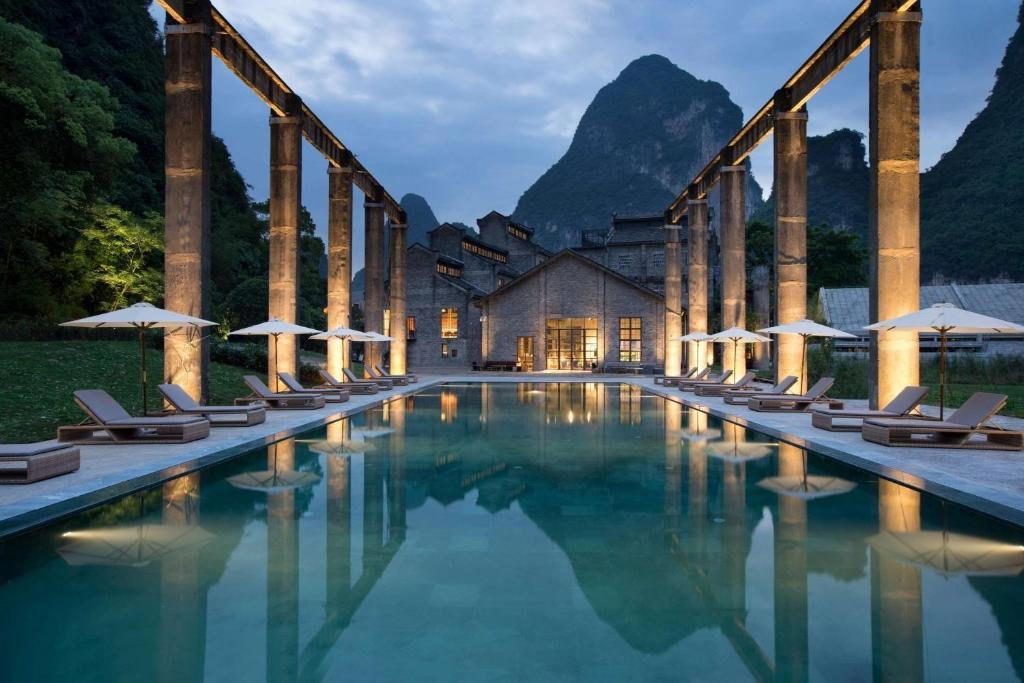
When Industrial Ruins Meet Karst Geology
The Li River corridor between Guilin and Yangshuo is among the more photographed stretches of landscape in China: limestone karst towers rising at near-vertical angles from flat agricultural land, the river threading between them in long, slow bends. What the photograph rarely shows is how difficult it is to build meaningfully in that environment without the architecture either disappearing into the scenery or competing with it in ways that rarely end well. The Yangshuo Sugar House addresses that problem through a strategy of deliberate contrast rather than mimicry, and it works.
The Architecture: Vector Architects and the Post-Industrial Turn
China's premium hospitality market has divided, broadly, into two camps: the international-brand tower model, which delivers consistency and scale, and a smaller cohort of site-specific conversions where the building itself is the primary draw. The Yangshuo Sugar House belongs firmly to the second group. Beijing-based Vector Architects, known for projects that take seriously the relationship between structure and landscape, took a decommissioned sugar mill and extended it into a full resort without erasing what made the original buildings worth preserving.
The result is a composition in contrasts. Weathered red brick from the original factory sits alongside new concrete additions, but the new concrete is perforated and screen-like, filtering light rather than blocking it. The structures feel permeable in a way that solid luxury architecture rarely does, you are aware of the karst landscape through the walls as much as from the windows. This is deliberate formal strategy, not decorative effect: the architecture acknowledges that the landscape is the dominant element and positions itself accordingly. Among Chinese properties that take a comparable approach to design-led adaptive reuse, peers include Amanfayun in Hangzhou, which converted a network of village tea-workers' dwellings, and Amandayan in Lijiang, which built into the Old Town's historic fabric rather than beside it.
The spa is one architecturally specific moment in the property: it occupies the sugar factory's original molasses storage tank, a circular industrial vessel that has been converted into treatment spaces. The geometry is predetermined by the industrial past, and the result reads as genuinely site-specific in a way that purpose-built resort spas rarely achieve.
Rooms and Accommodation Categories
With 117 keys at a starting rate of $265 per night, the Sugar House positions itself at the upper end of what Yangshuo can sustain as a market, though it remains meaningfully below the price ceiling of Aman-tier properties elsewhere in China such as Amandayan or the urban equivalent found at the Mandarin Oriental Qianmen in Beijing.
The accommodation range spans rooms, lofts, suites, townhouses, and villas, with entry-level units beginning at 55 square meters. That floor area is generous for a standard room in China's resort market, where many properties in this price bracket open at 40 square meters or less. The loft and villa categories spread into significantly larger footprints, functioning as self-contained stays within the resort rather than simply as upgraded versions of the base product. The architectural vocabulary carries through from the public spaces into the guest accommodation: materials are restrained, the industrial heritage is referenced without being fetishised, and the orientation toward the karst landscape is consistent across categories.
Guests choosing between categories face a direct decision: room and loft types suit shorter stays where the hotel's common facilities and activities form the primary draw, while the townhouse and villa formats make more sense for multi-night itineraries where the accommodation itself becomes a base rather than a bed. For comparison with other Chinese resort formats that privilege accommodation scale, 1 Hotel Haitang Bay in Sanya and Banyan Tree Chongqing Beibei both operate in a similar tier.
Food, Drink, and Common Spaces
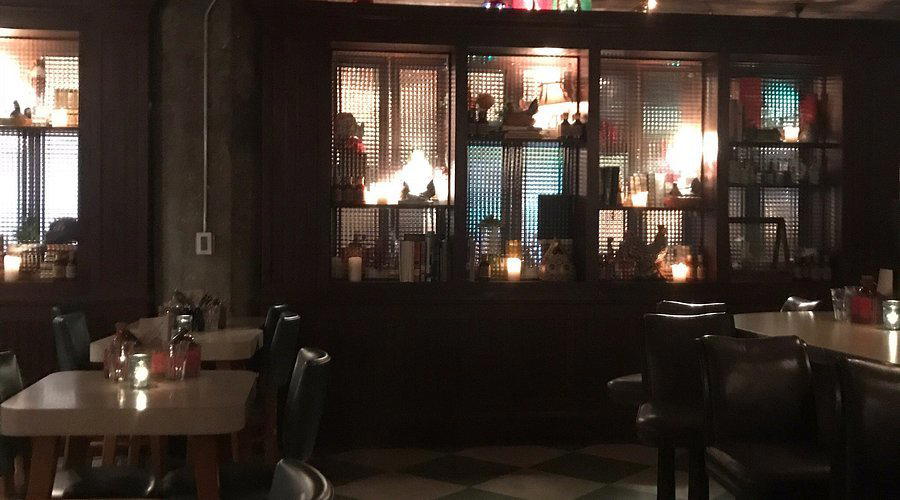
Three distinct food and beverage spaces operate within the converted industrial buildings. The Sugar House restaurant anchors the dining program with contemporary Chinese cooking; the 1969 Bar occupies a restored factory space and carries the property's cocktail and wine program; and the Water Pump private dining room offers a more sequestered format for smaller groups. The names alone signal the property's approach: the year 1969 references the mill's operational history rather than any exterior reference point, and the Water Pump makes literal the industrial infrastructure it replaced.
Contemporary Chinese cooking in resort contexts often defaults to a broad regional menu that serves the widest possible guest demographic. The Sugar House's kitchen draws on the ingredients and flavour profiles of southern China.
Activity Programming and the Landscape
The karst peaks surrounding Yangshuo are not only decorative. The limestone formations are climbable, and the Sugar House has integrated rock climbing into its activity offering. Cultural experiences round out the programming.
This combination of landscape-engaged activities and cultural programming places the Sugar House in a growing category of Chinese destination resorts that position themselves as access points to a place rather than escapes from it. Properties in comparable natural settings, including Xiamen Yunding Resort and the more remote Mohe Youran Mountain Residence in Da Hinggan Ling, follow a similar logic, though the Li River valley's accessibility by rail and road from Guilin gives the Sugar House a guest catchment those more remote properties cannot match.
Planning Your Stay
The town itself is small and walkable, and the Sugar House sits on the Dongling Road address in Yangshuo County. With 117 rooms, the property has enough inventory that last-minute availability is more plausible than at smaller boutique conversions, though peak seasons around Chinese national holidays and the October Golden Week compress bookings significantly across the entire Guilin corridor. Travellers connecting through other parts of China might use the stay as part of a longer itinerary that includes properties such as Amanfayun in Hangzhou, Andaz Shenzhen Bay, or JW Marriott Hotel Shanghai at Tomorrow Square to balance urban and landscape-focused stays across a single trip through China's south and east.
Comparable Venues
Comparable venues nearby, for context on price, style, and recognition.
| Venue | Cuisine | Price | Awards | Notes |
|---|---|---|---|---|
| Yangshuo Sugar HouseThis venue — the venue you are viewing | Converted historic sugar factory resort | $$$$ | Michelin 1 Key | Not listed |
| Alila Yangshuo | Modern retro resort in restored sugar mill | $$$$ | 5-Star | Yangshuo |
| The Londoner Hotel | British-inspired luxury townhouse with subtle London accents in patterns, furniture, and art. | $$$$ | Michelin 1 Key | Cotai |
| Four Seasons Hotel Guangzhou | Sky-high urban luxury tower hotel | $$$$ | Michelin 1 Key | Guangzhoushi |
| Capella Tufu Bay | Secluded beachfront resort inspired by natural elements amid lush gardens. | $$$$ | Michelin 1 Key | Haitang Bay |
| The St. Regis Macao | Classic luxury with local Macanese inspiration | $$$$ | Michelin 1 Key | Cotai Strip |
Recognition history
Dated appearances from independent guides and award organizations, with the underlying list record or original source where available.
Michelin 1 Key
Michelin
Continue exploring
More in Guilin
Restaurants in Guilin
Browse all →
At a Glance
- Scenic
- Rustic
- Modern
- Cozy
- Elegant
- Romantic Getaway
- Family Vacation
- Wellness Retreat
- Weekend Escape
- Panoramic View
- Terrace
- Wi Fi
- Pool
- Spa
- Fitness Center
- Room Service
- Concierge
- Restaurant
- Bar
- Kids Club
- Mountain
- Garden
- Wi Fi
- Pool
- Spa
- Fitness Center
- Room Service
- Concierge
- Restaurant
- Bar
- Kids Club
Relaxed and serene with natural light, minimalist design, and dramatic mountain and river views from spacious, comfortable rooms and pool deck.