
Michelin Selected
Set against the cloud-forested slopes of Pico Bonito National Park outside La Ceiba, The Lodge at Pico Bonito occupies a category that barely exists elsewhere in Central America: a jungle lodge where the architecture defers entirely to the terrain. For travellers who measure a property by how well it disappears into its surroundings, this is a credible alternative to the region's more polished beach resorts.

Pearl is the En Primeur Club membership app — saves, bookings, and concierge access live there. Same editors, same standards.
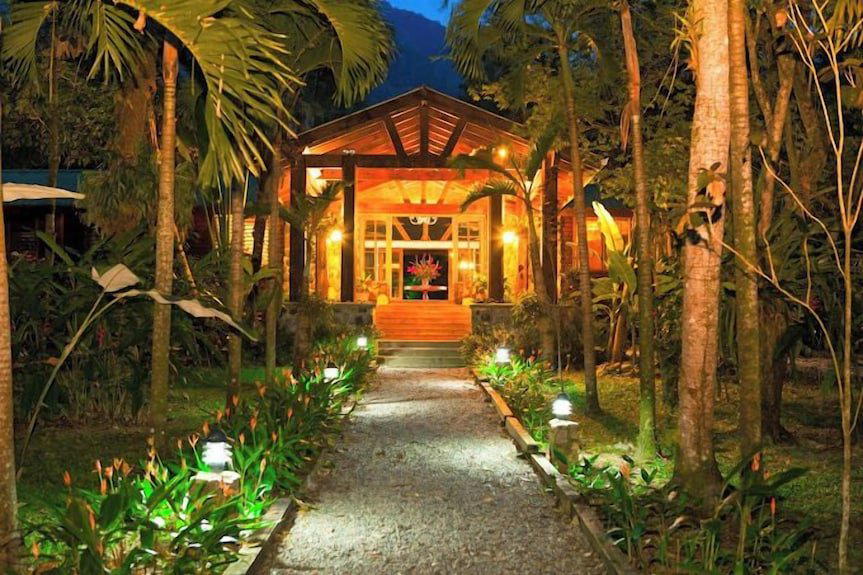
Where the Building Ends and the Canopy Begins
In Central American eco-lodging, the design problem is almost always the same: how do you build something that feels deliberate without overwhelming the landscape it depends on? Most properties solve this badly, arriving at either concrete-heavy structures that ignore the jungle entirely or thatched-roof pastiche that gestures toward nature without genuinely engaging with it. The Lodge at Pico Bonito, positioned at the edge of one of Honduras's most intact lowland rainforests, belongs to a smaller, more considered category — properties where the architecture is primarily a frame, and the forest is the content.
Pico Bonito National Park covers roughly 107,000 hectares of protected terrain across the Nombre de Dios mountain range, stretching from cloud forest at altitude down to humid lowland jungle near the Caribbean coast. The lodge sits at the transition zone, which means the surrounding habitat shifts noticeably depending on where you are on the property — a design condition that few built environments bother to use deliberately, but which Pico Bonito's layout appears to acknowledge. The relationship between structure and site is less about aesthetics and more about positioning: where you place a cabin relative to a river gorge, or a terrace relative to a canopy line, determines whether a guest experiences the forest or merely observes it.
La Ceiba as a Gateway, Not a Destination
La Ceiba sits on Honduras's north coast, connected to the Bay Islands by ferry and to Tegucigalpa and San Pedro Sula by domestic flights. For most international visitors, it functions as a logistical node rather than an end point, a place to pass through on the way to Roatan's reefs or the Cayos Cochinos. The Lodge at Pico Bonito inverts that logic, making La Ceiba the destination and the coast the afterthought. For those crossing into Honduras from the Bay Islands, Ibagari in Roatan represents the high-design beach alternative in the same country; Pico Bonito addresses a different need entirely.
The lodge is accessible from La Ceiba in under thirty minutes by road, which puts it close enough to the city for practical access while remaining genuinely isolated from it. This proximity matters: it means the property doesn't require the extended transit that makes some remote eco-lodges feel punishing to reach, and it keeps airport logistics manageable for travellers arriving on regional connections.
The Architecture of Restraint
Lodges built inside or adjacent to protected national parks operate under a different set of pressures than resort hotels. Footprint restrictions, environmental review requirements, and the basic condition of building in active rainforest all push design toward modularity, lightness, and materials that don't fight the humidity. In this context, architectural restraint isn't an aesthetic choice, it's a practical necessity that the leading properties convert into a distinguishing quality.
The broader category of jungle lodge design has evolved considerably over the past two decades. The model that once dominated Central American eco-tourism, utilitarian cabins with minimal amenity, has given way to a more considered approach in which comfort and low impact are treated as compatible rather than competing goals. Properties that do this well share certain structural habits: refined walkways that preserve ground-level habitat, open-sided common areas that reduce the need for mechanical cooling, and cabin placement that prioritises views and acoustic separation over density. These are design decisions with direct consequences for how a guest experiences the forest at night, in the early morning, or during rain.
At properties in this tier across the region, the quality of a stay is often determined less by what's inside the rooms than by what's audible and visible from them. The sound of a river at 4am, the light through a canopy at dawn, these are the sensory conditions that the architecture either enables or blocks. When a lodge gets site planning right, the building effectively disappears as the primary experience.
Where Pico Bonito Sits in the Regional Field
Honduras occupies an unusual position in Central American travel: substantially less visited than Costa Rica and Belize, less infrastructurally developed than Guatemala's tourist corridors, but home to ecosystems and wildlife density that compare favourably with all of them. The Lodge at Pico Bonito operates in that gap, a property serving a traveller who has likely already covered the more obvious regional itineraries and is looking for something with less foot traffic and more ecological integrity.
Within the Honduras market specifically, the lodge sits at the nature-focused end of a spectrum that also includes beach resort formats like Roatan's dive-oriented properties. Compared to the internationally branded luxury circuit, Amangiri in Canyon Point, One&Only; Mandarina in Riviera Nayarit, or Hotel Esencia in Tulum, Pico Bonito competes on proximity to protected wilderness rather than on branded amenity depth. That's a meaningful distinction: the competitive advantage here is fundamentally ecological, which is either the property's strongest argument or a dealbreaker depending on what a traveller is actually after.
For travellers whose reference points are design-led nature properties elsewhere, Castello di Reschio in Lisciano Niccone for its approach to landscape and architecture, or Casa Maria Luigia in Modena for its low-key, place-specific character, Pico Bonito operates from a similar premise in a radically different climate and context.
Planning Your Stay
Honduras's north coast runs dry from approximately November through April, which represents the most reliable window for lodge-based birding and hiking. The wet season (May through October) brings heavier rainfall but also denser vegetation and more active wildlife. Travellers arriving through La Ceiba should plan international connections through Tegucigalpa (TGU) or San Pedro Sula (SAX), with domestic connections onward; the lodge's proximity to La Ceiba's Golosón International Airport (LCE) reduces transfer complexity once in-country. For regional context and additional options in the area, our full La Ceiba restaurants guide covers the city's food scene for those spending time at either end of a stay.
At-a-Glance Comparison
| Venue | Price | Awards |
|---|---|---|
| The Lodge at Pico BonitoThis venue — the venue you are viewing | $100–200 | Michelin Selected |
| Ibagari Boutique Hotel | $300–500 | 1 Michelin Key · Mr & Mrs Smith Seal of Approval |
| Kimpton Grand Roatan Resort and Spa | $300–500 | 1 Michelin Key · Virtuoso Luxury Hotel Partner |
| Ibagari | $300–500 | 1 Michelin Key · Mr & Mrs Smith Seal of Approval |
Recognition history
Dated appearances from independent guides and award organizations, with the underlying list record or original source where available.
Michelin Selected
Michelin
Details
- Scenic
- Rustic
- Cozy
- Quiet
- Romantic Getaway
- Wellness Retreat
- Weekend Escape
- Panoramic View
- Garden
- Terrace
- Pool
- Spa
- Wi Fi
- Concierge
- Fitness Center
- Mountain
- Garden
Serene rainforest retreat with natural sounds, hummingbirds, and far-reaching mountain views from open porches and verandas.