The Frederick Hotel
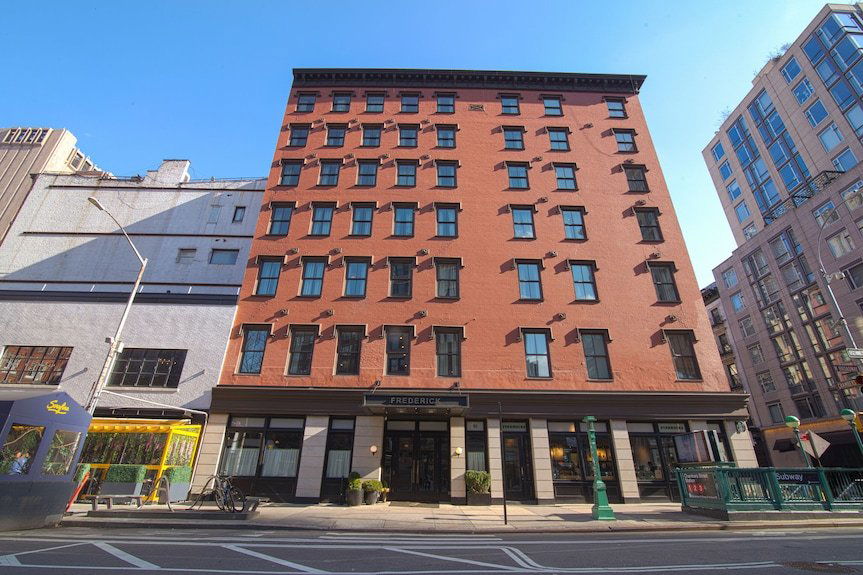
A Gothic Revival building at 95 West Broadway that has been receiving guests since 1845, The Frederick Hotel carries one of Lower Manhattan's most layered architectural histories into the present. The building's 19th-century bones — including rumoured visits from Abraham Lincoln — set it apart from the neighbourhood's newer boutique entrants, placing it in a small tier of New York hotels where the structure itself is the primary credential.
A Building That Predates the Hotel Industry
Lower Manhattan's hotel stock divides sharply between two eras: the wave of glass-and-steel boutique openings that followed the neighbourhood's post-2000 residential conversion, and a much smaller category of properties where the structure itself carries verifiable historical weight. The Frederick Hotel, at 95 West Broadway in Tribeca, belongs to the second group. The Gothic Revival building dates to the 1830s and has operated as a hospitality address since 1845 — a span that predates the American hotel industry's own formal conventions. That kind of continuous tenure is rare in any city; in New York, where real estate pressure has erased most 19th-century commercial fabric, it is particularly uncommon.
The building's provenance places it in a different conversation from the neighbourhood's newer design-led arrivals. Where properties like The Greenwich Hotel and Crosby Street Hotel built their identities through deliberate aesthetic curation and founder vision, The Frederick's claim is structural and historical. The Gothic Revival detailing — pointed arches, decorative stonework, vertical massing , reads as a direct artifact of 1830s New York ambition, when Broadway below Chambers Street was the city's primary commercial corridor.
What the Address Means in Tribeca Today
West Broadway in Tribeca sits at a particular intersection of the neighbourhood's layers. The immediate blocks carry the cast-iron industrial past that defined the area before its 1970s artist conversion, and the subsequent arrival of premium residential lofts and independent restaurants that gave Tribeca its current character. The Frederick's address at number 95 places it close to the intersection with Duane Street, within easy reach of the Hudson River piers to the west and the Fulton Center transit hub to the south , a position that suits both the finance and legal professionals based in the surrounding blocks and visitors using the hotel as a Lower Manhattan base.
For context on how New York's premium hotel market has stratified by neighbourhood: Midtown and the Upper East Side hold the highest concentration of flagship luxury, with properties like Aman New York (Michelin 3 Keys) and The Carlyle, A Rosewood Hotel (Michelin 2 Keys) anchoring that tier. Further uptown, The Mark and The Fifth Avenue Hotel hold comparable positions. Downtown's premium tier is thinner, and a property with genuine 19th-century credentials occupies a niche that newer openings cannot replicate through design alone.
The Overnight Experience: Architecture as Atmosphere
The case for staying at a building like The Frederick rests not on amenity stacking but on what Gothic Revival architecture does to a room experience. The pointed arch proportions and the vertical emphasis characteristic of the style produce interior volumes that differ measurably from the low-ceilinged efficiency of most contemporary hotel construction. Windows that follow the building's original fenestration pattern tend to be taller and more generously spaced than code-minimum openings, which affects both natural light and the sense of spatial generosity that makes a room feel like a considered place rather than a scaled sleeping unit.
The 1830s construction date also means the building predates the standardisation that came with 20th-century hotel chains , the floor plates, ceiling heights, and room configurations that emerged from an era when uniformity was a selling point. That inheritance can create idiosyncrasies in room layout, but it also produces the kind of spatial variety that guests in uniform contemporary hotels pay premiums to find in boutique properties. The Frederick's reinvention as a hotel , following its long operational history , means those original proportions have been brought into a contemporary context rather than built from scratch to approximate them.
Guests considering the overnight stay at a historic structure of this kind should expect the room experience to be framed by the building's own logic rather than a brand standard. The texture of the stay , what you hear, how light moves through the windows at different hours, how the corridors read as you move between floors , derives from 1830s construction decisions rather than a contemporary design brief. That is either a strong argument for booking or a clear signal to look elsewhere, depending on what you want from a New York overnight.
Lincoln, Rumour, and the Weight of History
The attribution of an Abraham Lincoln visit to The Frederick sits in the category of historical rumour that attaches itself to buildings of sufficient age and location. Lincoln passed through New York on multiple documented occasions before and during his presidency, and the hotel's operational dates , open since 1845, through the entirety of Lincoln's political career , make the geography plausible. The claim cannot be verified from available records, and should be treated as the kind of associated lore that accumulates around buildings of genuine historical standing rather than as documented fact. What the rumour does signal, accurately, is the building's longevity: a property that has been operating long enough for presidential-era stories to attach to it occupies a different category from the vast majority of New York's hotel stock.
How The Frederick Sits in the Broader New York Market
New York's premium hotel market has expanded significantly in the past decade, with properties at various price points competing on design credentials, chef-driven food and beverage programs, and brand affiliation. In that context, a building whose primary credential is architectural and historical rather than contemporary curation occupies a specific position. It appeals most directly to guests for whom provenance matters as a practical consideration , where the physical fabric of the overnight stay carries meaning beyond comfort metrics , rather than guests optimising for amenity breadth.
For travellers whose priorities lie primarily with contemporary luxury programming, the Michelin-recognised tier offers clear reference points: Aman New York and Casa Cipriani New York sit at the upper end of that market, while The Whitby Hotel and Crosby Street Hotel offer the Firmdale approach to curated boutique stays. The Frederick operates on different logic , one where the building's 1830s bones and nearly 180 years of continuous hospitality use are the primary offer, and where the reinvention adds contemporary functionality without erasing the historical legibility that makes the address matter.
For a fuller view of what Lower Manhattan and New York more broadly offer across hotel categories, EP Club's full New York City hotels guide maps the field in detail. The restaurants guide, bars guide, and experiences guide cover the surrounding neighbourhood programming that gives a Tribeca base its practical value. Guests whose travel extends beyond New York will find useful comparison in properties at the historic-luxury intersection elsewhere in the United States and internationally: Raffles Boston in Boston, Hotel Bel-Air in Los Angeles, and further afield, Aman Venice and Badrutt's Palace Hotel in St. Moritz, each of which places historic architecture at the centre of the guest proposition in ways that illuminate what The Frederick is attempting in its own context. For resort-oriented travel, Amangiri in Canyon Point, Auberge du Soleil in Napa, Four Seasons at The Surf Club in Surfside, Kona Village, A Rosewood Resort in Kailua-Kona, Little Palm Island Resort & Spa in Little Torch Key, Post Ranch Inn in Big Sur, and Canyon Ranch Tucson in Tucson each offer a different relationship between setting and guest experience. The New York City wineries guide rounds out the broader editorial picture for visitors.
Frequently Asked Questions
Is The Frederick Hotel more formal or casual?
The building's Gothic Revival architecture and 19th-century history give The Frederick a formal register that is structural rather than programmatic. As a property whose credential derives from historical longevity rather than a contemporary luxury brand, it occupies a different position from the deliberately relaxed boutique model. Guests should expect an atmosphere shaped by the building's character , one that reads as considered and historically weighted rather than either the studied casualness of design-led boutiques or the explicit formality of a flagship luxury brand. Without current pricing or brand affiliation data available, the precise tone of the guest experience is leading confirmed directly with the property.
What is the leading suite at The Frederick Hotel?
The Gothic Revival structure, with its original 1830s floor plates and ceiling proportions, typically yields leading accommodations that reflect the building's architectural character , taller volumes, period detailing, and spatial configurations shaped by 19th-century construction rather than contemporary suite formats. Specific suite categories, configurations, and pricing are not available in our current data. For a comparable point of reference on how historic New York buildings translate into premium room offerings, The Carlyle, A Rosewood Hotel (Michelin 2 Keys) and Aman New York (Michelin 3 Keys) provide useful reference points at the upper end of the New York market. The Bvlgari Hotel Tokyo offers an international parallel for how historic-register architecture is handled at the suite level.
Preferential Rates?
Our members enjoy concierge-led booking support and priority upgrades at the world's finest hotels.
Access the Concierge