Schlosshotel Chastè
A family-run Relais & Châteaux property in the Lower Engadine valley, Schlosshotel Chastè occupies a centuries-old stone tower above Tarasp with rooms finished in traditional Engadine pine. Rates from US$503 per night position it within Switzerland's smaller, character-led alpine tier, and a Google rating of 4.9 from 239 reviews signals consistent guest satisfaction across seasons.
 Discover on Pearl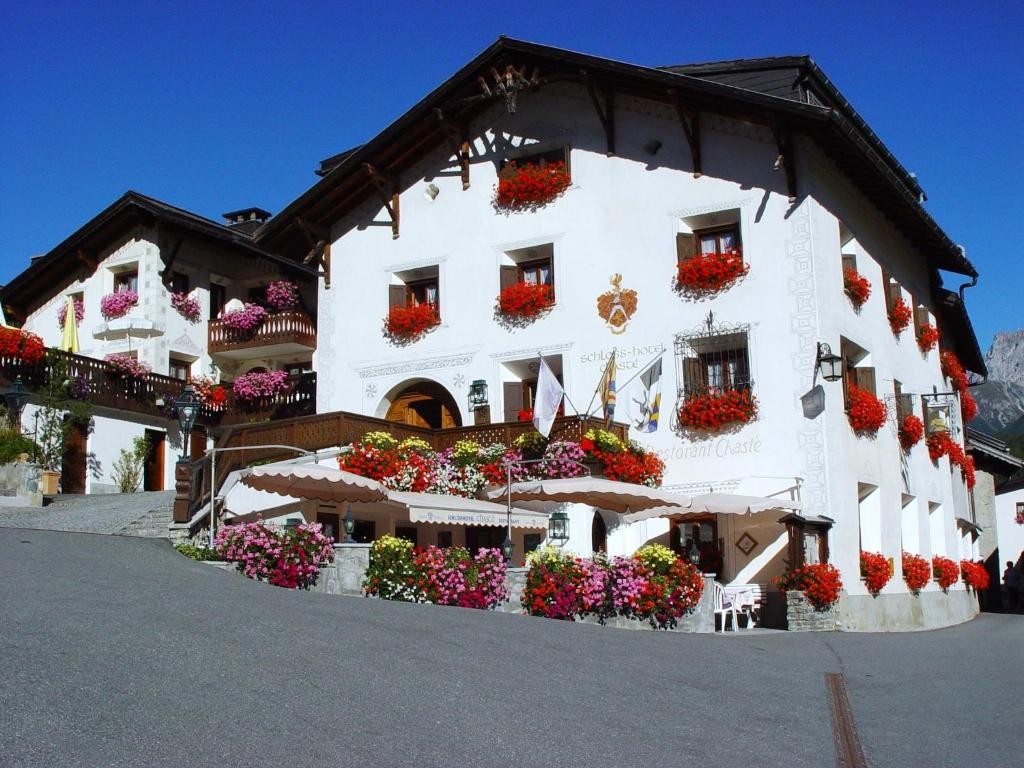
Stone, Pine, and the Lower Engadine Tradition
The approach to Tarasp already does much of the work. The road from Scuol climbs through the Inn valley past limestone bluffs and dense spruce, and the village itself sits in the shadow of Tarasp Castle, one of the most photographed fortresses in Graubünden. In this context, a hotel that occupies a historic tower and leans hard into Engadine vernacular architecture is not making a stylistic choice so much as accepting the logic of its location. Our full Tarasp hotels guide covers the broader accommodation picture for the region, but Schlosshotel Chastè belongs to a specific sub-tier: the small, family-operated, design-coherent alpine property that trades on place-rooted authenticity rather than international brand recognition.
That tier has become increasingly meaningful in the Swiss Alps. As larger resort operations expand across Graubünden and the Bernese Oberland, a counter-movement of deliberately intimate, architecturally specific properties has grown alongside them. Grand Hotel Kronenhof in Pontresina plays the grand Belle Époque register. CERVO Mountain Resort in Zermatt takes a contemporary chalet approach. Schlosshotel Chastè occupies a different position entirely: its identity is tied to the specific material culture of the Lower Engadine, an area where pine-panelled rooms, painted facades, and a domestic scale of architecture have persisted for centuries.
The Architecture of the Engadine Interior
Engadine domestic architecture is among the most distinctive in the Alpine arc. The characteristic stüva, a low-ceilinged room panelled entirely in arolla pine or larch, evolved as a practical response to high-altitude winters, the dense wood holding heat efficiently while developing a warm amber tone over decades of use. The graffito facade technique, where patterns are scratched through a dark plaster layer to reveal lighter stone beneath, gives Engadine villages a visual coherence found nowhere else in Switzerland. Schlosshotel Chastè's traditional pine rooms sit inside this architectural language rather than referencing it from a distance. The rooms are not decorative reconstructions; they are continuations of a building and furnishing tradition that has been the local norm for generations.
This matters to a particular kind of traveller: one who comes to the Lower Engadine not despite its remoteness but because of it. The Swiss National Park, Europe's oldest and one of its least-compromised protected zones, begins near Zernez, roughly 20 kilometres from Tarasp, and draws visitors who prioritise landscape access over resort amenities. That proximity frames the hotel's position clearly. The infrastructure here is oriented toward walkers, naturalists, and people who value stillness. Schlosshotel Chastè, as a family-run property with Engadine character at its core, fits that orientation in a way that a large-format resort would not. For context on dining and activities nearby, see our full Tarasp restaurants guide, the Tarasp bars guide, and our Tarasp experiences guide.
Where It Sits in the Swiss Luxury Hotel Set
Switzerland's hotel market is stratified with unusual clarity. At the upper end, properties like Badrutt's Palace Hotel in St. Moritz (Michelin 3 Keys) and The Alpina Gstaad compete on scale, amenity depth, and international recognition. Urban flagships like Baur au Lac in Zurich and Beau-Rivage Geneva anchor the city luxury segment. Mandarin Oriental Palace, Luzern (Michelin 2 Keys) and Beau-Rivage Palace in Lausanne represent the grand lakeside tradition. Then there is a smaller cohort of character properties with Relais & Châteaux affiliation, where membership signals curation standards and a commitment to local identity over branded uniformity. Schlosshotel Chastè's Relais & Châteaux status, combined with a 4.9 Google rating across 239 reviews, places it within this curated tier rather than the volume-hotel market.
Rates from US$503 per night position the property above regional mid-market options without reaching the nightly costs of St. Moritz's front-row properties. For Switzerland's smallest, most architecturally specific alpine properties, that pricing reflects the combination of family ownership, historic fabric maintenance, and the labour intensity of running a genuinely personalised operation at altitude. Compare that with the operational scale of Grand Resort Bad Ragaz or Bürgenstock Resort, and the difference in scope and approach becomes legible immediately.
Family-run alpine properties in this category tend to attract guests who want continuity of service from people with genuine knowledge of the surrounding landscape. That is a different value proposition from the branded consistency of an international chain. Whether that trade-off suits a given traveller depends on what they prioritise: amenity breadth or depth of local connection.
The Lower Engadine as a Context for the Stay
Tarasp is not St. Moritz. That distinction is worth making plainly. The Upper Engadine, with St. Moritz at its centre, has been a fixture of international winter tourism since the nineteenth century and carries an infrastructure built for that traffic. The Lower Engadine, where Tarasp sits, receives considerably less international visitor flow and has preserved a village character that the Upper valley largely traded away decades ago. Scuol, the nearest town of any scale, is known for its thermal baths and its Rhaeto-Romanic cultural heritage. The language of the valley is Romansh, specifically the Vallader dialect, and signage, local names, and place references reflect that. For a traveller interested in the texture of a functioning Swiss minority culture, the Lower Engadine offers something that no amount of alpine luxury branding can replicate. See also our Tarasp wineries guide for regional wine and spirits context.
Swiss National Park access from Tarasp is practical rather than theoretical. The park enforces strict no-intervention rules, meaning its wildlife populations, trail systems, and vegetation have developed with minimal human management since its founding in 1914. Red deer, chamois, and ibex are regularly visible from marked trails, particularly in early morning and late afternoon during summer months. That proximity to genuinely wild landscape is the experiential anchor for a stay in this part of Graubünden, and the hotel's character reflects it.
Planning a Stay
Schlosshotel Chastè is reachable via the Rhaetian Railway to Scuol-Tarasp station, one of the most scenic rail routes in Switzerland and a practical option from Zurich with a change at Landquart. The hotel's address at Sparsels, 7553 Tarasp, places it above the valley floor, and arrival by the narrow roads through the village is itself part of the orientation to the place. Summer months, when the Swiss National Park trails are fully open and the valley light runs long, represent the primary season, though the Lower Engadine winter is considerably quieter than St. Moritz and suits those specifically seeking that contrast. Booking and enquiries go through chaste@relaischateaux.com or by telephone at +41 (0)81 861 30 60, with the property website at schlosshoteltarasp.ch carrying room details and current availability. The Relais & Châteaux network also handles enquiries centrally for members who prefer that route.
For travellers assembling a wider Swiss itinerary, the Engadine pairs logically with Grand Hotel Kronenhof in Pontresina or, further afield, with 7132 Hotel in Vals, a property that takes an entirely different architectural approach to Graubünden's built heritage. Both reward the combination of train travel and unhurried pacing that the eastern Swiss rail network is designed to support.
Frequently Asked Questions
How It Stacks Up
These are the closest comparables we have in our database for quick context.
| Venue | Cuisine | Price | Awards | Notes |
|---|---|---|---|---|
| Schlosshotel Chastè | HIGHLIGHTS: • FAMILY-RUN PROPERTY • PICTURESQUE ENGADINE CHARM • TRADITIONAL PIN… | This venue | ||
| Badrutt's Palace Hotel | Michelin 3 Key | Michelin 3 Keys | ||
| Four Seasons Hotel des Bergues | Michelin 2 Key | Michelin 2 Keys | ||
| Mandarin Oriental Palace, Luzern | Michelin 2 Key | Michelin 2 Keys | ||
| The Ritz-Carlton Hotel de la Paix, Geneva | Michelin 2 Key | Michelin 2 Keys | ||
| Hotel President Wilson, A Luxury Collection Hotel |
Preferential Rates?
Our members enjoy concierge-led booking support and priority upgrades at the world's finest hotels.
Get Exclusive Access