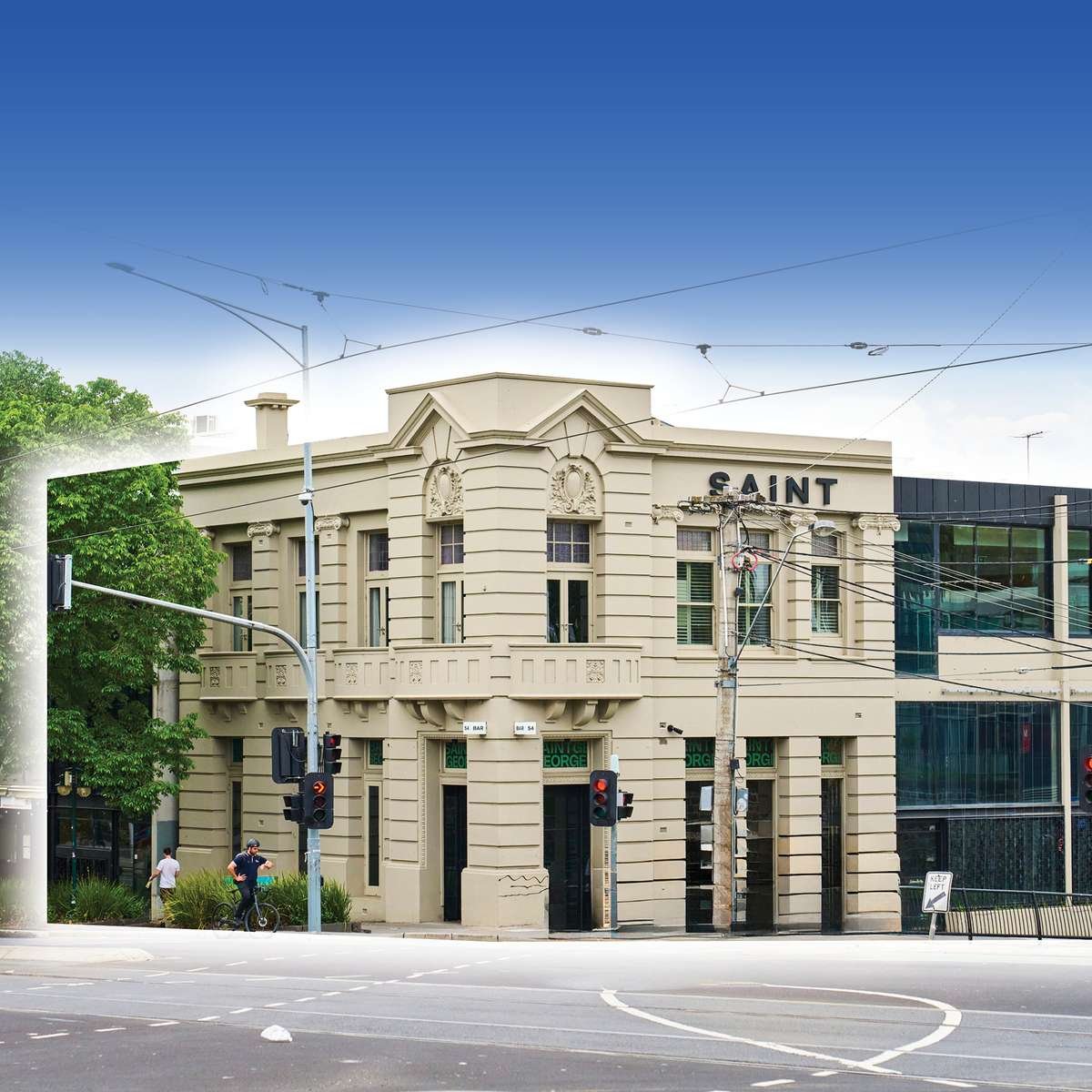
Saint Hotel occupies one of St Kilda's most characterful addresses, where the suburb's layered history of seaside glamour and counter-cultural energy shows up in the architecture and atmosphere. The property positions itself within Melbourne's boutique hotel tier, offering a design-led alternative to the city's larger CBD properties. For visitors who want to be inside the action on Fitzroy Street rather than observing it from a distance, the address makes a strong case.
- Address
- St Kilda, Australia
- Directions
- Get directions
St Kilda's Design-Led Boutique Tier
Melbourne's hotel market has split along a familiar axis: large international flags holding the CBD, and a smaller cluster of design-conscious independents and boutique properties anchoring the inner suburbs. St Kilda sits at the southern end of that second cluster, a suburb where the physical fabric itself, Federation-era terraces, Art Deco apartment blocks, and mid-century commercial frontages pressed together along Fitzroy Street and the Esplanade, creates a context that rewards hotels willing to work with the architecture rather than around it. Saint Hotel belongs to that sensibility. The building reads as a property that has absorbed the neighbourhood's character rather than imported a generic hospitality template onto it.
That approach matters in St Kilda specifically, because the suburb's identity is harder to reduce than most Melbourne neighbourhoods. It has been, at various points, a late-Victorian resort destination for the city's prosperous classes, a postwar rooming-house district, a centre of Melbourne's LGBTQ+ social life, and a backdrop for the local music and arts scenes that produced some of Australia's most distinctive cultural output in the 1970s and 1980s. Properties that ignore that layering tend to feel incongruous. Those that engage with it, through materiality, through spatial decisions, through what they choose to preserve and what they choose to update, tend to feel like they belong. Saint Hotel's positioning within the neighbourhood suggests the latter orientation. For context on where it sits relative to Melbourne's wider hotel scene, compare it against larger city-centre properties like 1 Hotel Melbourne or the CBD-anchored Hotel Chadstone Melbourne MGallery and the contrast in scale and urban context becomes immediate.
Architecture as Editorial Statement
In the current Australian hotel market, the properties generating the most sustained critical attention are generally those where design is doing genuine intellectual work rather than decorative work. At one end of that spectrum sit wilderness lodges where architecture is inseparable from landscape, properties like Southern Ocean Lodge on Kangaroo Island or Freycinet Lodge in Tasmania's Coles Bay, where the physical site drives every spatial decision. At the other end sit urban boutique hotels where design responds to history and neighbourhood rather than to landscape. Saint Hotel occupies that second category, and in St Kilda, that category is particularly loaded.
The suburb's built environment has survived several cycles of neglect and renovation, and the hotels and guest houses that predate the current boutique boom carry a lot of that history in their bones. A property that reads the existing structure carefully, that treats heritage elements as assets rather than obstacles, communicates something specific to a traveller who knows what the neighbourhood used to look like. It signals that the operator has a position on the place, not just on hospitality formats. That is a different proposition from what you get at a property purpose-built without the constraint and opportunity of an existing building.
For readers weighing urban boutique options in Australia's eastern cities, the comparison set is worth mapping carefully. The Tasman in Hobart works with a heritage-listed building in a comparable way, and the tension between period fabric and contemporary interior finish is handled with evident deliberateness. Capella Sydney makes a similar argument at much larger scale in a landmark CBD building. Saint Hotel operates in a smaller register, more intimate and more embedded in a specific residential neighbourhood rather than a central business precinct.
The St Kilda Context for Visitors
Understanding where to stay in St Kilda requires understanding which version of the suburb you are actually after. The Esplanade addresses face Port Phillip Bay and offer the broadest orientation toward the water, the Sunday market, and the Luna Park foreshore. Fitzroy Street runs perpendicular to the water and functions as the spine of the suburb's eating and drinking life, dense with restaurants, wine bars, and late-night venues that reflect the area's continued appetite for a certain kind of sociable energy. Acland Street to the south carries the weekend cake-shop tradition and the transition toward the calmer residential streets of St Kilda East.
Saint Hotel's position within that geography determines its practical character. St Kilda is approximately six kilometres south of Melbourne's CBD, a distance that takes around twenty minutes by tram on the Route 96 from Bourke Street, making it genuinely connected rather than remote. For visitors whose program is oriented toward Melbourne's inner south, including the restaurants of Fitzroy and Collingwood to the northeast or the beaches and wineries of the Mornington Peninsula to the south, St Kilda functions well as a base. For visitors whose priorities are CBD galleries, the MCG, or Federation Square, the tram connection works but a city hotel involves less friction.
The suburb's eating and drinking offer has broadened considerably over the past decade. For a full read on what is currently operating in the neighbourhood, our full St Kilda restaurants guide covers the range from casual all-day venues to the more considered dinner options. Our St Kilda bars guide maps the late-night offer, which remains one of the suburb's genuine strengths relative to other Melbourne inner-suburb areas. For experiences and activities beyond food and drink, our St Kilda experiences guide provides coverage of what the foreshore and surrounding streets offer. And for those assessing all accommodation options in the area, our full St Kilda hotels guide places Saint Hotel within its local competitive set.
Planning a Stay
Given the volume and range of Australian boutique hotel options now available to international and domestic travellers, it is worth being precise about what Saint Hotel is and is not. It is a suburban boutique property in one of Melbourne's most atmospherically specific neighbourhoods, sitting in a different category from the larger city-centre hotels like Capella Sydney or the international-group properties with full-service amenities at scale. It is also a different proposition from remote wilderness stays like El Questro Homestead in the Kimberley or Emirates One&Only Wolgan Valley, where the physical setting is the primary reason for the stay.
The case for Saint Hotel rests on neighbourhood immersion and architectural character. Visitors who have stayed at comparable suburban boutique properties, Drift House in Port Fairy, or coastal-adjacent design stays like 28 Degrees Byron Bay - will recognise the logic: a property that gives you a specific place rather than a generic room count. Booking is leading handled directly through the hotel's own channels where possible, which typically provides the most current availability and room category information. Given St Kilda's popularity as a weekend destination for Melburnians as well as interstate visitors, weekend availability during summer and over major event weekends around the Australian Open and the Formula 1 Grand Prix fills ahead of weeknight availability.
Side-by-Side Snapshot
| Venue | Awards |
|---|---|
| Saint HotelThis venue — the venue you are viewing | Not listed |
| Capella Sydney | World's 50 Best |
Continue exploring
More in St Kilda
Hotels in St Kilda
Browse all →
Bars in St Kilda
Browse all →
Restaurants in St Kilda
Browse all →

Details
- Modern
- Trendy
- Weekend Escape
- Beachfront
- Terrace
- Wi Fi
- Fitness Center
- Room Service
- Concierge
- Business Center
- Waterfront
- Wheelchair Accessible
Relaxed beachside atmosphere with terrace views and al fresco dining.