
A Michelin Selected grand hotel occupying Spetses' Dapia waterfront, Poseidonion Grand Hotel is the architectural centrepiece of an island that banned private cars decades ago. The neoclassical facade and colonnaded promenade reflect an Edwardian-era ambition rarely preserved this intact in the Aegean. For travellers prioritising historical atmosphere over resort amenities, it occupies a category largely its own among Greek island properties.
Pearl is the En Primeur Club membership app — saves, bookings, and concierge access live there. Same editors, same standards.
- Address
- Ντάπια, Spetses 180 50, Greece
- Phone
- +30 2298 074553
- Website
- poseidonion.com
- Directions
- Get directions
 Saves & bookings on Pearl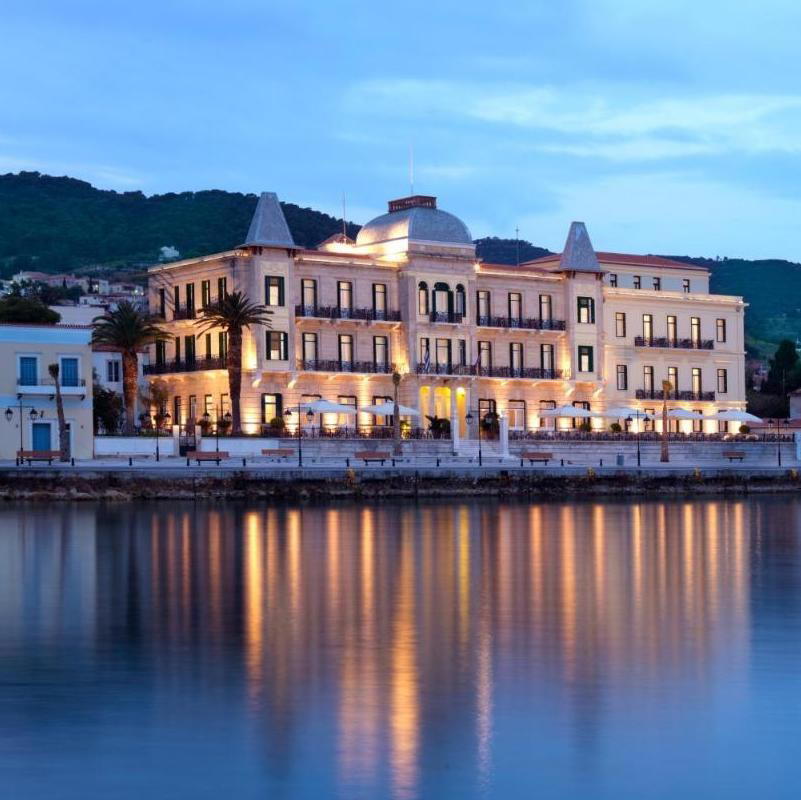
The Waterfront and What It Signals
Arriving at Spetses by sea, the first thing that registers is not a beach club or a hillside infinity pool but a long, pale neoclassical facade running the length of the Dapia harbour. The Poseidonion Grand Hotel anchors that view, and has done so since 1914. On an island where motor vehicles are prohibited on most roads, where horse-drawn carriages and water taxis define the pace of movement, the hotel's presence is inseparable from the town's character. This is not a resort inserted into a landscape. It is a building that helped shape how Spetses understands itself.
That framing matters when placing the property in the wider context of Greek island luxury. Properties like Amanzoe in Porto Heli or Four Seasons Astir Palace Hotel Athens belong to a different register: purpose-built resort compounds with private beaches, spa infrastructure, and international brand architecture. The Poseidonion operates from a different premise entirely, one grounded in period authenticity and civic presence rather than amenity stacking. Michelin's 2025 Selected designation confirms it holds a recognised position in the European hotel conversation, without requiring the property to compete on the same terms as the large-format resort tier.
Architecture as the Primary Experience
The Edwardian neoclassical style of the Poseidonion places it in a lineage of grand European seafront hotels that were built to be seen as much as inhabited. The colonnade at ground level, the symmetrical window rhythms, the proportions of the facade as seen from the water: these are deliberate architectural statements, made at a moment when Spetses was a retreat for Athenian shipping families and the hotel was designed to match their expectations of continental elegance.
What makes this relevant today is the relative rarity of the format in the Greek islands. Most premium island accommodation built in the last three decades draws from either the Cycladic whitewashed vernacular, as seen at properties like Astra Suites in Santorini and Pegasus Suites in Fira, or from the contemporary minimalist tradition visible at Myconian Ambassador in Mykonos or Kivotos Mykonos. A restored Edwardian hotel with intact period detailing and a functioning civic waterfront position is a structural outlier in that market.
The interior common areas continue the architectural register: high ceilings, formal proportions, materials referencing the early twentieth century rather than contemporary Aegean minimalism. For guests whose primary interest is the built environment of a place rather than pool access or spa menus, this is a meaningfully different offer. It also means the hotel's appeal skews toward a traveller who wants to read the island, not insulate from it.
Spetses Itself: What the Island Offers
Spetses sits in the Argosaronic Gulf, roughly an hour and a half from Athens by hydrofoil, and its car-free culture is not a marketing device but a long-standing civic policy. The effect on the quality of the town centre is substantial: the Dapia waterfront moves at a pace governed by walking and horse-drawn transport, and the island's pine-covered interior remains accessible without the noise infrastructure that defines vehicle-heavy Greek resort destinations.
The island carries a particular cultural weight in modern Greek history, partly through its role in the 1821 War of Independence and partly through its long association with Athenian intellectual and social life in the mid-twentieth century. John Fowles lived on Spetses and drew on it for The Magus. That literary geography still shapes how the island is perceived by a certain kind of educated European traveller, and the Poseidonion sits at the centre of the physical space Fowles was describing.
For context on the broader Saronic and Peloponnesian region, properties including Kinsterna Hotel in Monemvasía and Mandarin Oriental Costa Navarino in Pylos offer reference points at different price tiers and format types within southern Greece. The Poseidonion occupies a different niche: town-integrated, architecturally specific, and tied to an island that rewards slow, exploratory travel over resort convenience.
Positioning Within the Greek Island Tier
Michelin's Selected category for hotels does not carry the same weight as a star distinction, but it does signal that the property meets a threshold of quality, character, and consistency that the guide's editors consider worth directing travellers toward. In Greece, that list spans properties as varied as Grace Hotel, Auberge Resorts Collection in Imerovigli and Palazzo Santa Maria in Syros, confirming that the designation applies across property types and island contexts.
What places the Poseidonion in a distinct competitive position is the combination of its physical age, its waterfront address, and the particular atmosphere of Spetses as a destination. Comparable grand hotel experiences in the Mediterranean, such as Badrutt's Palace Hotel in St. Moritz or Hôtel de Paris Monte-Carlo, operate at higher price points and with considerably more amenity infrastructure. The Poseidonion offers a version of grand hotel culture that is less about luxury infrastructure and more about architectural gravity and a specific island atmosphere that cannot be replicated on a purpose-built resort site.
Other Greek island properties worth comparing across different formats include Eagles Palace in Halkidiki, Anemos Luxury Grand Resort in Chania, Acro Suites in Agia Pelagia, and Olea All Suite Hotel in Zakynthos. Each addresses a different version of what premium Greek island accommodation can mean. For dining on Spetses, see our full Spetses restaurants guide.
Planning a Stay
The main Spetses season runs from late April through October, with peak occupancy in July and August when Athenian families and international visitors converge on the island. Shoulder season, particularly May to June and September, offers quieter conditions on the waterfront and more availability at the hotel itself. Arrival is by hydrofoil or ferry from Piraeus, with the Dapia port placing guests directly at the hotel's address on arrival. There are no cars to arrange and no transfer logistics beyond the harbour walk.
How Poseidonion Grand Hotel Spetses compares with similar nearby venues.
| Venue | Awards |
|---|---|
| Poseidonion Grand Hotel Spetses | MICHELIN Guide, Hotels Selected (2025) |
Recognition history
Dated appearances from independent guides and award organizations, with the underlying list record or original source where available.
Michelin Selected
Michelin

At a Glance
- Classic
- Elegant
- Sophisticated
- Well Known
- Romantic Getaway
- Family Vacation
- Honeymoon
- Anniversary
- Historic Building
- Panoramic View
- Waterfront
- Infinity Pool
- Pool
- Spa
- Fitness Center
- Room Service
- Restaurant
- Wi Fi
- Concierge
- Waterfront
- Garden
- Pool
- Spa
- Fitness Center
- Room Service
- Restaurant
- Wi Fi
- Concierge
Turn-of-the-century grandeur with decorative archways, potted palms, trompe l'oeil tiled floors, and serene sea views evoking Golden Age elegance.
Know Before You Go
- Getting there
- Ντάπια, Spetses 180 50, Greece