
The castle that’s now known as the Parador de Alarcón traces its history all the way back to the eighth century. Its 2003 restoration brought it up to modern hospitality standards while retaining an incredible wealth of history. The ground-floor restaurant showcases the classic local flavors, including some left by the Moorish period, during which this castle itself was established. From its hilltop perch it overlooks the town of Alarcón, nearly encircled by a bend in the picturesque Júcar River; outside the castle walls you’ll find ample opportunity for outdoor recreation.
Pearl is the En Primeur Club membership app — saves, bookings, and concierge access live there. Same editors, same standards.
- Address
- Avenida Amigos de los Castillos, 3, Alarcon, Spain
- Phone
- +34 969 33 03 15
 Saves & bookings on Pearl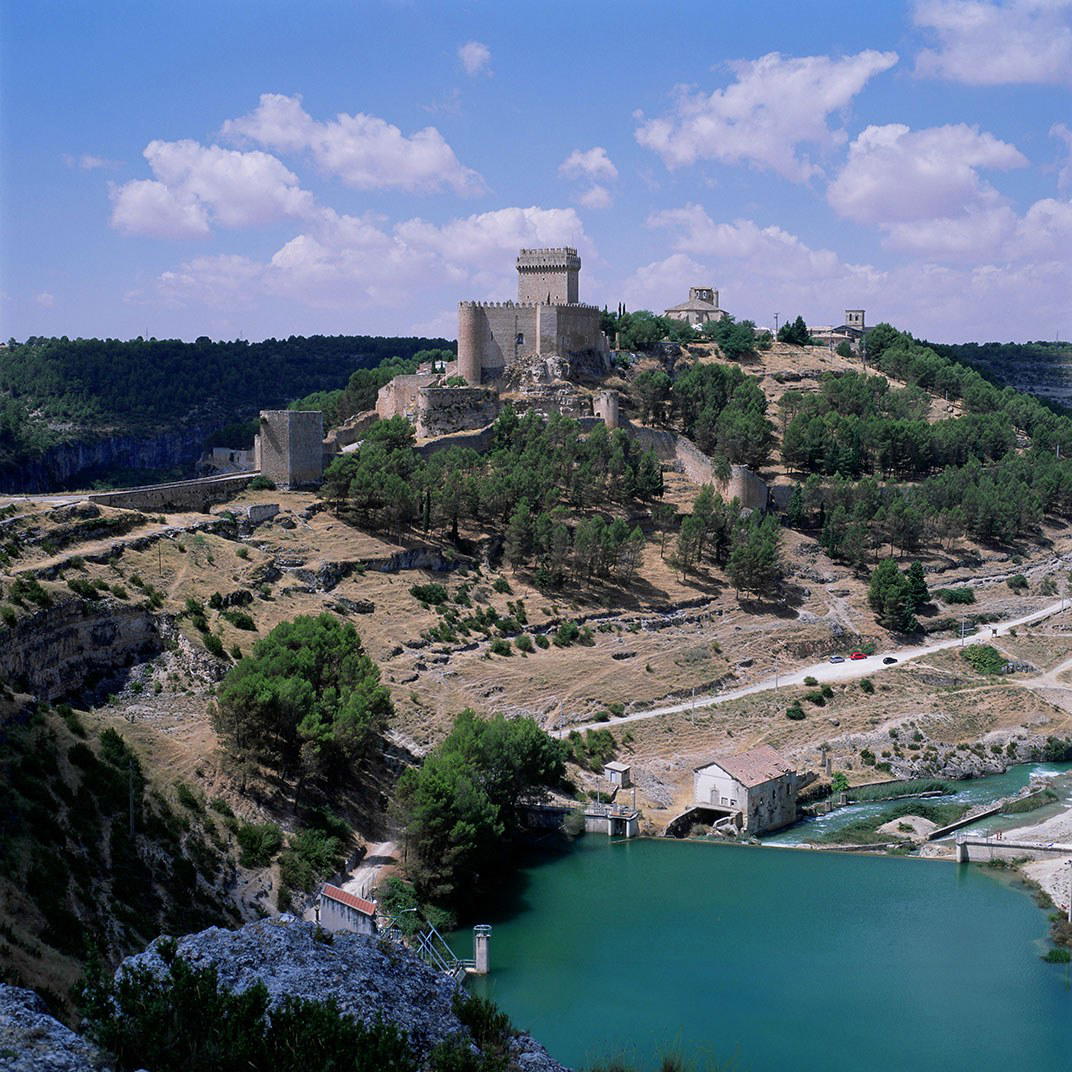
A Fortress Above the Júcar Gorge
Approaching Alarcón from the road that winds through Castilla-La Mancha's high meseta, the village announces itself as a promontory of pale stone rising above a near-complete loop in the Júcar River. The castle that crowns it dates to Moorish occupation in the eighth century, was reconquered in 1184 by Alfonso VIII of Castile, and has stood through the full arc of Spanish medieval history. The Parador de Alarcón occupies that structure directly: not a building inspired by it, not a modern hotel placed beside it, but the castle itself, converted into accommodation within the national Paradores network. Arriving at dusk, when the canyon walls below catch the last horizontal light and the village falls quiet, is an architectural experience that no amount of contemporary hotel design can approximate.
What It Means to Sleep Inside a Medieval Fortress
Spain's Paradores network was established in the early twentieth century with a specific brief: take historically significant buildings, monasteries, palaces, castles, and convert them into managed accommodation that preserves the structure while making it habitable. Alarcón is among the more extreme examples within that programme. The keep and defensive walls are structural facts of the building, not decorative references. Rooms occupy spaces that were designed for entirely different purposes, which means irregular geometries, walls of considerable thickness that keep interiors cool in summer and hold heat in winter, and window openings that frame the gorge or the rooftops of the village below rather than a manicured garden or a swimming pool terrace.
This positions the Parador de Alarcón in a different competitive category from the luxury rural hotels that have proliferated across Spain over the past two decades. Properties like Terra Dominicata in Escaladei or Abadía Retuerta LeDomaine represent the design-led, wine-estate model of Spanish rural hospitality, where the experience is constructed around a contemporary programme. The Alarcón parador is something categorically different: the building itself is the experience, and the hotel exists to grant access to it. The property holds,188 reviews, reflecting broad approval for its setting and service.
The Architecture as the Programme
The castle's defensive logic is readable throughout the building. The approach through the village, up a narrow lane that would have been defensible by a small number of soldiers, gives way to an entrance that passes through successive thresholds before opening into interior courtyard space. Stone vaulting appears in corridors and communal areas. The tower that forms the keep's core rises above the accommodation floors and, depending on access, offers refined views across the gorge and the surrounding plateau that extend for a considerable distance across flat Manchegan terrain.
This is the architectural tradition of Castilian military construction at its most legible: buildings that communicated power and impregnability through mass and verticality rather than ornament. The contrast with Spain's more decorative medieval heritage, the Mudéjar tilework of Toledo or the Plateresque stone carving of Salamanca, is marked. Alarcón's castle is austere by comparison, and that austerity is part of what makes a stay here different from the monastery-hotel conversion, which typically offers cloistered serenity, or the Andalusian parador, which trades more in garden beauty and Moorish water features. For those exploring Spain's heritage hotel circuit, the difference between this property and, say, Hotel Mercer Sevilla or Caro Hotel in València (both of which layer Roman and medieval archaeology beneath boutique hotel programming) is one of atmosphere and intensity. Alarcón offers less curation and more raw historical weight.
Alarcón in Context: A Village the Tourism Economy Largely Bypassed
Alarcón itself has a population measured in the hundreds. It sits in Cuenca province, roughly equidistant from Madrid and Valencia, in a region where the depopulation of rural Castile has reduced villages that once held significant populations to quiet places with a church, a handful of bars, and long views across empty land. That context matters for calibrating expectations. There is no restaurant scene here in the way that exists in San Sebastián or even in Cuenca city, forty kilometres to the north. The dining available at the parador represents, in practical terms, the main option for guests staying overnight. Dining options beyond the castle walls are limited, which is part of the experience here.
The village's relative obscurity within Spanish tourism is not a flaw in the destination; it is the condition that has preserved the quality of the experience. The castle was not restored to attract coach tourism. The gorge below the promontory sees kayakers in summer but draws no resort infrastructure. Visitors who arrive at the Parador de Alarcón are, by definition, people who made a deliberate choice to come to a specific place rather than following a well-worn circuit. That self-selection shapes the atmosphere of a stay in ways that more accessible properties cannot replicate.
Placing It Against the Spanish Heritage Hotel Spectrum
Within Spain's broader field of historically embedded hotels, the Paradores network occupies a distinctive position: state-managed, consistent in service approach, and covering a range of property types from beachfront to mountain. Alarcón sits at the more extreme end of the castle-conversion subset. For comparison, Atrio Restaurante Hotel in Cáceres pairs a Michelin-starred restaurant with a contemporary hotel building that engages with the medieval old city from adjacent rather than within. Cap Rocat in Cala Blava converts a nineteenth-century military fortress in Mallorca with a higher degree of contemporary interior design intervention. Alarcón's parador sits between those approaches: less gastronomy-focused than Atrio, less design-renovated than Cap Rocat, and more literally embedded in its original structure than either.
For those building a longer Spain itinerary that moves between cities and rural heritage properties, the parador makes logical sense as a stop between Madrid and Valencia, or as a base for exploring the Cuenca region, which includes the Serranía de Cuenca natural park and the hanging houses of Cuenca city. Urban counterparts at the high end of the Spanish hotel market, such as Mandarin Oriental Ritz, Madrid or Mandarin Oriental Barcelona, exist in a different register entirely, but the Alarcón parador is not competing with them on service metrics. It is offering something those properties cannot: physical occupancy of an eighth-century fortress in an intact medieval village above a river canyon.
Planning a Stay
Alarcón is most practically reached by car. The drive from Madrid takes approximately two hours heading southeast; from Valencia, roughly the same heading inland and west. There is no rail connection to the village itself. The parador operates year-round, and the shoulder seasons of spring and autumn are generally preferable for the Castilian meseta: summer heat in this inland region can be significant, while the stone walls of the castle provide some natural insulation. Weekend bookings, particularly in spring when Madrid day-trippers extend into overnight stays, tend to fill earlier than midweek availability.
Fast Comparison
Comparable venues nearby, for context on price, style, and recognition.
| Venue | Cuisine | Price | Awards | Notes |
|---|---|---|---|---|
| Parador de AlarcónThis venue — the venue you are viewing | Medieval castle parador blending authentic history with modern hospitality. | $$$$ | 4-Star | Not listed |
| Villa Magalean Hotel & Spa | Renovated neo-Basque villa blending family home warmth with luxury hotel amenities. | $$$$ | 4-Star | historic district |
| Casal Santa Eulalia | Historic finca hotel in rural Mallorca | $$$$ | 4-Star | Santa Margalida |
| Sabàtic Sitges Hotel | Mediterranean lifestyle hotel emphasizing freedom, wellbeing, and living like Saturday every day | $$$$ | 4-Star | La Plana |
| W Barcelona | Sailboat-shaped well-known beachfront landmark with upscale contemporary luxury. | $$$$ | 4-Star | Port Vell |
| Hotel Claude Marbella | Restored 17th-century Andalusian palace with modern boutique luxury. | $$$$ | 4-Star | Old Town |
Recognition history
Dated appearances from independent guides and award organizations, with the underlying list record or original source where available.
Michelin Selected
Michelin
At a Glance
- Romantic
- Scenic
- Rustic
- Elegant
- Historic
- Romantic Getaway
- Anniversary
- Weekend Escape
- Historic Building
- Panoramic View
- Terrace
- Wi Fi
- Restaurant
- Air Conditioning
- Mountain
- Wi Fi
- Restaurant
- Air Conditioning
Combination of medieval stone architecture and rustic elegance with modern comforts, high arched ceilings, and serene historical atmosphere.