

TIME 2026 TIME World's Greatest Places · Conde Nast Hot List Hotels
A nine-cabin retreat on the edge of the Tibetan Plateau in Gannan, Norden Camp trades conventional hotel infrastructure for traditional Tibetan joinery, yak-wool textiles, and communal bathhouse suites with copper soaking tubs. Rates from $1,200 per night position it in the premium wilderness tier, where deliberate material restraint and landscape access are the product, not an apology for missing amenities.

Pearl is the En Primeur Club membership app, where members save venues, book tables and use the concierge.
Where the Plateau Begins
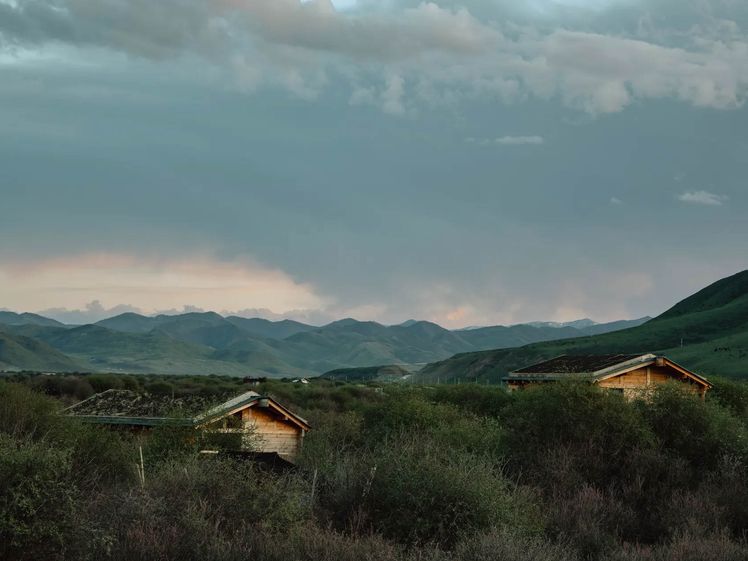
The road into Xiahe drops through a series of altitude shifts that make the Gannan Tibetan Autonomous Prefecture feel like a different country long before you arrive. By the time the valley floor opens onto the Sangke grasslands, the air is thin, the light is flat and wide, and the horizon is occupied by nomads moving yak herds across slopes that have not materially changed in centuries. Norden Camp sits at this edge, where the managed world runs out and the steppe takes over. That positioning is not incidental. It is the architectural premise of the entire property.
Premium wilderness retreats across China and the broader Himalayan region have split into two distinct models: high-capacity resorts that import urban amenity packages into remote settings, and smaller, deliberately spare properties that treat the land as the primary offering and treat conventional luxury signals as optional. Norden Camp, with nine cabins and rates from $1,200 per night, belongs unambiguously to the second group. The design choices here read as a coherent argument, not a series of compromises.
The Architecture of Restraint
The cabins were rebuilt leading to bottom in the summer prior to the camp's current iteration, replacing the original yak-hair nomad tents that launched the property in 2013. What replaced them is a considered study in Tibetan vernacular construction: traditional joinery, reclaimed timber, and a low profile that allows the surrounding willows and wildflowers to read as the dominant visual element rather than the buildings themselves. From a distance, the structures look like something that grew there rather than something placed there.
Inside, the design language is wabi-sabi in its discipline. Arrangements of twigs and river pebbles function as the decorative logic. Beds and sofas are covered in yak wool produced at the Norlha atelier, a textile workshop about 90 minutes from the camp. That sourcing detail matters because it closes a loop: the material comes from the same plateau ecosystem visible through every cabin window, and the atelier is part of the same founding vision as the camp itself. The effect is a coherence that properties importing generic luxury goods from distant supply chains rarely achieve.
Underfloor heating addresses the temperature reality of a site that sits at altitude, where spring and autumn evenings drop sharply. Most cabins open onto stove-warmed tented lounges that function as the transition zone between interior warmth and the open grassland. In practice, these covered outdoor spaces are where much of the day is spent when weather allows. For comparison, international luxury properties elsewhere in northwestern China, such as the Conrad Urumqi, deliver a fully enclosed, climate-controlled urban hotel product. Norden Camp makes a different calculation: that the environment itself is the amenity, and the architecture should frame rather than substitute for it.
The Bathhouse Logic
The most discussed aspect of Norden Camp's design is also its most deliberately provocative: the cabins have no running water and use compost toilets. This is a conservation position, framed as treading lightly on a fragile landscape, and it is built into the product at the $1,200 rate level. For guests accustomed to en suite bathrooms as a baseline expectation at this price tier, the reasoning requires buy-in.
The counterweight is the communal bathhouse, a five-minute walk through the property's wild gardens. What arrives there is closer to a spa complex than a campsite facility: private bathing suites, indoor and outdoor showers, personal saunas, and copper soaking tubs scented with juniper. The bathhouse reframes the absence of in-cabin plumbing not as a deprivation but as a reason to move through the landscape at dusk or dawn, when the light on the steppe is at its most distinctive. Whether that reframe works depends entirely on the guest. For those who accept it, the experience adds a ritual dimension that en suite infrastructure cannot replicate.
The Hylla Vintage Hotel in Lijiang and The ArcadiaPlace at Lugu Lake operate in adjacent territory, trading on vernacular design and regional specificity in ways that position them against urban hotel brands rather than alongside them.
Food, Land, and the Communal Table
The food program at Norden Camp draws directly from the plateau's agricultural reality. Breakfast centers on tsampa, the roasted barley flour that has sustained Tibetan communities at altitude for generations. Dinners move toward yak-meat hot pot eaten around a communal campfire. The format is deliberately collective, which reflects the nomadic culture of the surrounding grasslands more accurately than a plated à la carte service would. Local ingredients are not a marketing position here; they reflect what the land and its people actually produce.
Properties at comparable price points in China's major cities, including the Mandarin Oriental Qianmen in Beijing, the JW Marriott Shanghai at Tomorrow Square, or the Ritz-Carlton Xi'an, offer multicuisine restaurants and room service within a globally standardized hospitality framework. Norden Camp's food program has no comparable ambitions and does not pretend otherwise.
Planning a Stay
Xiahe sits in Gansu Province at altitude, and the Sangke grasslands where Norden Camp is located are most accessible and most visually compelling in the warmer months, roughly late spring through early autumn. Shoulder season, particularly spring and autumn, brings the sharpest light and cooler temperatures that make the underfloor heating and stove-warmed lounges feel purposeful rather than merely precautionary. Winter access is more logistically demanding given the altitude and Gansu's climate.
With only nine cabins, availability is structurally limited. Rates begin at $1,200 per night, which places the camp in the same pricing tier as internationally recognized luxury properties in China's major cities, though the product being purchased is categorically different. Those comparing options across China's western regions may also want to consider our full Xiahe guide, which covers the broader range of accommodation and cultural access points in the Gannan region. For context on how other premium properties in China approach design and positioning, see entries including the Hanyu Garden Reserve in Suzhou, the Muh Shoou Xixi Hotel in Hangzhou, and the InterContinental Chengdu Global Center, each of which represents a different approach to the premium accommodation question in China. International comparisons in the deliberate-luxury tier include Badrutt's Palace in St. Moritz and Hôtel de Paris Monte-Carlo, where the pricing logic is also anchored to place and exclusivity rather than room count.
Comparison Snapshot
Comparable venues nearby, for context on price, style, and recognition.
| Venue | Cuisine | Awards | Notes |
|---|---|---|---|
| Norden CampThis venue (the venue you are viewing) | Luxury nomadic Tibetan glamping with eco-friendly design. | TIME 2026 TIME World's Greatest Places · Conde Nast Hot List Hotels | Not listed |
| Beijing Marriott Marquis Hotel | modern luxury convention hotel | Not listed | Chaoyang District |
| Songtsam Basongcuo Linka Hotel | Tibetan resort lodge | Tatler Listed in Best Hotels Asia-Pacific | Cuogao Town |
| Mohe Youran Mountain Residence | Mountain lodge with traditional Northeast China design aesthetic | Not listed | Arctic Village, Mohe |
| Ruby Hotel Shanghai | Lean luxury, design-forward property created through the conversion and expansion of a former office building near Shanghai Hongqiao airport. | Not listed | Hongqiao |
| Sunyata Hotel, Dali | Zen village micro-boutique with courtyard oasis | Michelin Selected | Dali old town |
Recognition history
Dated appearances from independent guides and award organizations, with the underlying list record or original source where available.
Conde Nast Hot List Hotels
Conde Nast
TIME 2026 TIME World's Greatest Places
TIME
Details
- Rustic
- Scenic
- Cozy
- Quiet
- Romantic Getaway
- Wellness Retreat
- Weekend Escape
- Panoramic View
- Historic Building
- Restaurant
- Bar
- Sauna
- Mountain
- Garden
Serene and tranquil atmosphere in untouched wilderness with natural lighting and peaceful grasslands serenity.