
Built into the sheer rock walls of a flooded quarry in Songjiang, the InterContinental Shanghai Wonderland is one of the most structurally ambitious hotels constructed in the 21st century. Its 336 rooms descend below ground level, with two floors extending beneath the waterline. At approximately $240 per night, it offers a genuinely rare architectural experience within reach of central Shanghai.
A Quarry Reimagined: Engineering as Hospitality
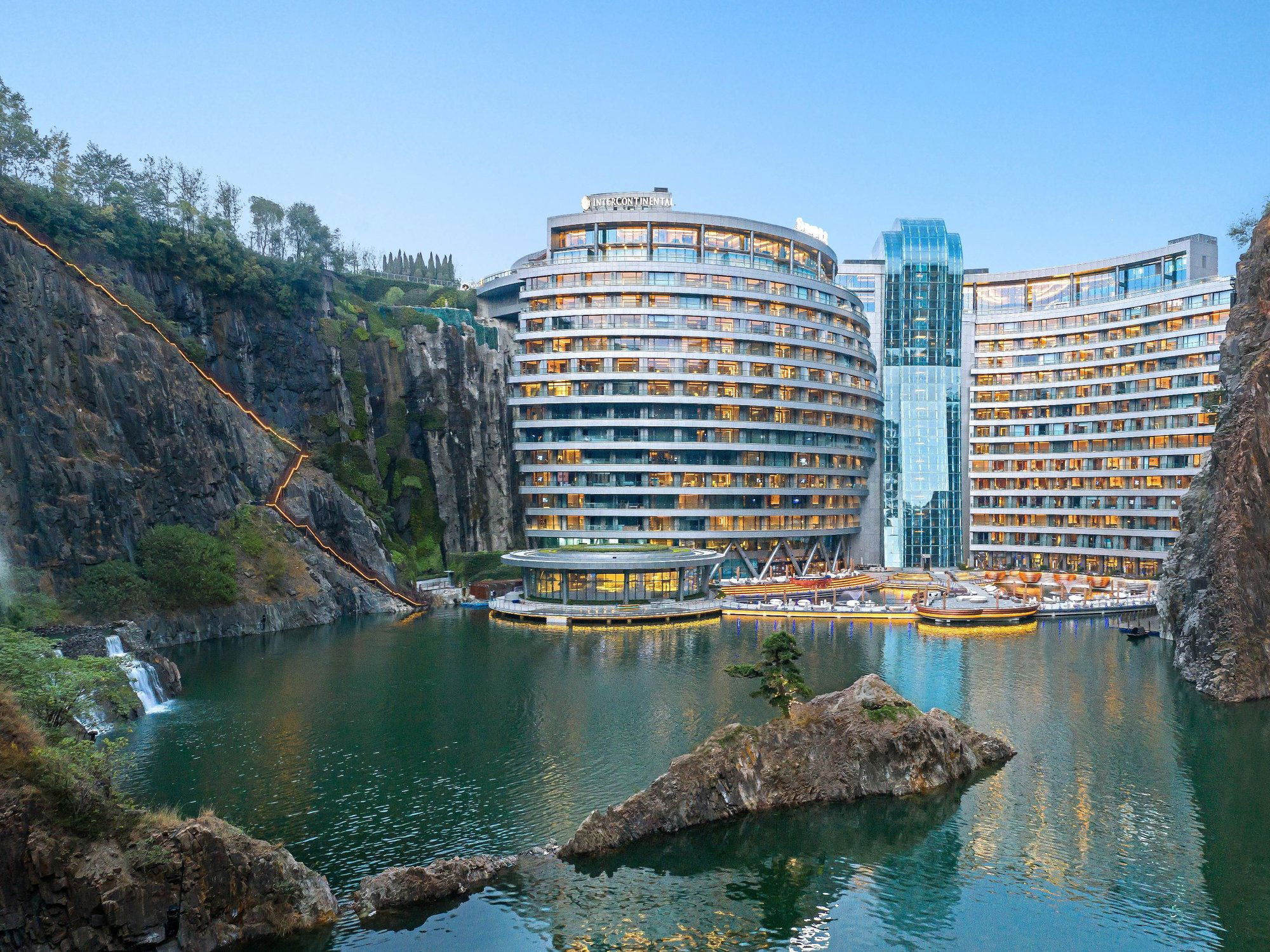
China's luxury hotel sector has, over the past two decades, split between two broad ambitions: the internationally branded tower property in a financial district, and the site-responsive design statement that turns geography into a selling point. The InterContinental Shanghai Wonderland belongs firmly to the second category, and it takes that premise further than almost any comparable project on the continent. The hotel occupies a decommissioned quarry in Songjiang District, roughly an hour southwest of central Shanghai, and its architecture treats the quarry's granite walls not as a problem to be solved but as the defining structural feature of the entire building.
The engineering required to achieve this is considerable. The structure descends 88 metres below the surface, with the majority of its 336 rooms positioned along the inner rock face. Two floors sit entirely below the waterline of the quarry lake that now fills the pit's base, with floor-to-ceiling glazing oriented toward the water. The challenge of bringing natural light into a semi-subterranean structure of this depth while maintaining thermal stability and structural integrity against both the rock and the water pressure required close collaboration between the design team and specialist engineering consultants. The result is a building that, from the quarry floor, reads as a cascade of glass and steel suspended against grey stone, lit by daylight that filters down from the open quarry mouth above.
In the broader context of Chinese destination hotels, properties that use dramatic natural topography as their design premise have become a distinct category. Amanfayun in Hangzhou works within a forested valley adjacent to a UNESCO-listed Buddhist site; Banyan Tree Ringha in Shangrila builds its identity around Tibetan plateau elevation and architectural reference. The Wonderland operates on a different logic entirely: the site was an industrial extraction site, a wound in the landscape rather than a preserved natural asset, and the hotel's premise is the transformation of extraction into occupation. That framing gives the property a specific conceptual weight that distinguishes it from scenery-led resort design.
Inside the Rock Face
The hotel's spatial organisation follows the quarry's vertical logic. Public areas, including reception, dining, and leisure facilities, are positioned at higher levels closer to the surface, while guest rooms descend the rock face on terraced floor plates. The two subaquatic floors represent the property's most discussed architectural feature: rooms at this level look directly into the quarry lake, where visibility varies with light conditions and season, and where the structural glass creates a boundary between interior climate-controlled comfort and the pressurised water column beyond it.
With 336 keys, the property is not a small-footprint boutique operation. It sits in a scale range that requires both the amenity depth of a full-service international hotel and the design coherence that justifies the destination visit. The InterContinental brand, operating as part of IHG's upper-upscale tier, brings the operational infrastructure: multiple food and beverage outlets, conference capacity, and the loyalty programme integration that matters to business travellers making the trip from Shanghai for a single-night stay. The combination of engineering spectacle and brand reliability is, in practice, what makes the property function at scale rather than remaining a design curiosity.
Songjiang and the Question of Proximity
Songjiang is not, by any conventional measure, a destination district. It sits in the outer ring of Shanghai's administrative geography, historically associated with light industry and suburban residential development rather than tourism infrastructure. The Wonderland's location there is a function of the quarry's location, and the hotel's success depends on guests treating the journey from central Shanghai as part of the experience rather than an inconvenience. By car or high-speed rail connection to Songjiang station, the trip from the city centre runs to approximately 40 to 60 minutes depending on traffic and departure point.
That positioning places the Wonderland in an interesting competitive relationship with Shanghai's urban luxury properties. Amanyangyun in Shanghai also operates outside the central hotel corridor, using its distance from the city as a feature rather than a flaw. Both properties ask guests to commit to a destination stay rather than a convenient base for city sightseeing. The Wonderland, however, makes a stronger claim on engineering spectacle as its primary draw, which means guests arrive with a specific visual expectation rather than a general preference for quieter luxury.
For context on broader regional hotel options across the Songjiang area, our full Songjiang hotels guide maps the district's accommodation range. For dining and drinking in the area, see our Songjiang restaurants guide, our Songjiang bars guide, and our Songjiang experiences guide.
Planning Your Stay
Rates start at approximately $240 per night, which places the property in the upper-midscale to upscale range for China rather than the ultra-luxury tier occupied by properties like Aman Summer Palace in Beijing or Mandarin Oriental Qianmen in Dongcheng. For the architectural experience on offer, that price point represents reasonable value relative to the engineering investment behind the property.
Weekend bookings, particularly during Chinese national holidays and the October Golden Week period, fill well in advance given the property's profile among domestic Chinese travellers. Guests with a specific interest in the subaquatic floors should confirm room category at booking rather than relying on upgrades, as those floors represent a small proportion of the total key count. The hotel is accessible via Songjiang's rail connections from Shanghai's main stations, and the property's address on Chen Hua Road in Songjiang District provides the reference point for navigation.
Travellers building a wider China itinerary alongside a Wonderland stay might consider pairing it with properties that contrast in character: Amanfayun in Hangzhou is a two-hour drive and offers forest and temple-adjacent calm in place of industrial transformation; 1 Hotel Haitang Bay in Sanya adds a coastal dimension for those extending south. For those looking beyond China entirely, the same architectural ambition in a European context finds a different expression at Aman Venice, where the building itself carries comparable weight as a destination argument.
Frequently Asked Questions
- What is the general vibe of InterContinental Shanghai Wonderland?
- The atmosphere is defined by the geology. Inside the quarry, natural light arrives from above and reflects off the water below, which gives public and room spaces a quality that shifts across the day. The scale is large (336 rooms, full-service facilities) but the rock walls and descending floor plates create a spatial drama that smaller urban hotels cannot replicate. Guests generally arrive with high expectations for the visual experience; the operational standard of an InterContinental property handles the hospitality side, but the quarry architecture is what drives the stay.
- Which room offers the leading experience at InterContinental Shanghai Wonderland?
- The subaquatic floors, positioned below the quarry waterline, offer the most distinctive experience the property provides. These rooms look directly into the quarry lake through structural glazing and represent the engineering achievement most associated with the hotel's reputation. Given that they occupy a small proportion of the total 336 keys, requesting them specifically at booking rather than hoping for availability on arrival is the practical approach at a $240+ entry rate.
- What should I know before visiting InterContinental Shanghai Wonderland?
- The hotel is in Songjiang District, not central Shanghai, which means the journey from the city centre takes 40 to 60 minutes. Treat this as a destination stay rather than a city-centre base. National holiday periods, particularly Golden Week in October, generate high domestic demand, so advance booking matters. The price entry point of approximately $240 per night sits in the upper-midscale range for China, and the architectural experience is the primary justification for the stay.
- Do they take walk-ins at InterContinental Shanghai Wonderland?
- As a full-service hotel with 336 rooms, same-day availability is possible outside peak periods, but the property's profile as a destination attraction means occupancy runs higher than a comparably sized urban business hotel. For stays during Chinese public holidays or weekends, advance reservation is the reliable approach. Booking through the IHG platform or directly via the hotel's reservations team will confirm current availability; specific contact details are leading confirmed through the official IHG website given the hotel's address at No. 5888 Chen Hua Road, Songjiang District, Shanghai.
Preferential Rates?
Our members enjoy concierge-led booking support and priority upgrades at the world's finest hotels.
Access the Concierge