
Michelin Selected
A Michelin Selected property in the rarely visited Yucatán town of Espita, Casona los Cedros occupies a restored colonial casona whose architecture anchors the experience as firmly as any amenity list. For travellers willing to leave the Riviera Maya circuit, it offers a slower, more rooted engagement with the peninsula's built heritage and daily life.

Pearl is the En Primeur Club membership app, where members save venues, book tables and use the concierge.
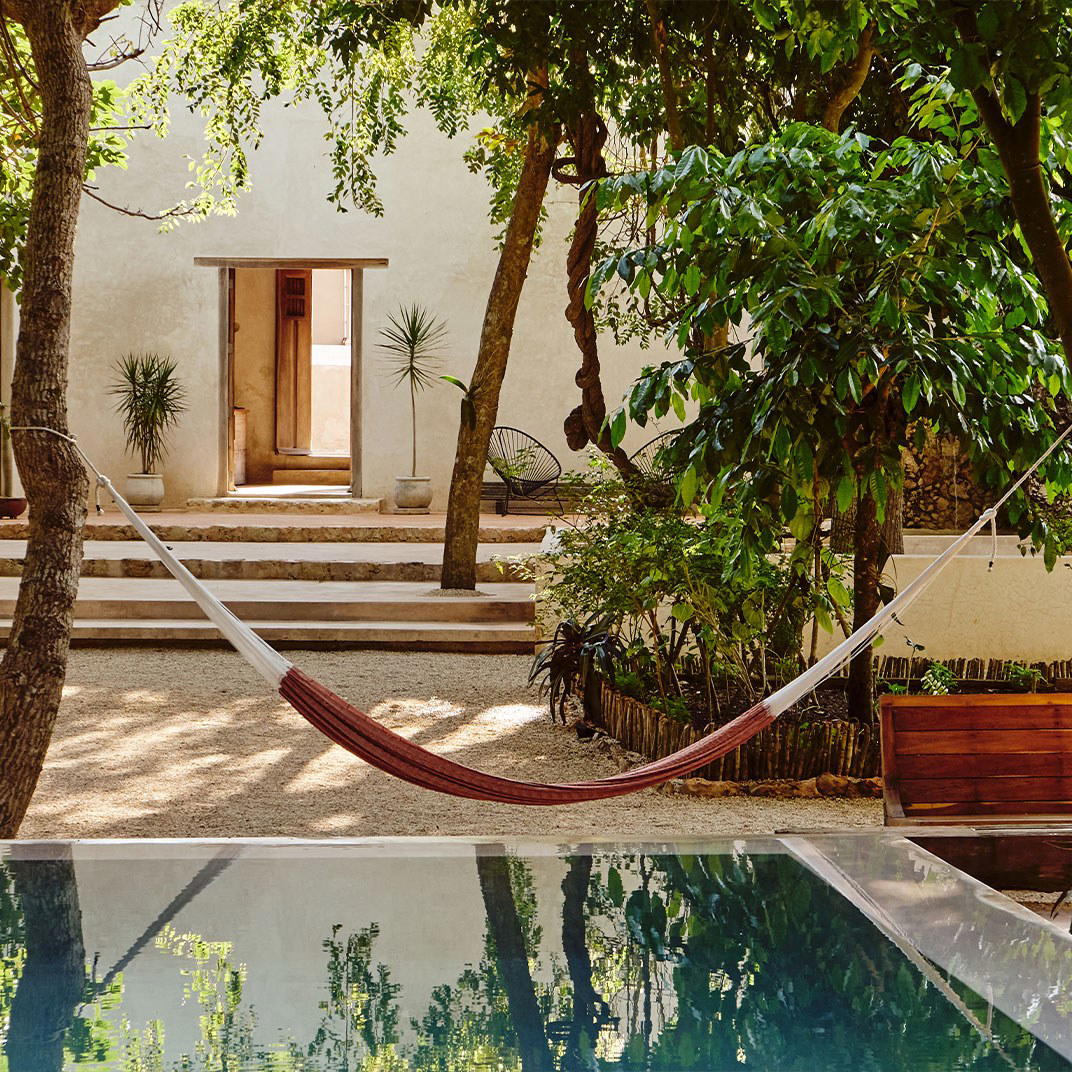
Espita sits roughly two hours northeast of Mérida on the flat limestone plain of the Yucatán interior, a town of colonial arcades and low ochre facades that most travellers blow past on the way to Chichén Itzá or the coast. The town's central square follows the same grammar as dozens of others across the peninsula: a single dominant church, a portaled municipal building, tamarind trees cutting the afternoon heat. What changes at Calle 26 is the scale of ambition behind one particular facade. Casona los Cedros is a restored colonial mansion operating within this ordinary-looking grid, and the Michelin Selected designation it carries in the 2025 hotels guide signals that the restoration has been taken seriously enough to earn external validation.
The casona format is specific to this part of Mexico. Large private houses built by landowning and merchant families from the 17th century onward, they typically occupy a full city block face, with thick rubble-and-lime walls, internal courtyards that manage ventilation, and a street-facing facade that communicates social standing through proportioned arches and carved stonework. When these buildings work as hotels, the architecture is not backdrop, it is the primary offer. The guest experience is shaped by ceiling heights that dwarf standard hotel rooms, by the sound physics of tiled courtyard floors, by corridors that were designed to move air rather than foot traffic. Hacienda Temozon in Temozon Sur operates on a similar premise at considerably larger scale and with a global brand behind it; Casona los Cedros represents the smaller, more local tier of the same tradition.
Colonial Architecture as the Organising Principle
In Yucatán's interior, the quality of a restored casona or hacienda is legible in specific architectural decisions: whether original tile floors have been retained or replaced, whether ceiling beams show genuine age or cosmetic distressing, whether the courtyard planting respects the climate logic of the original garden or substitutes photogenic tropicalia. The region has produced both careful restorations and opportunistic conversions, and the distance between them is measurable in how the building feels to move through. A property earning Michelin Selection in this category is typically one where the physical space holds together as a coherent object rather than a collection of renovated rooms around a swimming pool.
The cedar trees that name the property, los cedros, suggest that the courtyard planting has been treated as part of the architectural composition. In colonial Yucatán, mature trees within a property boundary were status markers, their presence implying continuity of ownership and stewardship across generations. When a restored casona retains or references original planting, it maintains a connection to the building's pre-hotel biography that sets it apart from properties that arrived at the same format through demolition and rebuild. That biographical depth is part of what small heritage properties in Mexico's interior can offer that coastal resorts, however polished, structurally cannot.
Espita and the Case for the Yucatán Interior
The argument for staying in a town like Espita rather than Mérida or Valladolid rests on tempo. Mérida has absorbed enough international attention that its centro histórico now operates partly as a stage for visitors; Valladolid, sitting closer to the major archaeological sites, has filled up with design boutique hotels aimed squarely at the Tulum diaspora. Espita has not yet undergone that transformation. The market on the square is a working market. The evening paseo involves residents. A property like Casona los Cedros sits inside that unmediated reality, which is either the draw or the drawback depending on what a traveller is actually looking for.
For context: the Yucatán interior operates on a different logic from the Mexican properties that dominate premium travel coverage. One&Only; Mandarina in Riviera Nayarit, Montage Los Cabos in Cabo San Lucas, and Zadun, A Ritz-Carlton Reserve in Los Cabos compete on beach access, spa infrastructure, and F&B; programming at a scale that small-town casona hotels cannot and do not attempt to match. The comparison is category error. What Espita offers is the peninsula's built and cultural fabric without the resort membrane between guest and place. Travellers making that trade deliberately will find the Michelin recognition a useful signal that the physical standard justifies the detour. See our full Espita restaurants guide for what the town offers beyond the property itself.
Positioning Within Mexico's Heritage Hotel Tier
Mexico's portfolio of restored colonial and hacienda properties has widened considerably over the past two decades. At the branded end, Las Ventanas al Paraíso, A Rosewood Resort in San José del Cabo and Casa de Sierra Nevada, A Belmond Hotel, San Miguel de Allende demonstrate what international group resources can do with historic Mexican architecture. At the independent end, properties like Chablé Yucatán near Mérida or Casa Antonieta in Oaxaca City show that smaller ownership can produce a more idiosyncratic result.
That positioning creates both an advantage and a dependency. The advantage is singularity in the local market: guests who choose Espita are, by definition, choosing this property. The dependency is that the property carries the full weight of the destination's hospitality case. In towns with more established visitor economies, a weak night at one hotel can be offset by a great dinner elsewhere. In Espita, the casona's quality and the town's appeal are harder to separate in the guest's overall assessment. The Michelin Selected status suggests the property is aware of that equation and has invested accordingly. For comparison properties that operate in similarly singular destination contexts, Casa Silencio in San Pablo Villa de Mitla and Hotelito At MUSA in Loma Bonita present analogous cases in Oaxaca.
Planning Your Stay
Espita is most comfortably reached by car from Mérida, a drive of roughly two hours northeast along Federal Highway 180. The town has no international-facing booking infrastructure visible in public records, so contacting the property directly via the address at Calle 26, 199, Centro, is the most reliable approach for reservations. The Yucatán interior is most manageable between November and March, when humidity drops and daytime temperatures sit in the mid-20s Celsius; the May-to-October wet season brings afternoon rain and heat that the thick walls of a casona handle better than air-conditioned boxes, though logistics for exploring the surrounding towns require more flexibility. The Michelin Selected designation, current as of 2025, applies to hotels rather than restaurants and reflects physical and service standards rather than a culinary program, so treat the recognition as a quality floor for the accommodation rather than a guide to dining. Other properties earning similar heritage-format recognition elsewhere in Mexico include Hotel Casa Santo Origen in Oaxaca and Etéreo, Auberge Resorts Collection in Punta Maroma, for travellers building an itinerary across Mexico's distinct architectural traditions.
Comparison Snapshot
Comparable venues nearby, for context on price, style, and recognition.
| Venue | Cuisine | Price | Awards | Notes |
|---|---|---|---|---|
| Casona los CedrosThis venue (the venue you are viewing) | Contemporary minimalist design integrated into restored colonial architecture with emphasis on local craftsmanship and materials. | $200–300 | Michelin Selected | Not listed |
| Santa Casa | Historic Mexican Colonial Revival mansion thoughtfully restored with contemporary design elements, positioned as a charming boutique hotel that honors its 1930s heritage while offering modern comforts. | $100–200 | Michelin Selected | Roma Norte |
| voco Guadalajara Neruda | Modern urban hotel with local Mexican influences | Not listed | Michelin Selected | Providencia |
| Delek Tulum | Contemporary classic boutique hotel with eco-conscious design philosophy emphasizing cultural sensitivity and sustainable tourism practices. | $200–300 | Michelin Selected | Tulum |
| Coqui Coqui Papholchac Coba Residence & Spa | Maya-Mexican medley inspired by ancient architecture | Not listed | Michelin Selected | Coba |
| Hotel La Semilla | Modern Mexican minimalist with vintage flea market aesthetic; whitewashed geometric architecture inspired by local coastal vernacular. | $100–200 | Mr & Mrs Smith Seal of Approval · Design Hotels Member | 2300800010067 |
Recognition history
Dated appearances from independent guides and award organizations, with the underlying list record or original source where available.
Michelin Selected
Michelin
Continue exploring
More in Espita
Details
- Romantic
- Quiet
- Minimalist
- Elegant
- Intimate
- Romantic Getaway
- Wellness Retreat
- Weekend Escape
- Infinity Pool
- Garden
- Terrace
- Historic Building
- Design Destination
- Private Dining
- Pool
- Restaurant
- Bar
- Garden
- Laundry Service
- Garden
Understated and calm with soft, natural lighting throughout the property; serene tropical garden atmosphere with hammocks, aromatic plants, and a breezy covered terrace creating a peaceful retreat.