The Marshall Store
On the western edge of Marin County, where Highway 1 meets Tomales Bay, The Marshall Store occupies a stretch of working waterfront that doubles as one of the Bay Area's most atmospheric spots for oysters eaten outdoors. The setting does most of the work: raw shellfish, salt air, and an unbroken view across the bay toward the Point Reyes peninsula. Plan ahead, especially on weekends.
 Discover on Pearl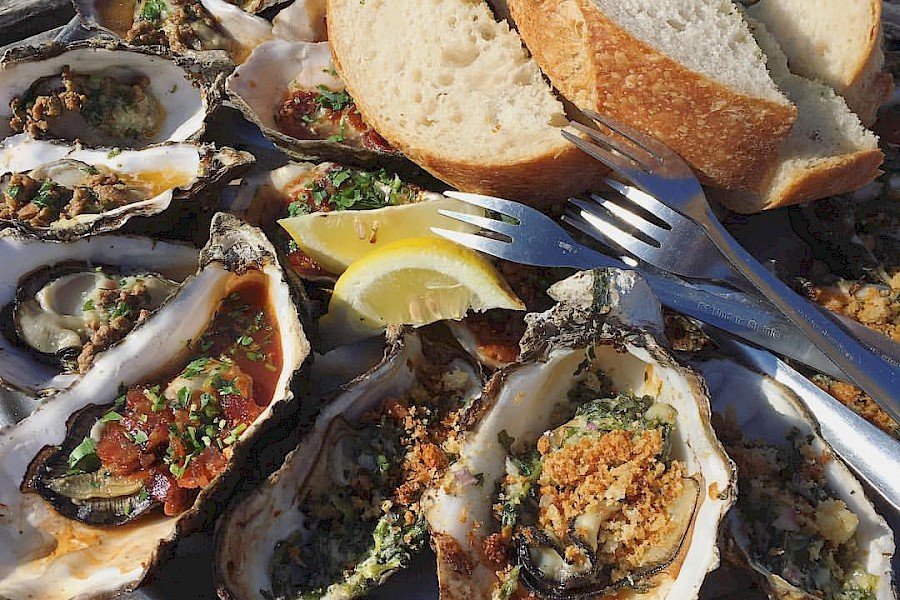
Where the Highway Ends and the Water Begins
There is a particular kind of California eating that has nothing to do with restaurant design or tasting menus. It happens on docks, at picnic tables, with paper napkins and cold drinks, in places where the food arrives fresh because the distance between harvest and plate is measured in yards rather than miles. Tomales Bay, the long, narrow tidal inlet that separates the Point Reyes peninsula from the Marin mainland, is one of the few places left in the Bay Area where that experience is still geographically intact. The Marshall Store, at 19225 CA-1 in the unincorporated community of Marshall, sits directly on the bay's eastern shore and belongs to that tradition in its most unmediated form.
Getting here is part of the experience in ways that matter to how the place feels when you arrive. Highway 1 narrows considerably north of Point Reyes Station, threading between the Inverness Ridge and the bay's edge with almost no shoulder and long sight lines over the water. By the time you reach Marshall, which is barely a community in the conventional sense, the idea of urban density has been replaced by working oyster beds, a scattering of buildings, and the sound of the bay. The drive from central Marin takes roughly an hour under normal conditions; from San Francisco, allow ninety minutes. That distance is not incidental. It functions as a kind of decompression, so that arriving at a waterfront oyster spot feels earned rather than convenient.
The shortlist, unlocked.
Hard-to-book tables, cellar releases, and concierge-planned trips.
Get Exclusive Access →The Atmosphere That Geography Creates
The physical environment at a place like this is not designed in any conventional hospitality sense. It accrues. What you encounter at the Marshall Store is an exterior eating structure on the water's edge, with the kind of weathered materiality that comes from decades of salt air and hard use rather than from an interior designer's mood board. The view across Tomales Bay is unobstructed and changes with the light, the season, and the tide. On a clear morning in late autumn, the water is flat and pewter-gray; on a summer afternoon, it catches the sun at angles that make the oyster shells glow. Neither version is staged. Both reward the decision to come.
This is a format that has largely disappeared from the Bay Area's developed coastline. The combination of working waterfront access, direct-from-bay shellfish, and minimal built infrastructure is something that Point Reyes and the Marin coast still protect by geography and land-use policy. The Marshall area sits within reach of the Golden Gate National Recreation Area's broader protective envelope, which limits the kind of commercial development that has transformed other coastal stretches. That regulatory context is part of why the experience here still reads as authentically raw rather than curated to look that way.
For context on how Marin County's food and drink scene distributes across its different zones, from roadhouse dining to waterfront eating, see our full Marin County restaurants guide. The county operates along a genuine geographic spectrum, and the Marshall coast is its most remote and elemental end.
Shellfish, Provenance, and the Logic of Eating Here
Tomales Bay's oyster farming history stretches back well over a century, and the bay remains one of California's most productive shellfish environments. Its unusual hydrology, a narrow, glacially carved inlet fed by cold Pacific water through a single northern opening, creates conditions that favor clean, briny Pacific oysters with a mineral finish that reflects the specific water column they grow in. Several farms operate on the bay, and the proximity of those farms to the handful of eating spots along the shore means that supply chains here are genuinely short. This is not a marketing claim about provenance. It is a physical fact about how close the growing beds are to the table.
Eating at the Marshall Store is an outdoor, self-service, or counter-style experience rather than a conventional sit-down restaurant. The format places the emphasis squarely on the product and the setting rather than on service choreography or room design. That is either a feature or a limitation depending on what you are looking for, and it helps to arrive knowing which applies to you. Visitors who treat it as a proper lunch destination, rather than a quick stop, tend to have a more satisfying experience.
Placing the Marshall Store in Its Peer Set
Along the Highway 1 corridor between Point Reyes Station and Bodega Bay, several establishments draw on the same waterfront-and-shellfish premise. Nick's Cove, a few miles south on Tomales Bay, operates in a more developed format, with cottages, a full bar program, and a dining room. The Marshall Store occupies the less polished, more direct end of that spectrum. Neither is wrong; they are answers to different questions about how much structure you want around the experience of being on the water.
Further south in Marin, Buckeye Roadhouse represents a different version of Marin's food identity entirely: indoor, heritage-American, and oriented toward Mill Valley's residential dining market rather than the coastal tourist corridor. The Marshall Store has nothing in common with that format, and comparing them usefully illustrates how much the county's eating culture bifurcates between its suburban southern tier and its agricultural, coastal north.
For readers who arrive at the Marshall Store via an interest in destination bar and drinks programming, it is worth clarifying that this is not that kind of venue. The serious cocktail programs that EP Club covers elsewhere in the United States, from ABV in San Francisco to Kumiko in Chicago, Julep in Houston, Jewel of the South in New Orleans, Bar Leather Apron in Honolulu, Superbueno in New York City, Allegory in Washington, D.C., Bar Kaiju in Miami, and The Parlour in Frankfurt, operate from a fundamentally different premise. What the Marshall Store offers is cold beer, local wine, and the particular satisfaction of eating oysters you can see the growing beds of from your table.
Planning the Visit
The practical realities of visiting the Marshall Store are shaped by its location and its format. Highway 1 through west Marin has no meaningful public transit connection, so arriving by car is the standard approach. The route from San Francisco via Sir Francis Drake Boulevard through the Point Reyes corridor is slower but more scenic than the 101-to-Point-Reyes-Station route; allow time for both the drive and the return. Weekend traffic on Highway 1 through west Marin can back up significantly in summer and on warm autumn weekends, particularly in the afternoon.
The Marshall Store's website and phone contact details are not currently listed in our database; confirming current hours before making the drive is worth the effort. Seasonal hours and days of operation vary, and the venue draws enough Bay Area visitors on clear weekends that arriving early improves both parking and the experience of the space. Bring layers. Tomales Bay runs cold and windy even in July, and the outdoor eating format means the weather is directly relevant to comfort.
Frequently Asked Questions
- What is the signature drink at The Marshall Store? The Marshall Store is a waterfront oyster spot rather than a cocktail destination, so the drink focus skews toward cold beer and local California wine, which suit the format and the food. Visitors looking for technical cocktail programming will find that better served at venues like ABV in San Francisco, which operates from a different premise entirely.
- What makes The Marshall Store worth visiting? The case for the drive rests on geography and format rather than awards or chef credentials. Tomales Bay's oyster-farming infrastructure and the Marshall Store's position directly on the working waterfront create the kind of provenance-to-plate shortness that has largely been engineered out of Bay Area dining. There is no equivalent experience this close to San Francisco.
- How far ahead should I plan for The Marshall Store? Current booking and hours information is not in our database, so confirming directly before the trip is the prudent step. For popular clear-weather weekends between April and October, arriving early in the day is the more reliable strategy than attempting to time around a reservation, given the venue's counter-service format.
- Is The Marshall Store suitable for a full lunch stop, or is it better as a brief roadside detour? The format rewards visitors who treat it as a proper lunch destination rather than a quick stop. The drive from San Francisco takes roughly ninety minutes each way, and the payoff, oysters eaten on the water with an unobstructed bay view, scales with how much time you allocate rather than how efficiently you pass through. Pairing the visit with a morning at Point Reyes National Seashore makes the trip more coherent as a day out.
Cuisine-First Comparison
A fast peer set for context, pulled from similar venues in our database.
Need a Table?
Our members enjoy priority alerts and concierge-led booking support for the world's most difficult bars and lounges.
Get Exclusive AccessThe shortlist, unlocked.
Hard-to-book tables, cellar releases, and concierge-planned trips.
Get Exclusive Access →