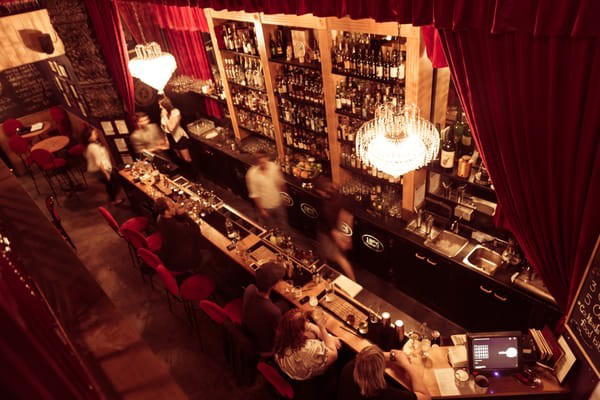
A wine and cocktail bar drawing its identity from Florence and Tuscany, The Florence brings Italian drinking culture to Melbourne with a program built around regional wines, aperitivo-style snacks, and cocktails that reference the Arno city's traditions. It sits within Melbourne's broader Italian bar conversation, where European format discipline meets a local appetite for serious yet unfussy drinking.
Pearl is the En Primeur Club membership app — saves, bookings, and concierge access live there. Same editors, same standards.
- Address
- Level 1/133 Flinders Ln, Melbourne VIC 3000, Australia
- Phone
- +61 401 998 512
- Website
- theflorence.com.au
- Directions
- Get directions
 Saves & bookings on Pearl
Florence Without the Jet Lag
There is a particular quality of light in a good Italian bar in the early evening: the hour when aperitivo shifts from obligation to ritual, when the wine pours before anyone has asked for it, and when the food exists not to fill you but to extend the conversation. The Florence, Melbourne's Tuscan-inflected wine and cocktail bar, works from that premise. The format is clear before you read a menu: this is a room that takes its cues from a specific Italian city, not from a generalised European aesthetic.
Melbourne has long been Australia's most confident Italian city by temperament, even if Sydney presses the claim. The suburb-level saturation of Italian restaurants, the institutional presence of places like Fratelli Paradiso in Potts Point, and the city's deep espresso culture all point to a population that has absorbed Italian hospitality at a granular level rather than a surface one. The Florence operates inside that tradition and sharpens it: instead of a broad Italian reference, it narrows to Florence and its region, which carries its own discipline.
The Tuscan Frame
Tuscan drinking has a logic that differs from, say, a Venetian bacaro or a Milanese aperitivo bar. The wines are heavier in structure: Sangiovese-dominant, with the tannin and acidity that make them difficult without food and persuasive with it. The snacks lean toward cured meats, aged pecorino, bread with olive oil, and the kind of preserved things that improve with a second glass. It is a slower, more deliberate way of drinking than the Campari-spritz circuit, and it asks something of the guest.
The Florence works in that register. The menu reads as Tuscan snacks rather than a full kitchen program, which is accurate to how the bars of Florence actually operate: the food is serious but not ambitious in a way that competes with the wine. That restraint is itself a technique, and it positions the bar within a specific category of Melbourne drinking that has grown steadily over the past decade.
Where It Sits in Melbourne's Bar Scene
Melbourne's bar program is among the most developed in the southern hemisphere, and the city's better venues have long since moved past novelty as an organising principle. Places like 1806, which built its identity around cocktail history and depth of spirits knowledge, and Black Pearl, which has sustained international recognition through technical precision and a serious spirits list, represent the kind of program-led bars that set the local standard. Above Board operates at the micro-format end, where intimacy and host knowledge do the work that scale cannot. Byrdi has made its name through native Australian ingredients applied with fermentation discipline.
The Florence occupies a different pocket: the geographically anchored concept bar, where the reference point is a specific place and its drinking customs rather than a technical method or a local ingredient philosophy. Across Australia, this format appears in various guises: Cantina OK! in Sydney does something adjacent with Mexican mezcal, and Bowery Bar in Brisbane works from a New York reference frame. What ties them is the commitment to a specific place's drinking logic rather than a menu assembled from global leading practices.
Internationally, bars with a single-city Italian identity have proven durable when they maintain format discipline. The failure mode is drift: a Florentine bar that adds a margarita to hold casual trade loses the thing that made it worth choosing. The Florence's Tuscan snack program suggests it is working to maintain that discipline.
Local Ingredients, Imported Logic
The editorial angle that makes The Florence interesting within its Australian context is the intersection of imported format logic and the local produce that inevitably shapes what ends up on the plate and in the glass. Tuscany's food identity depends on hyperlocal ingredients: the olive oil from specific estates, the pecorino from particular valleys, the specific grain character of its bread. None of that is replicable in Melbourne wholesale, but the technique of pairing and the structural logic of the menu can be.
What Melbourne's Italian bars have found is that Australian produce often holds up in Tuscan format surprisingly well. Victorian cheesemakers have developed aged styles with the fat content and crystalline texture that work alongside Sangiovese. The Yarra Valley and the Adelaide Hills produce cool-climate Italian varieties with the acidity to behave like their northern hemisphere counterparts. This is where the imported method meets the indigenous product in a way that is genuinely instructive: not fusion, but format applied with local material. Bars in this category across Australia have found something similar: La Cache à Vín in Spring Hill works a French wine bar format with Australian and imported bottles in deliberate balance, and Whipper Snapper Distillery in East Perth applies American whiskey production logic to local Australian grain.
The Florence does not need to resolve this tension completely to be worth visiting. The productive version of the concept is the one where Tuscan discipline organises the experience and Australian material gives it local grounding.
The Cocktail Program
A Florence-inspired cocktail program has clear reference points: Negroni variations, Florentine-style digestifs, Amaro-driven builds, and the kind of low-ABV aperitivo cocktails that the aperitivo hour demands. The cocktail culture of Florence is not as technically baroque as what comes out of London or New York, and that is the point. The drinks should taste like they belong to the food and the wine rather than competing with them for attention.
The cocktail programs at bars like Bar Leather Apron in Honolulu and Blu Bar on 36 in The Rocks demonstrate what geography-led cocktail identity can produce when it is executed with consistency. The Florence's Tuscan frame narrows the menu's ambition in a way that, handled correctly, produces drinks with a clearer point of view than a broader Italian reference would allow.
Planning Your Visit
The Florence sits inside Melbourne's wine bar circuit, which means it occupies the kind of early-evening-to-late-night window that the city's bar culture has made its own. For visitors building an Italian-inflected Melbourne evening, the bar works well as a first stop: the aperitivo format and snack menu are calibrated for drinking before rather than instead of dinner. Melbourne's most useful resource for building that kind of itinerary is our full Melbourne restaurants guide, which covers the city's bar and dining scene in neighbourhood-level detail. Given the spare data currently available on The Florence, confirming current hours and booking requirements directly before visiting is advisable.
How The Florence Melbourne compares with similar nearby venues.
| Venue | Cuisine |
|---|---|
| The Florence | Wine and cocktail bar inspired by Florence; Tuscan snacks |
| Bar Ferdinand | Cocktails |
Continue exploring
More in Melbourne
Bars in Melbourne
Browse all →
Restaurants in Melbourne
Browse all →
Hotels in Melbourne
Browse all →
At a Glance
Current opening hours
- Monday
- 5 PM–1 AM
- Tuesday
- 5 PM–1 AM
- Wednesday
- 5 PM–1 AM
- Thursday
- 5 PM–1 AM
- Friday
- 5 PM–1 AM
- Saturday
- 5 PM–1 AM
- Sunday
- 5 PM–1 AM
Hours can change for holidays and private events. Last verified .
Know Before You Go
- Getting there
- Level 1/133 Flinders Ln, Melbourne VIC 3000, Australia