Stanley's Wet Goods
Stanley's Wet Goods on Venice Blvd. pairs natural wine, craft beer, and zero-proof drinks with a seated bar, communal tables, and an outdoor terrace.
Pearl is the En Primeur Club membership app — saves, bookings, and concierge access live there. Same editors, same standards.
- Address
- 9620 Venice Blvd., Culver City, CA 90232
- Phone
- +1 424 341 2870
- Website
- stanleys.la
- Directions
- Get directions
 Saves & bookings on Pearl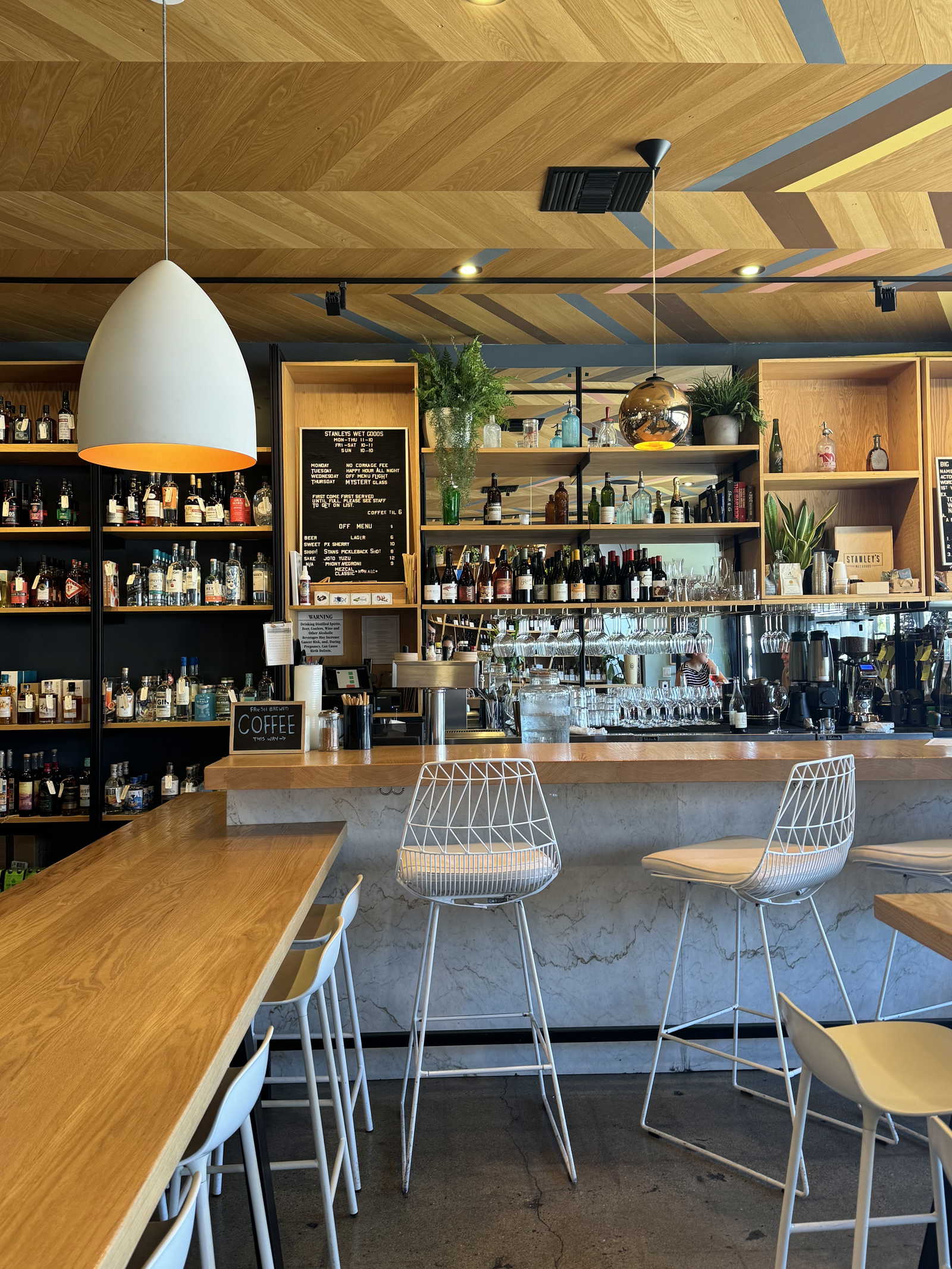
Venice Boulevard, Where the Sign Says Wet Goods
The stretch of Venice Boulevard running through Culver City has spent the better part of a decade trading light-industrial anonymity for a denser, more deliberate dining and drinking identity. Warehouse conversions sit alongside mid-century storefronts, and the after-work crowd from the nearby tech and media campuses has given the corridor a daytime-to-late-night rhythm that few other LA neighborhoods match. Stanley's Wet Goods occupies 9620 Venice Blvd.
The term "wet goods" is an old Anglo-American trade phrase for alcoholic beverages, the kind of language that appears in nineteenth-century customs ledgers and general-store inventories. Choosing it as a name plants a flag. It says the bar understands where its tradition comes from, that drinking culture in the English-speaking world has roots in commerce, craft, and community long before cocktails became a vehicle for Instagram architecture. That orientation toward the historical and the functional, rather than the fashionable, is what distinguishes a certain tier of American craft bar from its louder competitors.
Culver City's Bar Scene in Context
Los Angeles has developed one of the more stratified cocktail cultures in the United States over the past fifteen years. The city now sustains everything from high-concept beverage programs in Michelin-recognized dining rooms to neighborhood bars running tight, well-sourced back bars with no pretension about it. Culver City sits in a productive middle zone. It draws the kind of drinker who has opinions about producers and processes but does not need a dress code or a velvet rope to feel like something serious is happening.
Within the broader LA bar conversation, venues like Death & Co (Los Angeles) represent the high-production, technically ambitious end of the spectrum, with a national reputation and a menu architecture that rewards study. Mirate brings a different cultural framing, rooted in Mexican spirits and the agave canon. Bar Next Door and Standard Bar occupy their own positions in the city's geography of drinking. Stanley's Wet Goods reads as something more neighborhood-native, a place where the programming reflects the block it sits on rather than a brand identity designed for a national rollout.
That localism is a deliberate position, and in the current American bar market it is increasingly rare. The consolidation of cocktail culture around a handful of recognizable formats, the speakeasy, the apothecary aesthetic, the hyper-tasting-menu bar, has made genuinely local character a form of distinction in itself.
The Cultural Roots of the American Neighborhood Bar
The neighborhood bar as a social institution has a longer and more specific history in American cities than the cocktail revival narrative usually acknowledges. Before Prohibition reshaped the industry, the saloon served as meeting room, banking counter, and news exchange for working-class urban communities. The post-Prohibition bar compressed that social function into a smaller physical and legal footprint, but the underlying logic persisted: a place where regulars know the back bar by heart, where the bartender's judgment about what you should drink next carries real weight, and where the atmosphere is defined more by the people who return than by the people who visit once for a photo.
The revival of this format, distinct from both the cocktail laboratory and the dive bar, has produced some of the more interesting drinking rooms in American cities in the last decade. Kumiko in Chicago approaches it through a Japanese-American sensibility. Jewel of the South in New Orleans grounds it in the historical cocktail canon of the Gulf South. Julep in Houston builds its identity around Southern spirits and hospitality traditions. ABV in San Francisco holds a similar position on the West Coast. Each operates from a specific cultural address rather than a generic cocktail-bar template. Stanley's Wet Goods, based on its name and its location in a neighborhood still calibrating its own identity, suggests a similar kind of intentionality.
Internationally, the comparison extends further. Bar Leather Apron in Honolulu has built a reputation precisely because it takes the neighborhood bar format seriously on its own terms rather than importing a mainland aesthetic wholesale. The Parlour in Frankfurt on the Main operates from a similar logic in a European context. Superbueno in New York City brings a Latin American cultural frame to the same format. The through-line across all of them is a bar that knows what it is and does not apologize for having a point of view.
What to Expect When You Walk In
Venice Boulevard addresses tend to read lower-key from the outside than they perform inside. The commercial strip aesthetic, wide sidewalks, painted storefronts, mixed parking-lot and street access, does not prime you for anything precious. That's appropriate for a bar calling itself Wet Goods. The name primes you for function over theater, for a back bar worth looking at and a pour worth thinking about, rather than for a space designed to generate a specific emotional response before the first drink arrives.
In bars of this type, the physical environment tends to work through accumulation rather than statement pieces. The bar leading, the lighting temperature, the music volume at different hours of the night, the way regulars position themselves relative to the bartender: these details add up to an atmosphere that feels grown rather than designed. That quality is harder to achieve than it looks, and when it works, it is what makes a neighborhood bar worth the repeat visit.
Planning Your Visit
| Venue | Location | Format | Leading For |
|---|---|---|---|
| The bar | Culver City (Venice Blvd.) | Neighborhood bar | Regulars, local spirits focus |
| Death & Co (Los Angeles) | Downtown LA | High-concept cocktail bar | Technical program, destination drinking |
| Mirate | Los Angeles | Agave-focused bar | Mezcal and tequila depth |
| Bar Next Door | Los Angeles | Neighborhood bar | Accessible cocktails, local crowd |
| Standard Bar | Los Angeles | Hotel bar | Scene, design, occasion drinking |
Nearby-ish Comparables
Comparable venues nearby, for context on price, style, and recognition.
| Venue | Cuisine | Price | Notes |
|---|---|---|---|
| Stanley's Wet GoodsThis venue — the venue you are viewing | wine_bar | $$ | Not listed |
| Hey Hey Drinks | Bar | $$ | Echo Park |
| Hermanito | cocktail_bar | $$ | Sawtelle |
| Canter's Deli | lounge | $$ | Beverly Grove |
| Father's Office | beer_bar | $$ | Helms District |
| El Prado | wine_bar | $$ | Echo Park |
Continue exploring
More in Los Angeles
Bars in Los Angeles
Browse all →
Restaurants in Los Angeles
Browse all →
Hotels in Los Angeles
Browse all →
Wineries in Los Angeles
Browse all →
At a Glance
- Cozy
- Trendy
- Intimate
- Casual Hangout
- Date Night
- Group Outing
- Standalone
- Seated Bar
- Communal Tables
- Outdoor Terrace
- Natural Wine
- Craft Beer
- Zero Proof
Current opening hours
- Monday
- 11 AM–10 PM
- Tuesday
- 11 AM–10 PM
- Wednesday
- 11 AM–10 PM
- Thursday
- 11 AM–10 PM
- Friday
- 11 AM–11 PM
- Saturday
- 11 AM–11 PM
- Sunday
- 11 AM–10 PM
Hours can change for holidays and private events. Last verified .
Warm, relaxed, never-pretentious atmosphere with indoor communal tables and heated outdoor patio.